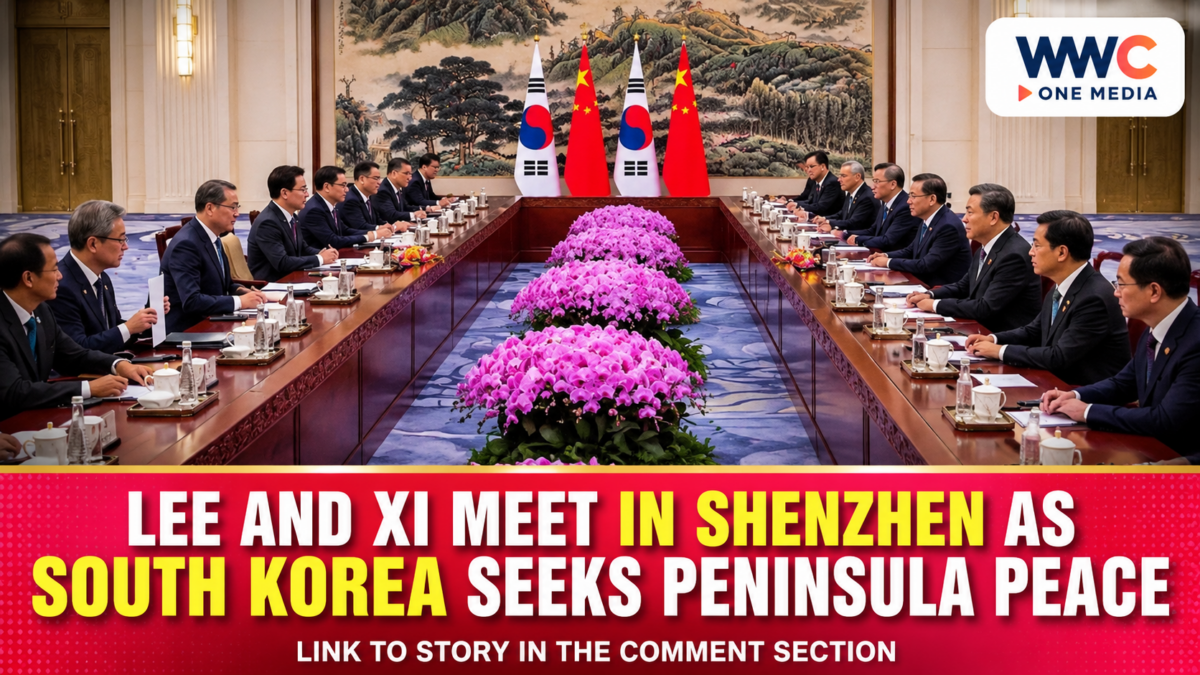
South Korean President Lee Jae Myung met Chinese President Xi Jinping in Shenzhen on Nov. 18, 2026, on the sidelines of the 33rd Asia-Pacific Economic Cooperation (APEC) Economic Leaders’ Meeting. The meeting followed Seoul’s stated intention to seek cooperation with Beijing on peace and stability on the Korean Peninsula.
The encounter gives the two governments another opportunity to discuss their strategic relationship, but the public records reviewed do not establish a new peace agreement, a North Korea negotiation timetable or a new security arrangement. The distinction matters: a presidential meeting can keep diplomatic channels open without resolving the peninsula’s underlying security issues.
The Lee–Xi meeting is now confirmed
China’s official government news service confirmed that Xi met Lee in Shenzhen on Nov. 18. It identified Lee as attending the 33rd APEC Economic Leaders’ Meeting, scheduled for Nov. 18–19. State Council of China
South Korea’s presidential office had previously outlined the intended agenda. Its Nov. 18 pre-meeting briefing said the leaders were expected to discuss bilateral relations, trade and investment, people-to-people exchanges, cultural cooperation and ways to support peace and stability on the Korean Peninsula.
The briefing also described the encounter as the third summit between the two leaders, following their meetings in Gyeongju in November 2025 and Beijing in January 2026. It said the meeting came ahead of the 35th anniversary of diplomatic relations in 2027. 대한민국 청와대+1
The meeting itself is confirmed. However, the pre-meeting briefing is not a record of what was agreed during the talks. The public Chinese meeting notice reviewed here also does not provide a detailed account of the discussion.
Seoul wants regional support for peaceful coexistence
Lee’s effort to build support for his peninsula policy was not limited to the Shenzhen meeting.
During the East Asia Summit in Manila on Nov. 17, South Korea’s presidential office said Lee presented his government’s vision for peaceful coexistence on the Korean Peninsula and called for regional countries to help create conditions for inter-Korean dialogue to resume.
The official briefing also recorded that participating leaders recognised the importance of peace and stability on the peninsula. It said two summit statements were adopted, including one on future East Asia Summit cooperation and another on stronger cooperation against online scams. 대한민국 청와대+1
This gives the Shenzhen meeting a wider diplomatic context. Seoul is seeking support from several regional partners rather than treating China as the only country with a role in the peninsula’s future.
For readers following the wider regional picture, WWC has also examined South Korea’s diplomatic and economic engagement with the Philippines, as well as the ASEAN–China partnership and its regional cooperation agenda.
China’s role is important, but a bilateral meeting is not a peace process
China is a major regional actor with an established diplomatic relationship with both Koreas. That makes communication between Beijing and Seoul relevant to any broader effort to reduce tensions and encourage dialogue.
But a meeting between the South Korean and Chinese presidents cannot, by itself, produce an agreement involving North Korea. Any formal inter-Korean process would require participation and decisions from the governments directly involved.
The same caution applies to wider discussions involving Washington, Beijing and Pyongyang. WWC’s report on North Korea’s diplomatic engagement with Russia provides context for the other relationships shaping Northeast Asian diplomacy.
Analysis: The practical test for Seoul and Beijing is whether their political statements lead to identifiable follow-up. That could include official consultations, agreed diplomatic channels or a publicly documented effort to encourage dialogue. Without those developments, the meeting should be understood as continued engagement rather than a breakthrough.
Economic cooperation remains part of the relationship
The two governments’ agenda also includes economic and social ties. South Korea’s pre-meeting briefing listed trade, investment, people-to-people exchanges and cultural-content cooperation among the issues expected to be discussed.
That breadth matters because the bilateral relationship is not limited to security. Both countries have interests in maintaining stable commercial ties, encouraging travel and supporting cooperation between their businesses and institutions.
The 35th anniversary of diplomatic relations in 2027 provides another reason for both sides to maintain contact. But an anniversary or diplomatic declaration should not be mistaken for evidence that individual projects or economic commitments have already been delivered.
What happens next
The next important evidence will come from more detailed official accounts of the Shenzhen discussions and any subsequent announcements from Seoul or Beijing.
For the Korean Peninsula, the most meaningful indicators would be a documented follow-up mechanism, a specific initiative to encourage dialogue or a confirmed willingness by North Korea to participate in talks.
Until such developments are announced, the confirmed position is narrower: Lee and Xi met in Shenzhen, Seoul had identified peninsula peace as an intended topic, and Lee had also sought regional support for peaceful coexistence during the East Asia Summit in Manila.
The meeting keeps the diplomatic issue active. Whether it changes the conditions for dialogue remains to be seen.
Frequently asked questions
Did Lee Jae Myung meet Xi Jinping in November 2026?
Yes. China’s official government news service confirmed that the two presidents met in Shenzhen on Nov. 18, 2026.
What did South Korea want to discuss with China?
South Korea’s pre-meeting briefing listed peace and stability on the Korean Peninsula alongside trade, investment, people-to-people exchanges and cultural cooperation.
Did China agree to a new Korean Peninsula peace deal?
The public primary records reviewed do not establish a new peace agreement or a formal process involving North Korea.
Why is China important to Korean Peninsula diplomacy?
China is a major regional actor with diplomatic ties to both Koreas. Its engagement with Seoul can be relevant to regional stability, although a bilateral meeting cannot replace the participation of the governments directly involved.
What would demonstrate progress after the Lee–Xi meeting?
A published follow-up mechanism, official consultations or a confirmed process involving the relevant governments would provide stronger evidence of progress than general statements supporting peace.