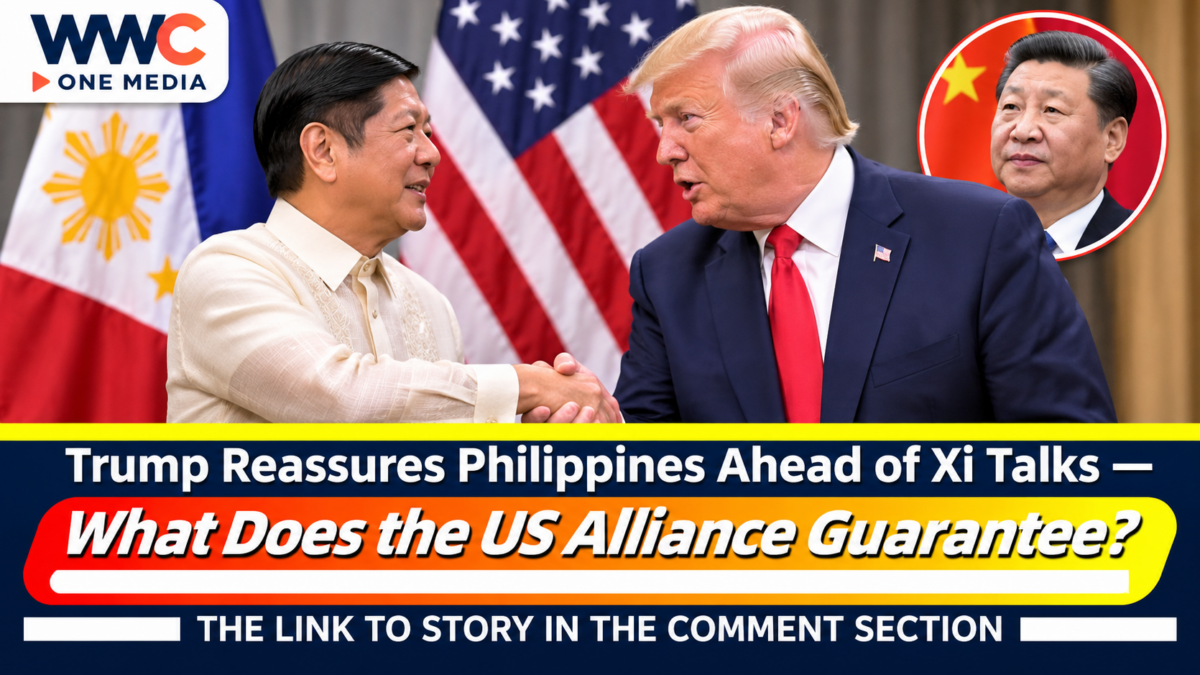
MANILA — US President Donald Trump reaffirmed Washington’s support for regional allies during ASEAN meetings in Manila on Nov. 17, 2026, before further talks with Chinese President Xi Jinping. The renewed attention to the US Philippines alliance comes as President Ferdinand Marcos Jr. seeks continued security cooperation, but the public statements reviewed do not establish a new mutual-defence agreement or an automatic military response to a future confrontation.
The difference matters to the Philippines. Diplomatic reassurance can signal political continuity; the legal duties of the two governments still come from their existing treaty and any separately documented arrangements.
US Philippines Alliance: What Trump Said in Manila
In remarks at the ASEAN-US Special Summit, Trump described the bilateral relationship as especially close and voiced strong support for partners and allies. A Philippine government news account of the speech also described plans to expand joint special-forces training and defence modernisation cooperation.
Those are public expressions of policy direction, not a completed procurement contract or a newly activated treaty obligation. The available account does not provide a project-by-project schedule, new appropriation or final agreement covering those activities.
Trump arrived in Manila on Nov. 17 for the 49th ASEAN Summit. His participation followed the Philippines’ preparations as the summit host and placed security alongside the region’s economic and diplomatic agenda.
WWC’s earlier report on the US ambassador’s security commitment to Manila provides background on the alliance’s public messaging before the summit. The new question is whether leaders’ statements are followed by specific, documented implementation steps.
The 1951 Treaty Sets Conditions, Not a Blank Cheque
The Mutual Defense Treaty signed on Aug. 30, 1951, establishes the parties’ commitment to respond to common dangers arising from an armed attack in the Pacific area. Article IV states that each country would act in accordance with its constitutional processes.
Article V defines the treaty’s coverage to include armed forces, public vessels and aircraft in the Pacific, in addition to specified territories. Article III calls for consultations when either party considers its security threatened by external armed attack.
These provisions are more precise than a promise to intervene militarily in every dispute. Whether a particular maritime encounter constitutes an armed attack and how each government responds would require examining the facts and the treaty’s obligations.
The treaty also obliges the parties to pursue peaceful settlement of international disputes. Analysis: Its significance lies both in deterring attacks and in providing a framework for consultation; neither purpose is equivalent to advance approval for any specific military operation.
The Quad Statement Adds a Regional Layer
On Nov. 17, Trump met Australian Prime Minister Anthony Albanese, Indian Prime Minister Narendra Modi and Japanese Prime Minister Sanae Takaichi at a Quad leaders’ summit in Manila. Their joint statement addressed freedom of navigation, maritime information sharing, secure supply chains and technology cooperation.
The leaders announced an Indo-Pacific Maritime Surveillance Collaboration and described a 2027 maritime exercise involving P-8 and P-3C aircraft in a Quad context. The statement did not specify a Philippine deployment, an assistance amount for Manila or a new Philippine role in that exercise.
This matters because regional cooperation and bilateral treaty commitments operate through different frameworks. A Quad maritime initiative may strengthen broader situational awareness, but it should not be counted as an additional Philippine defence package unless the participants identify one.
WWC’s coverage of the Manila Quad summit and its announced initiatives examines that separate regional track. In assessing the US alliance, readers should distinguish actual announced programmes from potential benefits that have not yet been allocated.
Why the Xi Meeting Raises the Stakes
Trump’s Manila visit came ahead of expected high-level engagements in China involving Xi. That sequence gives Philippine security concerns a diplomatic setting, but it does not prove that Washington and Beijing have already reached a new understanding on the South China Sea.
For Manila, the central issue is whether support expressed publicly is consistent with the country’s maritime rights and the mechanisms of the existing alliance. For Beijing, issues of sovereignty and maritime jurisdiction remain contested; no joint US-China declaration reviewed here settles those disagreements.
Analysis: The outcomes to watch are formal statements and actions rather than predictions about what either leader will privately offer. A commitment to continue talking is different from an agreed change to maritime operating rules.
WWC has previously examined the legal and security questions surrounding the BRP Sierra Madre. That background illustrates why the exact circumstances of an encounter, rather than diplomatic rhetoric alone, matter when discussing possible treaty consultations.
What Concrete Reassurance Would Look Like
Joint exercises, equipment deliveries, authorised defence funding and published agreements would provide measurable evidence of cooperation. Each requires the appropriate governmental or contractual record before it can be reported as completed.
The same caution applies to announced ambitions. A proposal to expand training does not establish the number of personnel trained. A discussion of modernisation does not confirm that particular equipment has been ordered, delivered or paid for.
Analysis: The Philippines can evaluate the relationship through both military readiness and diplomatic communication. Clear implementation records would offer a firmer assessment than either optimistic or pessimistic predictions about the effect of Trump’s upcoming China talks.
What Happens Next
The immediate records to monitor are the formal readout of the Marcos-Trump bilateral engagement, any US-China joint statement, and subsequent defence-agency announcements naming concrete activities. No statement reviewed for this draft verifies a newly signed Manila security package.
The central conclusion is limited but important: Washington publicly reaffirmed support for its allies, while the pre-existing treaty continues to define the legal relationship. Whether the reassurance produces additional operational cooperation remains a question for later official disclosures.
Frequently Asked Questions
Did Trump reassure the Philippines during the 2026 ASEAN summit?
Yes. In public remarks covered firsthand by the Philippine government’s news agency, Trump voiced support for allies and described US-Philippine ties as close. Those remarks are not themselves a new treaty.
Does the US-Philippines defence treaty guarantee an immediate US military strike?
No. Article IV calls for action to meet common dangers in accordance with each country’s constitutional processes. The response to a specific incident depends on its circumstances and applicable obligations.
What did the Quad announce in Manila?
Its Nov. 17 joint statement described maritime-surveillance collaboration, a planned 2027 aircraft exercise and other regional initiatives. It did not allocate a specific new security package to the Philippines.
Did Trump and Xi settle the South China Sea dispute?
No official outcome reviewed for this article establishes that they did. The discussion and any eventual agreement should be assessed through subsequent public records.
What should Filipinos watch after the meetings?
Official bilateral readouts, defence funding decisions, training schedules and written agreements would show whether general reassurance is followed by concrete measures.