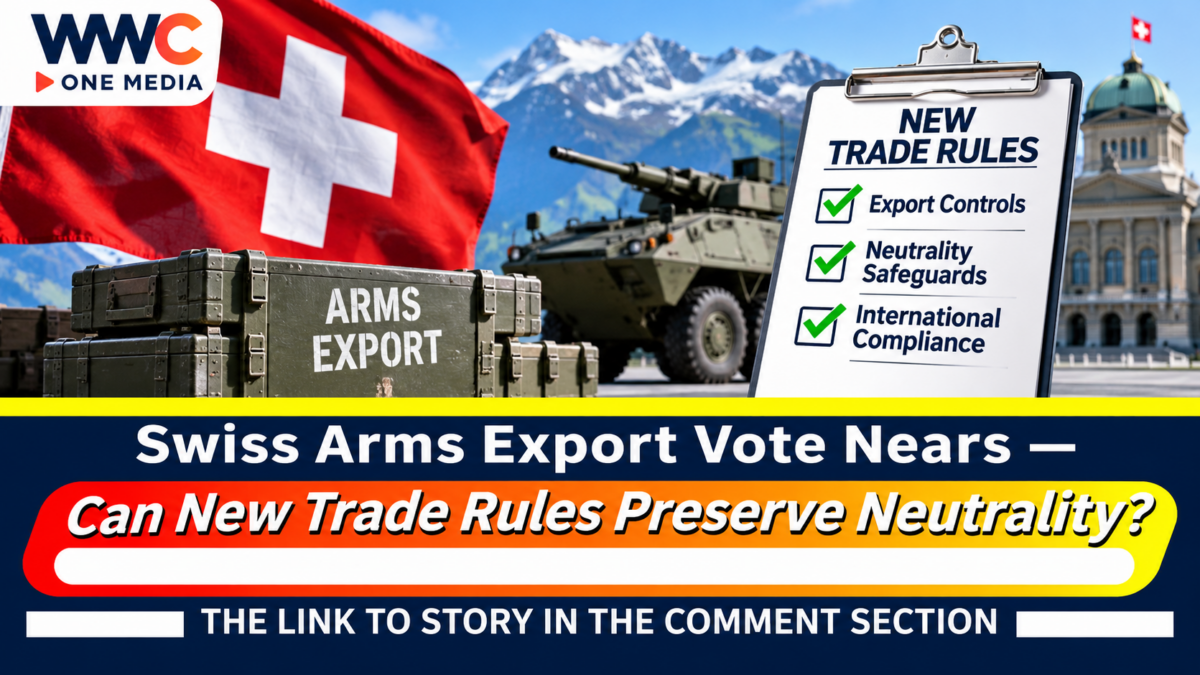
BERN, Switzerland — Swiss voters will decide on Nov. 29, 2026, whether to approve changes to the country’s War Materiel Act that would give the government more flexibility over weapons exports and onward transfers. The Swiss arms export referendum comes after Parliament approved the changes in December 2025 and opponents gathered enough support to submit the law to a popular vote.
The issue reaches beyond a simple choice between selling and banning weapons. The official ballot explanation identifies separate questions about neutrality, the ability to supply established partners and Switzerland’s control over where exported equipment may ultimately go.
Swiss arms export vote: What is on the ballot?
Parliament adopted the amendment on Dec. 19, 2025. The National Council passed it by 122 votes to 68, with six abstentions; the Council of States approved it by 31 to 11, with one abstention. Those are legislative votes, not the result of the referendum still to be held.
Under the present framework, export licences can be refused when a destination is involved in armed conflict or violates human rights. Authorities must also consider whether war materiel could be used against civilians or transferred unlawfully.
The amendment would allow certain exports to partner states involved in conflict when consistent with Swiss neutrality and foreign or security policy interests. It would also permit the Federal Council to depart from specified authorisation criteria in exceptional circumstances necessary to safeguard national interests.
Analysis: The legal question is not whether every weapon export becomes legal. It is how much discretion the government receives, and which checks remain binding when a particular application arrives.
The proposal changes how re-exports are controlled
Today, buyers of Swiss war materiel generally face restrictions on passing equipment to another country without Swiss permission. The proposed law would remove the need for a non-re-export declaration in every case, while allowing authorities to require one where risks or policy considerations demand it.
Switzerland’s economic affairs secretariat says individual export applications would still require licences. If officials identify a significant risk that goods will be diverted to an unacceptable destination, they must require safeguards or refuse authorisation.
That difference matters to manufacturers and governments that combine parts sourced from several countries into one weapons system. A component may be exported to one country for manufacture, while the finished product is ultimately delivered elsewhere.
WWC has separately examined European companies’ calls for predictable defence-trade rules in Korea. That is a different regulatory system, but it illustrates why contractual restrictions and licensing requirements matter to cross-border supply chains.
The government and referendum opponents disagree over risk
The Federal Council and Parliament recommend approving the amendment. Their stated case is that Switzerland needs a viable domestic defence industry and dependable relationships with countries from which it may also need to acquire military equipment.
The referendum committee argues that the new flexibility could weaken safeguards and increase the possibility of exported materiel reaching countries involved in wars or serious human-rights abuses. It is particularly concerned about the reduced routine requirement for buyers to seek permission before transferring goods onward.
These are documented positions, not verified forecasts of what will happen after the vote. The government’s own guidance says Switzerland must continue to comply with the Arms Trade Treaty, neutrality law, human-rights commitments and other international obligations.
Analysis: The disagreement concerns the practical effectiveness of those remaining safeguards. A case-by-case assessment offers flexibility, but its value depends on the evidence available to licensing officials and their ability to identify the ultimate use of equipment.
Why Ukraine and the United States reveal the limits
The Swiss government expressly states that the amendment would not permit direct war-materiel exports from Switzerland to Ukraine under current neutrality requirements. A law that gives officials more discretion is not the same as a blanket exception to neutrality.
Its explanation also addresses the United States in the context of the 2026 conflict involving Iran. The government says no new definitive US export application had been approved since the escalation on Feb. 28, 2026. Under the proposed amendment, Switzerland could consider exports of components that are not militarily relevant to that particular conflict, subject to the applicable restrictions.
The ongoing demand for allied equipment forms the background to NATO partners’ plans to fund weapons for Ukraine. Those procurement discussions do not override Swiss law or prove that any Swiss application will be authorised.
Analysis: Each destination and proposed end use must be assessed separately. Broad references to security partnerships cannot replace a licence decision for the actual goods and recipient.
What the ballot means for the defence industry
Switzerland’s economic affairs secretariat publishes official arms-export statistics by destination and equipment category. Its 2026 series includes data through the first nine months, while its 2025 annual files provide a longer benchmark.
The government says European buyers account for more than 80% of Swiss war-materiel exports. That is the context for its argument that Swiss companies should remain integrated with partners’ procurement and manufacturing networks.
But more permissive rules do not automatically translate into larger orders, higher profits or new jobs. Each transaction still depends on customers, licensing, production capacity and commercial terms.
WWC’s article on European defence manufacturer CSG’s earnings and orders illustrates a separate point: strong defence demand and company profitability do not always move together. It provides industry context, not evidence about the financial effects of Switzerland’s referendum.
What happens next
The federal vote is scheduled for Sunday, Nov. 29, 2026. Approval would permit the legislative amendment to proceed under the applicable implementation arrangements; rejection would prevent this set of changes from taking effect.
This ballot must not be confused with the Sept. 27, 2026 neutrality initiative, which voters rejected by 70.15% to 29.85%. That was a separate proposal concerning a stricter constitutional definition of neutrality.
The forthcoming result, official implementation notices and subsequent export-licensing decisions will show what changes in practice. Neither the parliamentary vote nor competing campaign statements establish how Swiss voters will decide on Nov. 29.
FAQ
When is Switzerland voting on weapons-export rules?
The referendum on the War Materiel Act amendment is scheduled for Nov. 29, 2026.
Would the amendment allow weapons exports to countries in armed conflicts?
It would permit some exports to listed partners when consistent with Swiss neutrality and other legal obligations. It would not remove the requirement for individual licence review.
Could Switzerland directly export weapons to Ukraine after approval?
The government’s official explanation says no under the neutrality rules applicable to the current conflict.
Would foreign buyers be free to re-export Swiss weapons anywhere?
No. Routine declarations would be relaxed, but authorities could still require guarantees or refuse applications where diversion risks or international obligations require them.
Has Switzerland already voted on this particular amendment?
No. Parliament passed the amendment in December 2025, but the nationwide referendum is scheduled for Nov. 29, 2026.