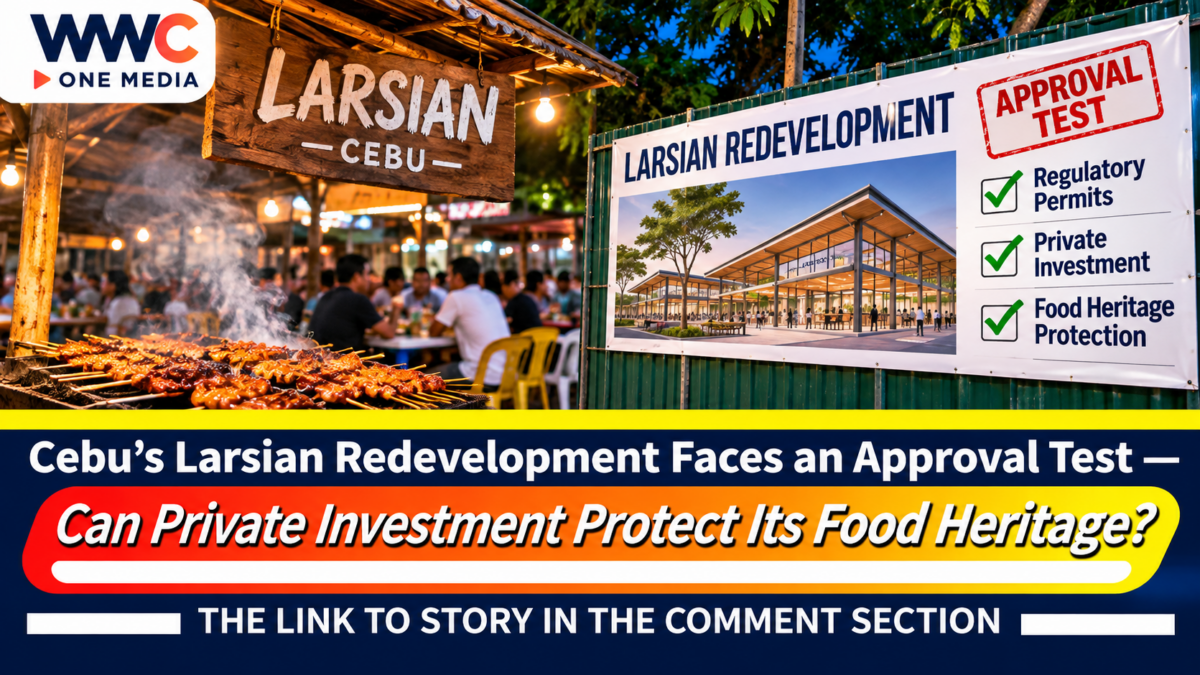
CEBU, Philippines — Cebu’s provincial government is pursuing a strategy to attract private investment into public assets, bringing renewed attention to possible improvements at the Larsian food park and commercial facilities around Cebu IT Park. The Cebu Larsian redevelopment discussion now raises a central question: what documentary approvals, competitive safeguards and protections for existing vendors would be needed before the province could proceed?
The provincial government’s published records confirm the investment-promotion programme and identify Larsian as a public food-park facility. They do not, in the materials independently verified for this report, establish a final tower design, construction contract, lease award or approved revenue-sharing agreement for the two locations.
Cebu Larsian redevelopment and the investment programme
On July 10, 2025, the Cebu provincial government published its decision to reactivate the Cebu Provincial Investment and Promotions Division through Executive Order No. 6. The order placed investment generation, business facilitation and enterprise promotion within a dedicated provincial office.
The government subsequently organised Cebu Economic Forum 4.0, with its Sept. 14, 2026 post reporting 515 participants from 13 countries. In the available forum registration data, 51.7% selected investment opportunities as an area of interest and 46.4% selected public-private partnerships. Respondents could choose more than one category, so those percentages cannot be added together to estimate total support.
The published forum findings describe interest in investment pathways, financing, tourism and infrastructure. They do not by themselves award a specific redevelopment project or identify a winning contractor.
Analysis: Turning public property into a productive commercial asset involves more than generating interest from developers. A proposal needs a defensible business case, a lawful selection procedure and an explanation of how local residents and tenants benefit.
What the public record establishes about Larsian
A March 24, 2026 provincial announcement identified Larsian among public areas included in the planned expansion of a government waste-segregation initiative. That official reference confirms Larsian’s place in the province’s public-facility operations.
It does not confirm the dimensions of a proposed replacement building, any committed developer financing or the precise treatment of food stalls during construction. Reports of a high-rise mixed-use design and temporary relocation arrangements have circulated, but an original government-approved proposal was not available for independent inspection.
Analysis: The distinction matters to traders and customers. A conceptual presentation may change during feasibility review, negotiations or permitting. Until binding arrangements are published, proposed commercial floors, hotel uses or vendor locations remain possibilities rather than settled project features.
A separate Cebu redevelopment debate appears in WWC’s reporting on the Carbon Public Market joint-venture dispute. That project involves different authorities and legal proceedings, but it shows why vendor arrangements and government contracting terms deserve careful scrutiny before major changes to public trading spaces.
How a private redevelopment would be evaluated
The Philippine Public-Private Partnership Code, Republic Act No. 11966, and its implementing rules establish procedures for qualifying government-private development arrangements. The PPP Center’s official guidance explains that an unsolicited proposal must undergo defined review stages, including a completeness check, determination of the appropriate approving body and, where applicable, a comparative challenge.
The PPP Center has also emphasised that forwarding or endorsing an unsolicited proposal does not equal project approval. A proponent’s interest, an agency’s willingness to discuss terms and an enforceable contract are separate steps.
Not every ordinary commercial lease necessarily follows the same path as a qualifying PPP. The legal structure must be determined from the actual agreement and the relevant rules, rather than from a project description alone.
Analysis: For any proposed Larsian agreement, the most useful records would include a feasibility study, the chosen procurement route, the valuation of provincial land use, the project risk allocation and the final contract. Without those documents, a proposed revenue percentage cannot be assessed as a reliable return for taxpayers.
Why an IT Park food hub needs its own business case
An upgrade to a food facility in the Cebu IT Park area is a different commercial undertaking from replacing Larsian with a mixed-use building. Its viability would depend on tenant demand, food-safety requirements, pedestrian access, utilities, maintenance responsibilities and the terms of any lease.
For a provincial property, officials would also need to establish who pays for improvements and whether the expected rental income exceeds the public owner’s continuing obligations. A projected increase in monthly collections is not realised revenue and should be evaluated against net operating costs.
WWC has examined separate business-development efforts in Talisay City’s South Road Properties investment programme. It illustrates the broader issue of attracting private activity to public locations, not proof that the Cebu food-park upgrade has been approved.
Analysis: Officials should make it possible to compare the existing property’s actual income with realistic post-upgrade scenarios. The full calculation would include maintenance, vacancy risk, fees and obligations retained by the province.
What vendors and taxpayers need to know
The provincial investment forum described business matching and investment implementation as priorities. But a successful project should also be judged by whether vendors retain practical access to customers and whether the public receives clear value from its property.
For a food landmark, practical safeguards could include written rules for temporary relocation, transparent stall allocation, accessible sanitation and waste facilities, and reasonable terms for existing tenants. These are questions to resolve, not benefits already guaranteed by a completed agreement.
WWC’s report on Cebu’s proposed logistics and food-hub development provides another example of an investment concept that must be tested against demand, infrastructure and operating economics.
Analysis: Protecting Larsian’s identity and improving revenue need not be opposing aims. But each objective requires measurable commitments in approved documents rather than assurances about a future design.
What happens next
The next verifiable milestones would be publication of the provincial project documents, the applicable approval or procurement route, comparative offers where required, and the signed development or lease terms. Subsequent notices would need to explain permits, construction timing and arrangements for affected traders.
As of Nov. 18, 2026, the original government records reviewed establish Cebu’s investment-promotion policy, not a completed Larsian high-rise deal or final IT Park food-hub contract. That distinction should guide coverage until the province releases the specific approvals.
FAQ
Has Cebu approved a 27-storey Larsian building?
An approved project document confirming that tower height was not independently obtained. The proposal should not be described as a final government-approved design.
Is Larsian a provincial public facility?
Yes. Cebu’s official March 2026 announcement explicitly identified Larsian as a food-park location for a provincial waste-segregation initiative.
Must a private developer face a competitive challenge?
Qualifying unsolicited PPP proposals follow the procedures in the PPP Code and its implementing rules. The appropriate process depends on the legally established project structure.
Has the IT Park food-hub upgrade been awarded?
No original signed award, lease or final financial agreement for that upgrade was independently verified in the records reviewed.
What should vendors look for next?
Published consultation arrangements, relocation provisions, future stall terms, construction schedules and final government approvals would clarify how any redevelopment affects their businesses.