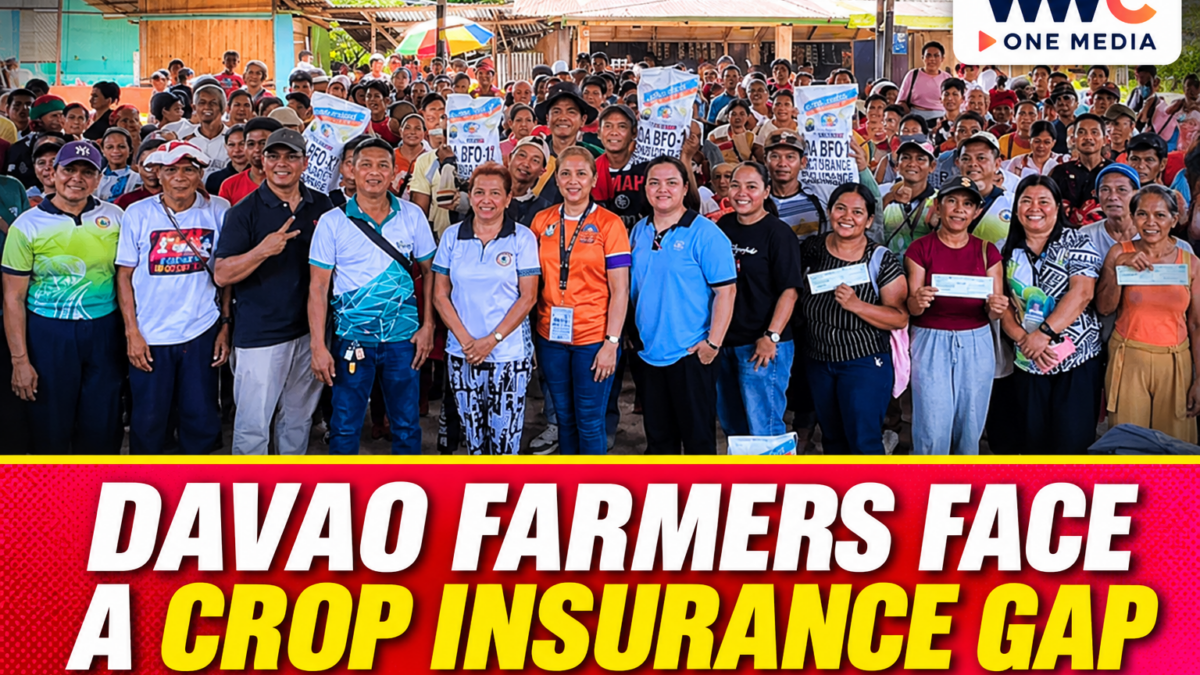
Davao Region’s crop-insurance challenge highlights a critical weakness in the country’s agricultural safety net: government-funded protection can only help farmers who are actually enrolled. As El Niño threatens to disrupt planting and harvests, the bigger issue is whether insurance coverage can reach vulnerable farms before drought damage begins.
The Department of Agriculture’s 2026 programme provides ₱6.5 billion for the Philippine Crop Insurance Corporation (PCIC), up from ₱4.5 billion in 2025. The national government has also raised the maximum insurance cover for rice and corn to ₱25,000 per hectare, a 25% increase from the previous ₱20,000 level. USDA Portal
That larger budget is important, but funding alone does not guarantee protection. Farmers must meet eligibility requirements and complete the enrolment process before their crops are exposed to an insured risk.
Why crop insurance matters as El Niño approaches
PAGASA’s Nov. 4, 2026, advisory confirmed that a very strong El Niño was present in the tropical Pacific and was expected to continue until the first half of 2027. It warned that rainfall deficits could lead to dry spells and drought in several parts of the country. PAGASA Public Files+1
For farmers, this creates a financial risk that extends beyond the loss of a single harvest. A damaged crop can leave a household without expected income while also making it harder to pay for seeds, fertiliser, labour and the next planting cycle.
Crop insurance is intended to reduce some of that exposure. It does not prevent drought or guarantee that a farmer will recover every peso invested, but it can provide financial assistance when an insured loss meets the policy’s conditions.
What the ₱6.5-billion insurance programme provides
The Department of Agriculture announced that the 2026 allocation for PCIC had increased to ₱6.5 billion from ₱4.5 billion in 2025. The programme is designed to support premium subsidies for eligible farmers and fisherfolk registered in the Registry System for Basic Sectors in Agriculture.
The government also raised the maximum insurance cover for rice and corn to ₱25,000 per hectare. This represents a 25% increase from the previous ₱20,000 coverage.
The expanded programme covers several agricultural insurance lines, including rice, corn, high-value crops, fisheries and aquaculture, livestock, and non-crop agricultural assets. Credit and life term insurance are excluded from the free coverage described in the DA announcement. USDA Portal
The distinction between insurance coverage and government assistance is important. A farmer should not assume that registration in the agricultural database automatically activates an insurance policy.
Registration is not the same as being insured
The RSBSA is the Department of Agriculture’s official electronic registry for farmers, farmworkers, fisherfolk and agri-youth. Its Davao Region portal describes the registry as a database used to identify and validate people who may qualify for government programmes. ictsdavao.da.gov.ph
But registration and insurance serve different purposes. The registry helps establish eligibility; the farmer must still complete the applicable insurance enrolment requirements.
The DA has also explained that premium-free coverage is intended for eligible RSBSA-listed beneficiaries, while PCIC continues to offer insurance arrangements outside the subsidised programme. Farmers should confirm their coverage, insured crop, area and policy period directly with PCIC or their municipal agriculture office.
This is particularly important before planting. Insurance cannot be treated as a last-minute remedy after a crop has already been exposed to a known risk.
Why timely reporting and documentation matter
Insurance protection is only one part of agricultural disaster response. Farmers also need to document damage properly and coordinate with local authorities when crops are affected.
In its earlier coverage of Davao’s drought preparations, WWC discussed the importance of reporting El Niño-related crop damage before clearing affected fields.
The practical lesson is that farmers should contact their municipal agriculture offices promptly when they observe crop damage. They should ask what inspection, documentation and claim procedures apply rather than assume that every reported loss automatically qualifies for payment.
The same principle applies to irrigation. WWC has examined how drought exposure is prompting agricultural adaptation in Central Visayas, while a completed irrigation project in Kalinga illustrates why reliable water infrastructure remains important to farm resilience.
Insurance and irrigation address different problems. One helps manage financial losses after an insured event; the other can help reduce exposure to water shortages. Neither replaces the need for sound farm planning.
What happens next
The immediate priority is to make sure eligible farmers understand how to enrol before their crops face drought exposure. PCIC and local agriculture offices can help explain the requirements, available insurance products and documents needed for coverage.
The regional government should also make updated enrolment figures publicly accessible. A useful report would show the number of registered farmers, the number actually insured, the crops and areas covered, and the remaining subsidy balance.
Those figures would allow the public to assess whether government funding is translating into actual protection for farming communities.
For Davao, the central question is not simply how much money has been allocated to crop insurance. It is how many eligible farmers have active coverage before the next damaging dry spell.