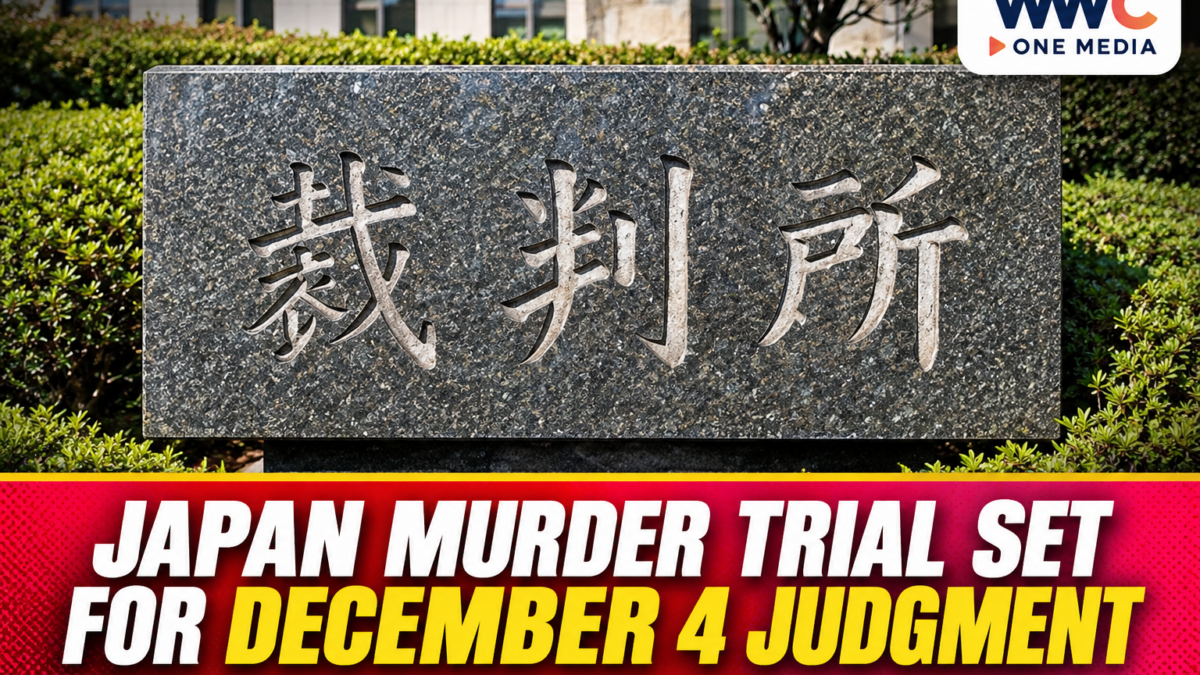
A murder trial at the Hamamatsu branch of the Shizuoka District Court is scheduled to reach judgment on December 4, 2026, following six listed hearing dates in November. The official court calendar identifies the case as involving murder and violations of Japan’s firearms and swords control law, but does not publicly identify the defendant or describe the alleged victims. 静岡地方裁判所/静岡家庭裁判所/静岡県内の簡易裁判所
The court’s published schedule lists the case under docket number Reiwa 7 (Wa) No. 110. Hearings were scheduled for Nov. 4, 5, 9, 10, 11 and 16, with the judgment set for 2 p.m. on Dec. 4.
That official information establishes the proceedings and the next major court date. It does not, by itself, establish the details of the alleged killings, the defendant’s identity, the arguments presented by prosecutors and defence counsel, or the punishment requested by either side.
This distinction is important in a case where the possible death penalty has attracted public attention. A prosecutor’s request for capital punishment is not a court ruling, and it must not be reported as though the court has already imposed that sentence.
How Japan’s lay-judge system works
The case is listed on the court’s saiban-in trial calendar. Japan’s lay-judge system brings members of the public into serious criminal proceedings alongside professional judges.
The Supreme Court explains that six lay judges participate with three professional judges in determining whether an accused person is guilty and, if convicted, what sentence should be imposed. Supreme Court of Japan
This means the decision is not simply a recommendation made by prosecutors. The court panel must consider the evidence and arguments presented during the proceedings before reaching its judgment.
The system is intended to involve citizens in decisions involving serious offences, including cases in which the possible punishment can be life imprisonment or death.
A prosecutor’s demand is not the final sentence
Japan’s criminal procedure distinguishes between the prosecution’s position and the court’s decision.
The Ministry of Justice explains that prosecutors present evidence, examine witnesses and make a recommendation on the appropriate punishment. The court then considers the prosecution and defence positions before delivering its judgment. Ministry of Justice
For homicide under Japanese law, the possible statutory punishments include the death penalty, life imprisonment or a fixed term of imprisonment of at least five years. The Supreme Court says sentencing considerations include the seriousness of the outcome, the circumstances and motive of the crime, the accused person’s culpability and other individual factors. Supreme Court of Japan
A request for the death penalty therefore does not make that outcome automatic. The court must reach its own decision based on the case before it.
What happens on December 4?
The Shizuoka District Court’s published calendar identifies Dec. 4 at 2 p.m. as the judgment date for the case. The schedule also warns that hearing dates and courtrooms may change. 静岡地方裁判所/静岡家庭裁判所/静岡県内の簡易裁判所
The judgment will be the key development to watch. It should establish the court’s findings and the sentence, if a conviction is entered.
The court’s publicly accessible calendar does not disclose the eventual outcome in advance. Until the judgment is delivered, the prosecution’s position and the defence’s arguments must remain distinct from the court’s final findings.