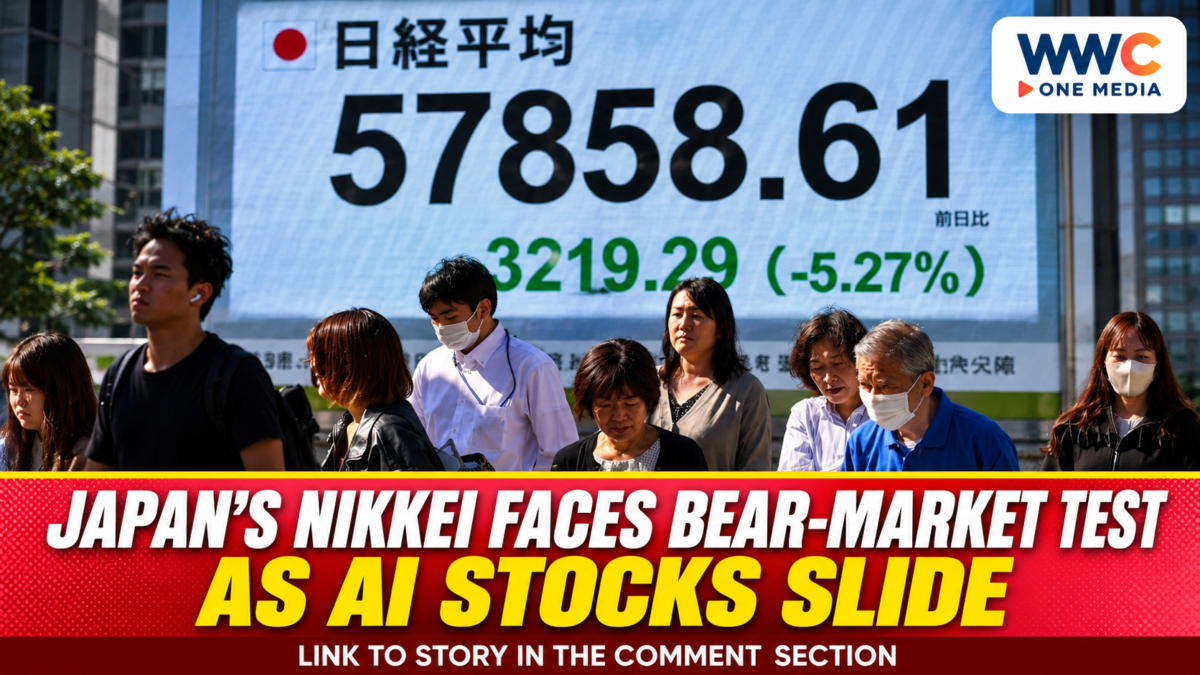
Japan’s Nikkei 225 remained under pressure on Nov. 17, closing at 58,860.43 after another decline in technology-related shares. The benchmark has suffered a sharp correction since its June record, but its latest closing level reveals an important distinction between briefly crossing the technical bear-market threshold during trading and remaining below it at the end of a session.
The distinction matters because a 20% decline from a market peak is widely used to describe a bear market. Japan’s benchmark fell beyond that threshold during the Nov. 6 session, but its Nov. 17 close was still less than 20% below its June 25 record closing level.
The figures point to a market under significant pressure, not necessarily one that has settled into a prolonged bear market. They also highlight a difficult question for investors: how much of Japan’s recent stock-market rally depended on expectations that artificial intelligence investment would continue expanding at an exceptional pace?
The Nikkei’s decline is substantial, but the 20% threshold needs context
The official Nikkei Indexes historical data show that the benchmark closed at 72,366.34 on June 25, its highest closing level in the period under review.
By Nov. 6, the index had fallen to an intraday low of 56,745.81 before finishing the session at 57,434.77. The intraday low was approximately 21.6% below the June closing record, taking the index beyond the commonly used 20% bear-market threshold.
However, the Nov. 17 close of 58,860.43 was approximately 18.7% below that June record. In other words, the index had moved back above the threshold on a closing-price comparison, even as it remained considerably weaker than its previous high. Nikkei Indexes+1
That distinction does not make the selloff insignificant. It simply prevents a technical label from obscuring what the market data actually show.
The index also declined from 59,662.02 on Nov. 16 to 58,860.43 on Nov. 17, a one-day drop of approximately 1.34%. The latest session therefore extended the pressure rather than confirming a sustained recovery. Nikkei Indexes
Why AI expectations became a market vulnerability
Japan’s recent rally had been closely connected to enthusiasm surrounding artificial intelligence, semiconductor equipment and data-centre construction.
A November market assessment published by Invesco described how expectations for AI and semiconductor investment had supported Japanese shares, while concerns about excessive investment became more prominent later in the year.
The assessment also identified uncertainty surrounding US policy and possible regulation of AI development and investment as factors weighing on related shares after the US midterm elections. Invesco
This is important because stock prices reflect expectations about future earnings, not simply the amount of business companies are generating today.
Companies supplying semiconductor manufacturing equipment, advanced components and data-centre infrastructure can benefit when customers expand their investment budgets. But if investors begin questioning the scale, timing or profitability of those projects, valuations can fall even before companies report a corresponding deterioration in sales.
That helps explain why the recent market weakness should not automatically be interpreted as proof that AI demand has collapsed.
It is also the risk explored in WWC’s earlier report on Wall Street’s changing reaction to AI investment and technology valuations.
Semiconductor exposure makes the Nikkei sensitive to technology sentiment
The composition of the Nikkei 225 helps explain why concerns about AI spending can have an outsized effect on the index.
The official Nikkei daily summary for June 25 listed Advantest and Tokyo Electron among its largest weighted components, alongside Fast Retailing and SoftBank Group. Advantest and Tokyo Electron alone represented a substantial share of the index’s weighting on that date. Nikkei Indexes
These companies operate in industries connected to semiconductor production and technology investment. When investors reassess the prospects of the AI infrastructure cycle, large technology-related components can exert considerable influence on the benchmark.
The wider Asian semiconductor sector is exposed to similar expectations. WWC previously examined how AI-related spending concerns affected chip stocks across Asia.
For Japan, the issue is not simply whether AI remains an important technology. It is whether the expected returns from the enormous investments supporting the industry will justify the valuations investors previously assigned to companies connected to it.
Market forecasts are becoming more cautious
The changing mood is also visible in the November survey published by QUICK, a Japanese financial information provider.
Its monthly equity survey, released on Nov. 9, showed that market participants’ one-month-ahead forecast for the Nikkei 225 declined to ¥63,376 from ¥69,813 in the previous survey.
QUICK said this was the first downward adjustment in the forecast over two months. Its assessment also identified concerns about the credit position of an emerging US AI cloud company and uncertainty surrounding policy towards AI investment as factors weighing on sentiment. 株式会社QUICK:Our Knowledge, Your Value.
The forecast is not a guaranteed market target. It is a measure of the expectations reported by survey participants at a particular time.
Nevertheless, the shift suggests that market participants were becoming more cautious about the near-term outlook even before the Nov. 17 close.
Nomura Asset Management’s Nov. 10 commentary offered another perspective. It said its fund had reduced positions in some AI and semiconductor-related stocks while continuing to assess individual companies based on their business prospects and share-price movements.
The commentary also warned that if growth across the AI market slowed, differences between companies’ competitiveness and growth potential could become more important to investors. nomura-am.co.jp
That is a significant change from a market environment in which enthusiasm for AI-related companies could lift a broad range of shares.
What the correction could mean for the Philippines
The Japanese selloff matters beyond Tokyo because the AI infrastructure industry depends on a regional supply chain involving chipmakers, equipment manufacturers, electronics producers, storage suppliers and data-centre operators.
The Philippines participates in this ecosystem through electronics manufacturing and related technology services. Japanese investment is also relevant to the country’s manufacturing base, including the planned expansion of Toshiba’s Philippine AI storage manufacturing operations.
However, a decline in Japanese share prices does not automatically mean that Philippine factories will lose orders or that announced investments will be cancelled.
The more important question is whether companies eventually reduce capital spending, revise procurement plans or delay projects because expected AI returns no longer justify their costs.
For Philippine businesses, that distinction is critical. A change in investor sentiment can happen quickly, while changes in manufacturing orders and investment decisions may take longer to emerge.
For Filipino investors with exposure to international technology funds, the correction is also a reminder that strong demand for a technology does not guarantee that every company associated with it will deliver strong investment returns.
What happens next
The next stage of Japan’s market correction will depend partly on whether companies can demonstrate that AI-related spending is translating into sustainable revenue and earnings.
Investors will also be watching corporate results, technology-sector guidance and developments affecting data-centre construction and semiconductor demand.
The November figures already show why the distinction between a market correction and a sustained bear market matters. The Nikkei briefly crossed the 20% threshold during the Nov. 6 session, but its Nov. 17 closing level remained above that line when measured against the June closing record.
That does not remove the risks facing Japanese equities. It means the market’s direction should be judged using consistent price comparisons rather than relying on a dramatic label alone.
Japan’s AI-related rally may still have a long-term foundation in technology demand. But the latest correction suggests investors are becoming more selective about which companies can turn that demand into lasting profits.
The real test is no longer just how much money the world plans to spend on AI. It is whether the companies receiving that money can generate returns strong enough to support the expectations already built into their share prices. Nikkei Faces a Bear-Market Test as AI Stocks Slide — But Do the Closing Numbers Tell a Different Story?
Japan’s Nikkei 225 remained under pressure on Nov. 17, closing at 58,860.43 after another decline in technology-related shares. The benchmark has suffered a sharp correction since its June record, but its latest closing level reveals an important distinction between briefly crossing the technical bear-market threshold during trading and remaining below it at the end of a session.
The distinction matters because a 20% decline from a market peak is widely used to describe a bear market. Japan’s benchmark fell beyond that threshold during the Nov. 6 session, but its Nov. 17 close was still less than 20% below its June 25 record closing level.
The figures point to a market under significant pressure, not necessarily one that has settled into a prolonged bear market. They also highlight a difficult question for investors: how much of Japan’s recent stock-market rally depended on expectations that artificial intelligence investment would continue expanding at an exceptional pace?
The Nikkei’s decline is substantial, but the 20% threshold needs context
The official Nikkei Indexes historical data show that the benchmark closed at 72,366.34 on June 25, its highest closing level in the period under review.
By Nov. 6, the index had fallen to an intraday low of 56,745.81 before finishing the session at 57,434.77. The intraday low was approximately 21.6% below the June closing record, taking the index beyond the commonly used 20% bear-market threshold.
However, the Nov. 17 close of 58,860.43 was approximately 18.7% below that June record. In other words, the index had moved back above the threshold on a closing-price comparison, even as it remained considerably weaker than its previous high. Nikkei Indexes+1
That distinction does not make the selloff insignificant. It simply prevents a technical label from obscuring what the market data actually show.
The index also declined from 59,662.02 on Nov. 16 to 58,860.43 on Nov. 17, a one-day drop of approximately 1.34%. The latest session therefore extended the pressure rather than confirming a sustained recovery. Nikkei Indexes
Why AI expectations became a market vulnerability
Japan’s recent rally had been closely connected to enthusiasm surrounding artificial intelligence, semiconductor equipment and data-centre construction.
A November market assessment published by Invesco described how expectations for AI and semiconductor investment had supported Japanese shares, while concerns about excessive investment became more prominent later in the year.
The assessment also identified uncertainty surrounding US policy and possible regulation of AI development and investment as factors weighing on related shares after the US midterm elections. Invesco
This is important because stock prices reflect expectations about future earnings, not simply the amount of business companies are generating today.
Companies supplying semiconductor manufacturing equipment, advanced components and data-centre infrastructure can benefit when customers expand their investment budgets. But if investors begin questioning the scale, timing or profitability of those projects, valuations can fall even before companies report a corresponding deterioration in sales.
That helps explain why the recent market weakness should not automatically be interpreted as proof that AI demand has collapsed.
It is also the risk explored in WWC’s earlier report on Wall Street’s changing reaction to AI investment and technology valuations.
Semiconductor exposure makes the Nikkei sensitive to technology sentiment
The composition of the Nikkei 225 helps explain why concerns about AI spending can have an outsized effect on the index.
The official Nikkei daily summary for June 25 listed Advantest and Tokyo Electron among its largest weighted components, alongside Fast Retailing and SoftBank Group. Advantest and Tokyo Electron alone represented a substantial share of the index’s weighting on that date. Nikkei Indexes
These companies operate in industries connected to semiconductor production and technology investment. When investors reassess the prospects of the AI infrastructure cycle, large technology-related components can exert considerable influence on the benchmark.
The wider Asian semiconductor sector is exposed to similar expectations. WWC previously examined how AI-related spending concerns affected chip stocks across Asia.
For Japan, the issue is not simply whether AI remains an important technology. It is whether the expected returns from the enormous investments supporting the industry will justify the valuations investors previously assigned to companies connected to it.
Market forecasts are becoming more cautious
The changing mood is also visible in the November survey published by QUICK, a Japanese financial information provider.
Its monthly equity survey, released on Nov. 9, showed that market participants’ one-month-ahead forecast for the Nikkei 225 declined to ¥63,376 from ¥69,813 in the previous survey.
QUICK said this was the first downward adjustment in the forecast over two months. Its assessment also identified concerns about the credit position of an emerging US AI cloud company and uncertainty surrounding policy towards AI investment as factors weighing on sentiment. 株式会社QUICK:Our Knowledge, Your Value.
The forecast is not a guaranteed market target. It is a measure of the expectations reported by survey participants at a particular time.
Nevertheless, the shift suggests that market participants were becoming more cautious about the near-term outlook even before the Nov. 17 close.
Nomura Asset Management’s Nov. 10 commentary offered another perspective. It said its fund had reduced positions in some AI and semiconductor-related stocks while continuing to assess individual companies based on their business prospects and share-price movements.
The commentary also warned that if growth across the AI market slowed, differences between companies’ competitiveness and growth potential could become more important to investors. nomura-am.co.jp
That is a significant change from a market environment in which enthusiasm for AI-related companies could lift a broad range of shares.
What the correction could mean for the Philippines
The Japanese selloff matters beyond Tokyo because the AI infrastructure industry depends on a regional supply chain involving chipmakers, equipment manufacturers, electronics producers, storage suppliers and data-centre operators.
The Philippines participates in this ecosystem through electronics manufacturing and related technology services. Japanese investment is also relevant to the country’s manufacturing base, including the planned expansion of Toshiba’s Philippine AI storage manufacturing operations.
However, a decline in Japanese share prices does not automatically mean that Philippine factories will lose orders or that announced investments will be cancelled.
The more important question is whether companies eventually reduce capital spending, revise procurement plans or delay projects because expected AI returns no longer justify their costs.
For Philippine businesses, that distinction is critical. A change in investor sentiment can happen quickly, while changes in manufacturing orders and investment decisions may take longer to emerge.
For Filipino investors with exposure to international technology funds, the correction is also a reminder that strong demand for a technology does not guarantee that every company associated with it will deliver strong investment returns.
What happens next
The next stage of Japan’s market correction will depend partly on whether companies can demonstrate that AI-related spending is translating into sustainable revenue and earnings.
Investors will also be watching corporate results, technology-sector guidance and developments affecting data-centre construction and semiconductor demand.
The November figures already show why the distinction between a market correction and a sustained bear market matters. The Nikkei briefly crossed the 20% threshold during the Nov. 6 session, but its Nov. 17 closing level remained above that line when measured against the June closing record.
That does not remove the risks facing Japanese equities. It means the market’s direction should be judged using consistent price comparisons rather than relying on a dramatic label alone.
Japan’s AI-related rally may still have a long-term foundation in technology demand. But the latest correction suggests investors are becoming more selective about which companies can turn that demand into lasting profits.
The real test is no longer just how much money the world plans to spend on AI. It is whether the companies receiving that money can generate returns strong enough to support the expectations already built into their share prices.