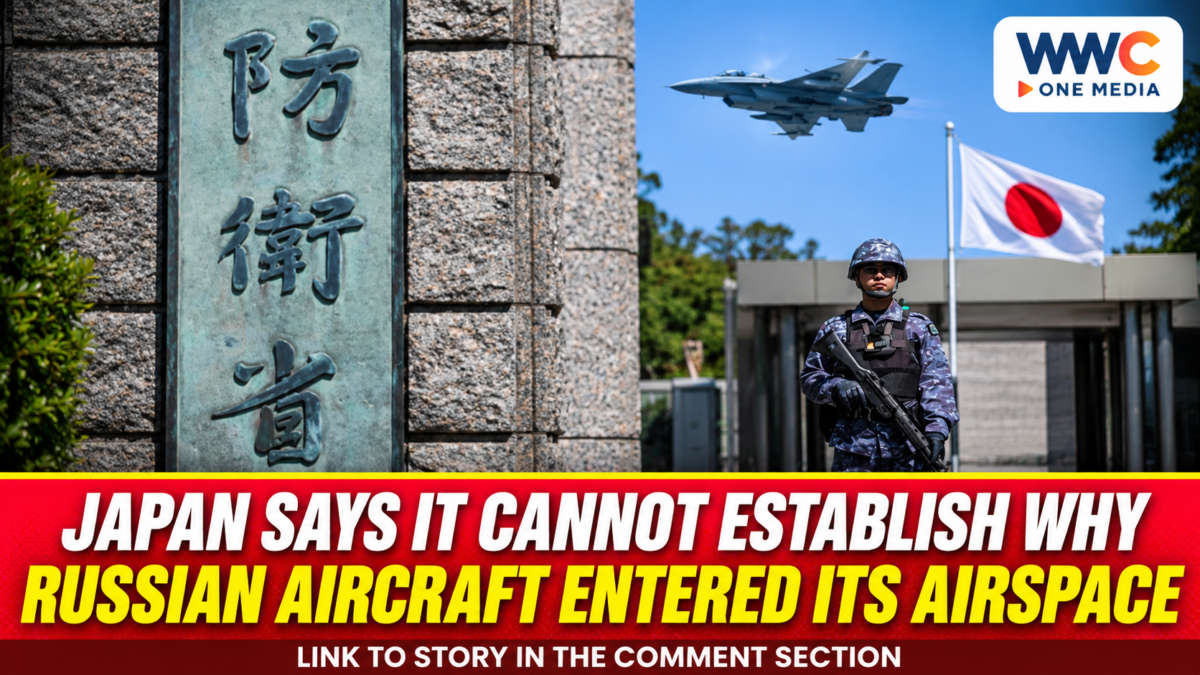
Japan has confirmed that two aircraft believed to be Russian entered its territorial airspace near Okinoshima, off Fukuoka Prefecture, on Nov. 17, 2026. But even after scrambling fighter aircraft and lodging a strong diplomatic protest with Moscow, the Japanese government said it could not establish the purpose behind the flights.
The clarification is important because it separates what Japan has officially confirmed from what remains unknown. Tokyo has described the incident as a serious infringement of its sovereignty, but its public statement does not identify the aircraft models, establish their mission or explain why they entered Japanese airspace.
Japan confirms two separate airspace entries
The Japanese Ministry of Defense recorded two suspected Russian aircraft entering the airspace northwest of Okinoshima.
The first incident occurred between approximately 4:07 a.m. and 4:10 a.m. The second aircraft, identified as separate from the first, entered between approximately 4:09 a.m. and 4:12 a.m.
Japan’s Air Self-Defense Force scrambled fighter aircraft from its Western Air Defense Command and issued notifications and warnings. The ministry also confirmed that the aircraft subsequently passed through the Tsushima Strait, travelled between Yonaguni Island and Taiwan, and continued towards the Pacific Ocean. Ministry of Defense Japan+1
The Japanese government has not publicly identified the aircraft types in its incident notice. It has described them as aircraft presumed to be Russian, rather than publishing technical identification that independently establishes their models.
Tokyo acknowledges that the aircraft’s purpose remains unknown
During his Nov. 17 press conference, Defence Minister Shinjiro Koizumi said the government could not provide a definitive explanation of the suspected Russian aircraft’s intentions or purpose.
He confirmed that Japan had lodged an extremely strong protest with the Russian government through diplomatic channels and demanded measures to prevent a recurrence.
Koizumi also said the Defence Ministry and Self-Defense Forces would continue monitoring Russian military movements and maintain their surveillance and airspace-response measures. Ministry of Defense Japan
This is an important limitation in the public record. The aircraft’s route and the timing of the incident are documented, but neither establishes whether the entry was deliberate, accidental or connected to another military activity.
The distinction matters because attributing an operational motive without evidence could turn a confirmed security incident into an unsupported geopolitical accusation.
What Japanese law allows its defence forces to do
Japan’s 2026 Defence White Paper explains the legal framework for responding to foreign aircraft entering national airspace.
It states that a country has complete and exclusive sovereignty over its airspace under international law. Japan’s Self-Defense Forces Act, particularly Article 84, provides the legal basis for measures against foreign aircraft that enter Japanese airspace in violation of applicable international or domestic rules.
The measures described in the White Paper include directing an aircraft to land or leave Japanese airspace, issuing warnings by radio and taking other necessary actions within the legal framework. Ministry of Defense Japan+1
This explains why Japan’s response involved fighter deployments and warnings rather than an automatic use of force.
The official record confirms that Japan scrambled aircraft and issued warnings. It does not say that Japanese fighters fired weapons or that the suspected Russian aircraft were forced to land.
The diplomatic response is now part of the incident
The protest to Moscow gives the incident a diplomatic dimension beyond the immediate air-defence response.
Japan has formally demanded preventive measures, while its defence minister has publicly committed the country to continued monitoring. However, the public Japanese statements reviewed do not establish what response, if any, Russia has provided.
For now, the next important developments are whether Moscow addresses the protest and whether Japan releases further information about the aircraft or their movements.
Until additional official information becomes available, the incident’s operational purpose should remain an open question rather than a conclusion presented as fact.