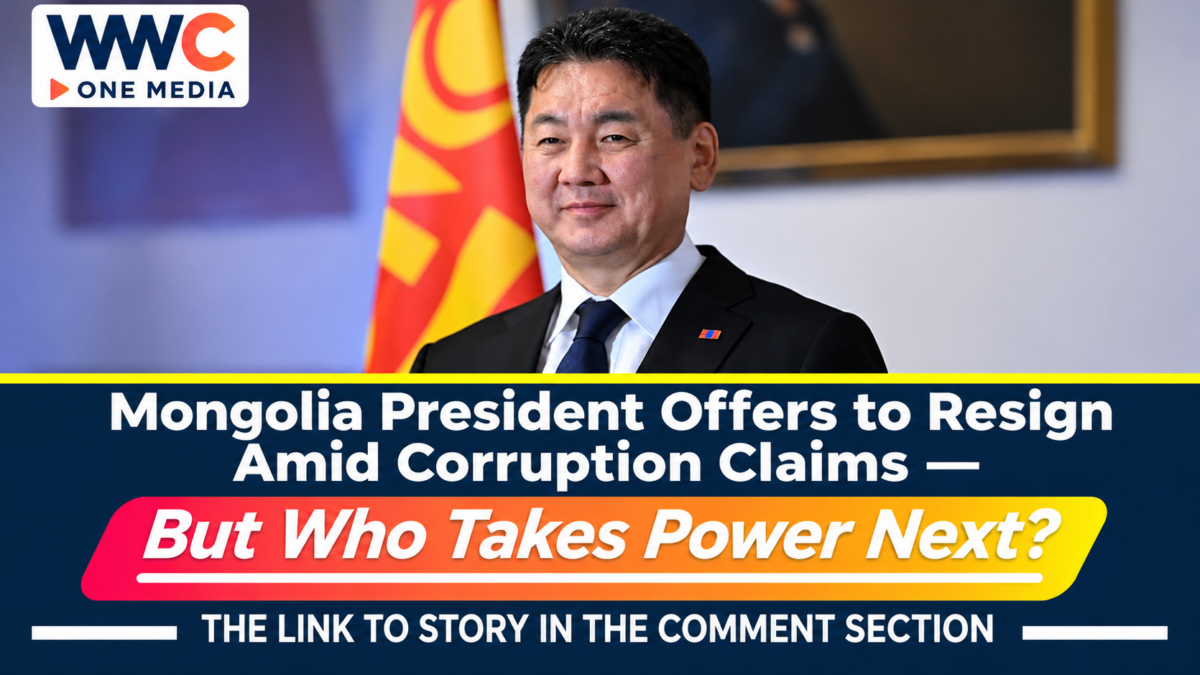
ULAANBAATAR, Mongolia — President Khurelsukh Ukhnaa announced on Nov. 17, 2026, that he was prepared to hand over his presidential duties and face an investigation following corruption allegations raised by the opposition Democratic Party. The declaration marks a serious political development, but it does not by itself verify that Mongolia’s parliament has formally accepted a resignation.
The Mongolia president resignation question is now both political and constitutional. The president has rejected the suggestion that he committed wrongdoing, while the Constitution sets out rules for the transfer of presidential powers and the election of a successor. Whether those procedures have formally begun remains a separate issue from his public announcement.
What the president actually announced
In a Nov. 17 statement reproduced by Mongolia’s national news agency, Khurelsukh agreed with an opposition demand that he step aside to allow the allegations to be examined. He said he would hand over his duties and seek to restore his reputation through an investigation.
His remarks are a declaration of intent, not proof of a completed parliamentary process. As of the official material checked for this report, a parliamentary resolution accepting a presidential resignation had not been verified.
That difference is crucial. The public must be able to distinguish a president’s stated willingness to leave office from the legal decision that determines when the duties transfer. A headline that treats the latter as complete would go beyond the documents currently available.
Why Mongolia president resignation rules matter
Article 37 of Mongolia’s Constitution addresses presidential succession. When a president resigns, dies or voluntarily leaves office, presidential powers are exercised by the speaker of the State Great Khural, Mongolia’s parliament, until a newly elected president is inaugurated.
The same article requires parliament to announce and conduct a presidential election within four months in those circumstances. It does not give the outgoing president unrestricted power to designate an individual successor.
The constitutional framework is especially important during political uncertainty: it provides a route for continuity in the office without assuming that any disputed allegation has already been resolved. It also separates the question of who exercises presidential powers from the question of whether a person committed an offence.
The presidential office’s published biography lists Khurelsukh as having served as prime minister from 2017 to 2021 and as president since 2021. His earlier government responsibilities provide context for the political scrutiny now directed at him, but they do not establish wrongdoing.
What the opposition has alleged — and what is unproven
On Nov. 16, the Democratic Party parliamentary caucus raised allegations of graft and cronyism involving senior figures in the ruling Mongolian People’s Party. Its leadership called for officials implicated in alleged corruption to step aside, undergo investigation and face public accountability through formal procedures.
The caucus said its 42 members supported creating a temporary parliamentary investigative committee. It also demanded greater disclosure of coal offtake agreements connected with Erdenes Tavan Tolgoi, a major Mongolian coal enterprise.
These are political allegations and demands, not court findings. The available statement does not independently establish that any payment was illegal, that the president personally received money or that a particular contract was corruptly awarded.
The distinction is similar to the one readers encounter when examining government coal-contract disputes in the Philippines: a demand for scrutiny, a party’s allegation and a binding legal determination are not interchangeable.
Why coal contracts have entered a presidential dispute
The opposition’s call for publication of offtake agreements makes access to contract information part of the broader accountability debate. Such agreements can involve the future delivery or sale of commodities, so their detailed conditions matter when evaluating public-resource management.
Yet the call to disclose documents does not demonstrate that every agreement contains an irregularity. Meaningful review would require the actual contract terms, the decisions authorising them and the relevant audit or investigative findings.
Analysis: Public access to primary contract records can narrow the distance between competing political claims. It allows a discussion about prices, responsibilities and approvals to be tested against documents instead of competing assertions.
The same underlying distinction between announced infrastructure commitments and verifiable delivery appears in WWC’s examination of Philippine infrastructure spending and implementation. That comparison is about oversight of public resources, not an assertion that the two countries face identical allegations.
What this could mean for political stability
Analysis: A voluntary presidential departure, if formally completed, can provide an orderly path through a political crisis. But a resignation alone cannot settle the substance of corruption allegations or establish the accuracy of claims made by either side.
A credible process would need to keep three questions separate: whether a resignation becomes legally effective, what evidence exists concerning the allegations and whether public institutions can continue operating while those questions are examined.
Political accountability is strongest when standards apply consistently to accusers and accused. The president’s denial deserves accurate presentation, just as the opposition’s calls for investigation deserve to be described without treating them as proven findings.
For an illustration of why documentary verification matters in another political dispute, WWC has examined what official records can establish in a contested voter-roll debate. The lesson for the Mongolia story is methodological: the existence of a controversy is verifiable, but its most serious allegations still require evidence.
What happens next
The first development to watch is a formal parliamentary record establishing whether the president has submitted a resignation and whether it has been accepted through the relevant procedure. Without that confirmation, descriptions of an already completed handover remain premature.
Next comes the constitutional succession mechanism. If the resignation takes effect, the speaker exercises presidential powers pending a new president’s inauguration, and the Constitution sets a four-month election requirement.
Separate from succession, any investigative committee, contract disclosures or formal investigative findings would need to be assessed on their own merits. Political statements are not substitutes for a completed investigation.
For now, the strongest supported conclusion is narrower than the dramatic shorthand of a president already out of office: Khurelsukh has offered to relinquish his duties amid allegations he disputes, while the formal outcome and any determination of wrongdoing remain unresolved.
FAQ
Has Mongolia’s president formally resigned?
Khurelsukh announced on Nov. 17 that he would hand over his duties. A parliamentary decision completing the resignation process was not verified in the official material reviewed.
Who becomes president if Khurelsukh leaves office?
Under Article 37 of the Constitution, the speaker of parliament exercises presidential powers until a newly elected president is inaugurated. This is not the same as an immediate permanent election to the office.
When would Mongolia hold a new presidential election?
Article 37 requires parliament to announce and conduct an election within four months when the presidency becomes vacant through resignation, death or voluntary departure.
What are the corruption allegations about?
The opposition has demanded investigations into alleged graft and greater transparency over coal offtake agreements. The allegations have not been established as facts by the official materials reviewed.
Has Khurelsukh admitted wrongdoing?
No. His public statement rejects the accusations and says he is willing to undergo an investigation to restore his reputation.