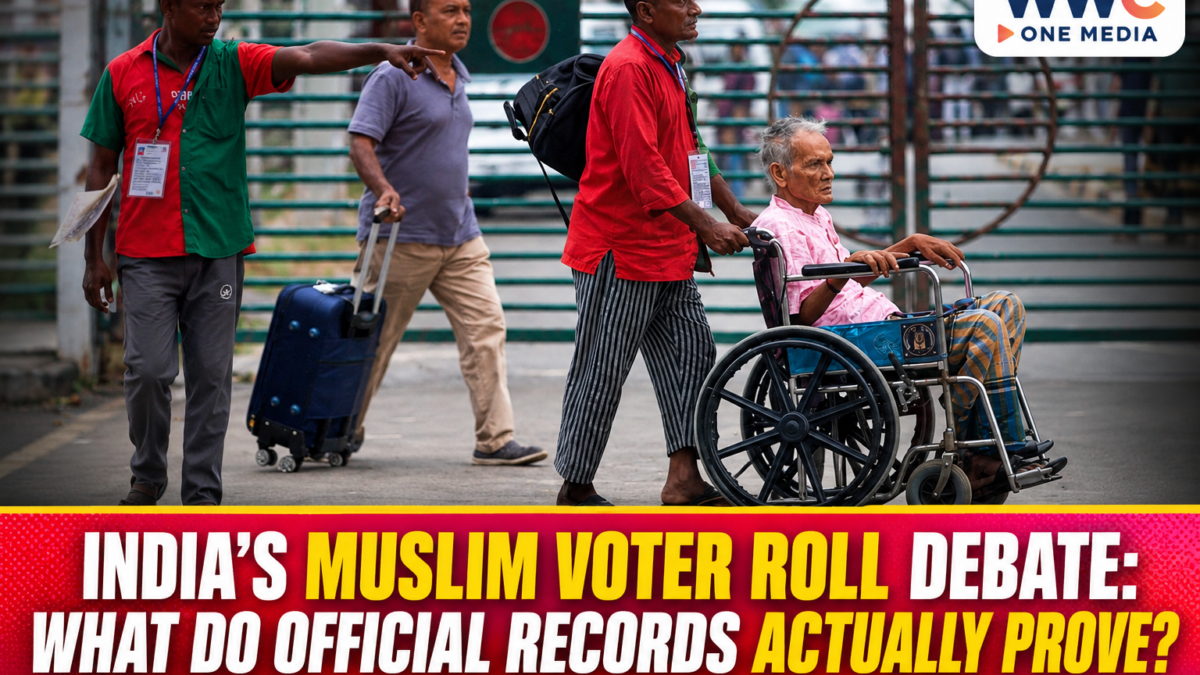
India’s voter-roll revision is facing renewed scrutiny over claims that Muslim voters have been disproportionately affected, but the official records available for examination leave a crucial question unanswered: how many people removed from electoral lists belong to particular religious communities?
The Election Commission of India’s published procedures and West Bengal’s electoral-roll figures document a large verification exercise, including additions, deletions and cases requiring further adjudication. However, the official figures examined for this report classify electors by gender and administrative status, not religion.
That distinction matters. Claims of disproportionate impact deserve serious examination, but a numerical conclusion about Muslim voters requires evidence that directly identifies the religious composition of the affected population. Without that information in the underlying official records, the figures cannot independently establish the scale of any religion-based disparity.
The debate also carries consequences beyond election administration. India’s legal framework treats voter registration and citizenship determination as separate processes, and a change in electoral status should not automatically be interpreted as proof that someone is a foreign national.
What India’s Electoral Records Actually Show
West Bengal’s Chief Electoral Officer published a detailed press note on February 28, 2026, outlining the results of the state’s Special Intensive Revision.
The document recorded 76,637,529 electors before draft publication on October 27, 2025. It also reported that 5,820,899 enumeration forms had not been received, with the listed categories including deceased, absent, shifted, already enrolled and other cases.
The draft roll published on December 16, 2025, contained 70,816,630 electors. The final February 28 statement recorded 70,459,284 electors. 2nd Draft Press Release_27.02.2026
The same document reported 546,053 deletions through Form 7, alongside 182,036 additions through Forms 6 and 6A and another 6,671 additions through Form 8.
These figures describe administrative changes to the electoral register. They do not establish that every person whose name disappeared was ineligible, nor do they identify the religious affiliation of those affected.
The final roll also included 6,006,675 electors whose cases were under adjudication, according to the press note. That figure is particularly important because it shows that the publication of a final roll did not mean every eligibility-related matter had reached the same procedural outcome.
Why the Muslim-Specific Figures Need Careful Verification
The central question in the current controversy is whether Muslim voters were affected at a higher rate than other communities.
To answer that conclusively, researchers would need a reliable dataset identifying the relevant group of voters, the number of people affected, the stage of the revision process and the basis for comparing their experience with that of other electors.
The official West Bengal press note provides totals and gender classifications. It does not provide a religious breakdown of the 546,053 Form 7 deletions or the 6,006,675 cases under adjudication.
This does not disprove claims of disproportionate impact. It means the official document alone cannot confirm them.
There is also a methodological issue. Inferring a person’s religion from their name is not equivalent to having verified religious-identification data. Names can be shared across communities, and a person’s religious identity cannot safely be established from a name alone.
Any analysis using names as a proxy must disclose its methodology, limitations, the records examined and the possibility of classification errors. Without that transparency, a percentage may appear more definitive than the underlying evidence warrants.
For a story involving voting rights and a religious minority, that distinction is essential. Accurate reporting should neither dismiss allegations without examination nor turn an unverified estimate into an official finding.
The Election Commission’s Rules Include Notice and Appeals
The Election Commission’s October 27, 2025 instructions for the revision set out procedures for handling electors whose enumeration forms were not returned or whose eligibility needed further examination.
The instructions allowed Booth Level Officers to identify probable reasons such as absence, shifting, death or duplicate registration after making inquiries. They also required notices to be issued after publication of the draft electoral rolls to people who could not be linked with previous revision records, so their eligibility could be assessed. Election Commission of India
The process also included opportunities to submit claims and objections.
West Bengal’s February 28 press note explained that appeals against decisions by Electoral Registration Officers could be filed with the District Magistrate under Section 24(a) of the Representation of the People Act, 1950. A second appeal under Section 24(b) could then be brought before the Chief Electoral Officer.
These mechanisms are important because electoral-roll revision can affect a person’s ability to participate in an election. A system that removes ineligible entries must also provide a meaningful route for eligible people to challenge errors.
The Election Commission has separately described safeguards such as household verification, draft publication, claims and objections, and appeals. The government’s July 25, 2026 parliamentary response also listed deaths, permanent relocation, duplicate entries and people who could not be traced after repeated visits among the broad categories used to explain deletions. Press Information Bureau
The existence of safeguards, however, does not by itself establish that every case was handled correctly. Their effectiveness depends on whether notices reach affected voters, evidence is properly assessed and appeals are resolved in time.
Voter Registration Is Not the Same as Citizenship Determination
Another important issue is the relationship between electoral registration and citizenship.
India’s Representation of the People Act, 1950, governs electoral-roll registration, while citizenship is governed by the Citizenship Act, 1955. These laws address related but distinct legal questions.
The Supreme Court of India examined that distinction in its May 27, 2026 judgment in Association for Democratic Reforms and Others v. Election Commission of India and Others, a case arising from the Special Intensive Revision in Bihar.
The judgment addressed the Election Commission’s authority to examine eligibility for registration and the procedures applicable to people whose enrolment is questioned. It also distinguished the electoral-registration process from a final determination of citizenship.
That distinction is especially important when voter-list changes are discussed alongside allegations of detention or deportation. A person’s absence from an electoral roll is not, by itself, a deportation order or a final ruling that the person is a foreign national.
The Supreme Court proceedings concerned Bihar. They should not be treated as a judicial finding about every individual case in West Bengal or about the circumstances of any particular detention.
WWC has previously examined the wider documentation issue in its explainer on which documents can establish Indian citizenship. The legal distinction remains central: election officials assess registration eligibility, while citizenship questions must be handled under the applicable citizenship framework.
Why the Issue Matters Beyond West Bengal
Electoral rolls are not simply administrative lists. They determine who is recognised as eligible to vote, making the accuracy of the registration process directly relevant to democratic participation.
A wrongful deletion can prevent an eligible citizen from voting. An inaccurate entry can also undermine confidence in the integrity of the register. Both problems require transparent procedures and credible review mechanisms.
The controversy has also generated political protests and public criticism. WWC previously covered the detention of a youth movement organiser during demonstrations over India’s voter-list revision. That coverage provides context for the political response, but protest activity alone does not establish whether individual deletions were lawful or discriminatory.
The broader challenge for election authorities is to demonstrate that verification rules are applied consistently, regardless of a person’s religion, political affiliation or location.
For the public, the most useful evidence would include clear explanations of deletion decisions, accessible appeal outcomes and reliable statistics that allow independent scrutiny without exposing voters’ personal information.
What Happens Next?
The immediate need is for transparent, verifiable information about the people affected by the revision and the outcomes of their appeals.
The Election Commission and the relevant state authorities publish electoral-roll information and procedural notices through their official channels. The West Bengal Chief Electoral Officer’s website also provides access to revision-related materials, including supplementary lists and electoral-roll resources.
Any further claim about the religious composition of deleted voters should be checked against the underlying records and a clearly explained methodology. If a study classifies names by presumed religion, its findings should be described as an estimate based on that method, not as an official government count.
For people whose names have been removed or whose eligibility remains under review, the practical priority is to check the current electoral roll and use the prescribed claims and appeal procedures where necessary.
The central question is not whether India has the authority to maintain accurate voter lists. It does. The question is whether the process can demonstrate, through transparent evidence and effective safeguards, that every eligible voter receives equal treatment.
Frequently Asked Questions
Are Muslim voters being disproportionately removed from India’s electoral rolls?
Claims of disproportionate impact have emerged, but the official West Bengal figures examined here do not provide a religious breakdown of deletions. A reliable conclusion requires independently verifiable data and a transparent methodology.
How many voters were deleted from West Bengal’s electoral roll?
The West Bengal Chief Electoral Officer’s February 28, 2026 press note recorded 546,053 deletions through Form 7.
Does removal from India’s voter list mean someone is not an Indian citizen?
No. Electoral registration and citizenship determination are separate legal processes. A voter-list change alone does not establish that a person is a foreign national.
Can a voter challenge removal from the electoral roll?
Yes. The West Bengal press note describes an appeal to the District Magistrate under Section 24(a) of the Representation of the People Act, 1950, followed by a second appeal to the Chief Electoral Officer under Section 24(b).
Where can voters check India’s electoral-roll information?
Voters can use the Election Commission of India’s official voter services portal and the relevant state Chief Electoral Officer’s website to check registration information and access applicable forms and procedures.
Verification note for the editor: The West Bengal Chief Electoral Officer’s February 28 press note, the Election Commission’s October 27 instructions and the government’s July 25 parliamentary response were examined. None of these records provides a religion-wise breakdown that would substantiate a precise Muslim share of deletions. The existing WWC article should be updated with this distinction rather than publishing a duplicate.