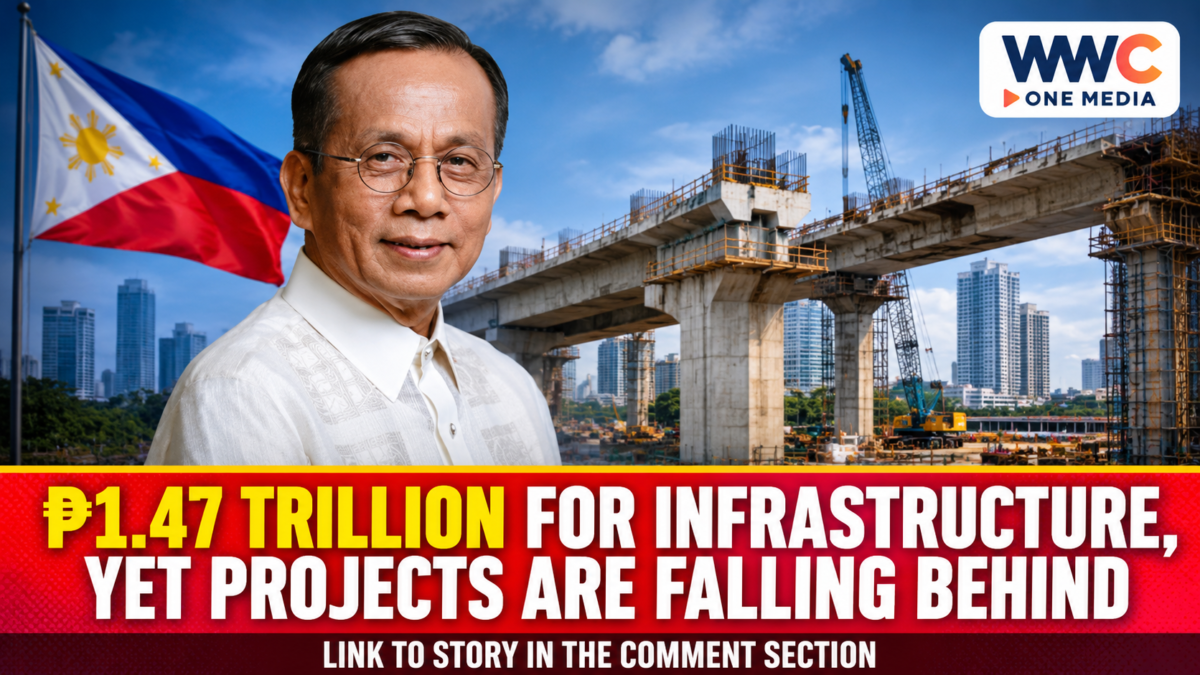
The Philippine government is preparing a massive infrastructure spending programme for 2027, but the country’s latest economic figures highlight a growing challenge: turning approved budgets into completed roads, bridges, railways and other projects that can support economic growth.
The Department of Budget and Management (DBM) has proposed ₱1.47 trillion for the Build Better More Infrastructure Program in 2027, equivalent to 4.4% of gross domestic product (GDP). Yet Philippine Statistics Authority (PSA) data show that construction contracted by 4% in the third quarter of 2026, while general government construction activities declined by 15.1%.
The contrast raises an important question about the country’s development strategy. Increasing infrastructure allocations can create opportunities for economic expansion, but the benefits depend on whether government agencies can implement projects on schedule, manage public funds effectively and deliver infrastructure that businesses and communities can actually use.
For an economy struggling with weaker growth, infrastructure implementation is becoming more than a government spending issue. It is also a question of productivity, employment, investment confidence and the country’s ability to sustain its economic recovery.
Infrastructure spending faces an implementation challenge
The government’s proposed 2027 infrastructure allocation reflects its continued commitment to large-scale public investment.
In an Aug. 27, 2026 announcement, the DBM disclosed that the administration was proposing ₱1.47 trillion for the Build Better More programme, up from ₱1.29 trillion under the 2026 General Appropriations Act.
The proposed increase amounts to ₱178 billion, or 13.8%.
The proposed allocation includes funding for major infrastructure projects across Luzon, Visayas and Mindanao.
However, a larger budget does not automatically translate into faster construction or completed infrastructure.
Projects must pass through several stages, including feasibility studies, detailed engineering, procurement, right-of-way acquisition, permits and funding arrangements.
A delay in any of these stages can affect the entire implementation schedule.
Recognising these concerns, the DBM said infrastructure proposals for the 2027 National Expenditure Program underwent evaluation based on project maturity, implementation readiness, agencies’ capacity to spend and expected public benefits.
The department also requires supporting documents covering feasibility, engineering, procurement and right-of-way requirements.
These safeguards are important because the government must ensure that projects receiving public funding are sufficiently prepared for implementation. Department of Budget and Management+1
Construction contraction exposes the economic cost of delays
The latest national accounts show why infrastructure implementation matters to the wider economy.
The PSA reported that construction contracted by 4% year on year in the third quarter of 2026.
More significantly, general government construction activities declined by 15.1% during the same period.
The weakness contributed to industry’s overall contraction of 0.003%.
Gross capital formation, which measures investment in productive assets and changes in inventories, also contracted by 0.2%.
Construction is an important component of capital formation because it includes investment in buildings and other physical infrastructure.
When public construction slows, the effects can extend beyond government contractors.
Suppliers of cement, steel, electrical equipment, machinery and construction materials may experience weaker demand. Transport operators, engineering firms and businesses providing project-related services can also feel the impact.
Construction employment and related economic activities may likewise be affected when projects are postponed.
The figures do not establish that every infrastructure delay caused the third-quarter contraction. Economic performance reflects several factors, including private investment, household demand, financing conditions and production activity.
Nevertheless, the weakness in government construction demonstrates why project implementation deserves closer attention. Philippine Statistics Authority+1
Five flagship projects illustrate the scale of public investment
The proposed 2027 budget identifies several major Infrastructure Flagship Projects that demonstrate the government’s spending priorities.
Among them are:
1. Laguna Lakeshore Road Network Project
The proposed allocation is ₱35.21 billion. The project involves a 37.6-kilometre primary road connecting Lower Bicutan to Calamba, with completion targeted for 2028.
2. Bataan-Cavite Interlink Bridge Project
The proposed allocation is ₱22.49 billion for a 32.15-kilometre, four-lane bridge across Manila Bay, connecting Mariveles, Bataan, and Naic, Cavite.
3. Davao City Bypass Construction Project, Package I
The proposed allocation is ₱11.96 billion for an ongoing Japan-assisted project involving a 45.5-kilometre, four-lane bypass road. Completion is targeted for 2028.
4. Cebu-Mactan Bridge and Coastal Road Construction Project
The proposed allocation is ₱8.57 billion. The project covers a 3.34-kilometre bridge and a 5.34-kilometre Mandaue Coastal Road, with completion targeted for 2030.
5. Pasig-Marikina River Channel Improvement Project, Phase IV
The proposed allocation is ₱8.54 billion for an ongoing Japan-assisted water resources project covering the National Capital Region and Region IV-A.
These projects demonstrate the geographical reach and financial scale of the government’s infrastructure ambitions.
They also highlight why timely implementation matters. A delayed bridge can postpone improvements in regional connectivity, while delayed flood-control infrastructure can defer its intended contribution to disaster preparedness.
The completion dates and project allocations remain important benchmarks for monitoring government performance. Department of Budget and Management
Why infrastructure delays can become more expensive
Infrastructure projects are exposed to changing construction costs, financing conditions and implementation requirements.
When completion schedules move, project proponents may need to reassess their original budgets.
Construction materials, labour, equipment and other inputs can become more expensive over time.
Changes in project design or site conditions may also require additional engineering work and adjustments to implementation plans.
For large projects, even relatively small cost increases can translate into substantial additional funding requirements.
There is also an opportunity cost.
A road that remains unfinished cannot deliver its intended travel-time savings. A delayed bridge cannot provide the connectivity benefits expected by businesses and commuters.
The same principle applies to irrigation, flood-control facilities and transport systems.
The longer a project takes to become operational, the longer communities must wait for its intended economic and social benefits.
This is why project monitoring should measure more than the amount of money allocated or released.
Actual physical accomplishment, procurement progress, financial utilisation and completion milestones are equally important.
Government acknowledges the need for faster implementation
The DBM’s own 2027 Budget Priorities Framework identifies timely implementation of Infrastructure Flagship Projects as a government priority.
The framework specifically calls for addressing implementation constraints and institutional bottlenecks to improve project execution rates.
It also emphasises climate resilience, sustainability and disaster risk reduction in infrastructure planning and design.
These priorities suggest that the government’s infrastructure challenge involves both funding and administrative capacity.
A project may have an approved budget but still encounter difficulties involving land acquisition, permits, procurement or coordination between implementing agencies.
Addressing these problems requires cooperation among departments, local government units, contractors and financing institutions.
The Department of Public Works and Highways (DPWH) also maintains an online transparency portal where the public can examine infrastructure contract information, including project costs, implementing offices, contractors, accomplishments and completion dates.
Such monitoring mechanisms can help strengthen public accountability by making project implementation easier to examine.
However, transparency must be accompanied by timely action when projects fall behind their approved schedules. DPWH Infrastructure Portal+1
What happens next
The proposed 2027 infrastructure programme will need to pass through the national budget process before its allocations become authorised spending under the General Appropriations Act.
Once funding is approved, implementing agencies must translate their budget allocations into procurement activities, construction milestones and completed projects.
The government’s performance should therefore be evaluated through actual implementation results rather than headline budget figures alone.
The next important indicators will include the pace of public construction, capital formation, infrastructure contract accomplishments and the progress of major flagship projects.
For the Philippines, the stakes are significant.
Infrastructure can improve transportation, reduce logistics costs, support regional development and strengthen disaster resilience.
But these benefits cannot be fully realised while major projects remain delayed or unfinished.
The country has committed substantial public resources to its infrastructure ambitions. The real test now is whether the government can turn those commitments into completed projects that deliver measurable benefits to Filipinos.
With economic growth weakening and public construction contracting, the question is no longer simply how much the government plans to spend.
It is whether the Philippines can finally deliver the infrastructure its economy needs.