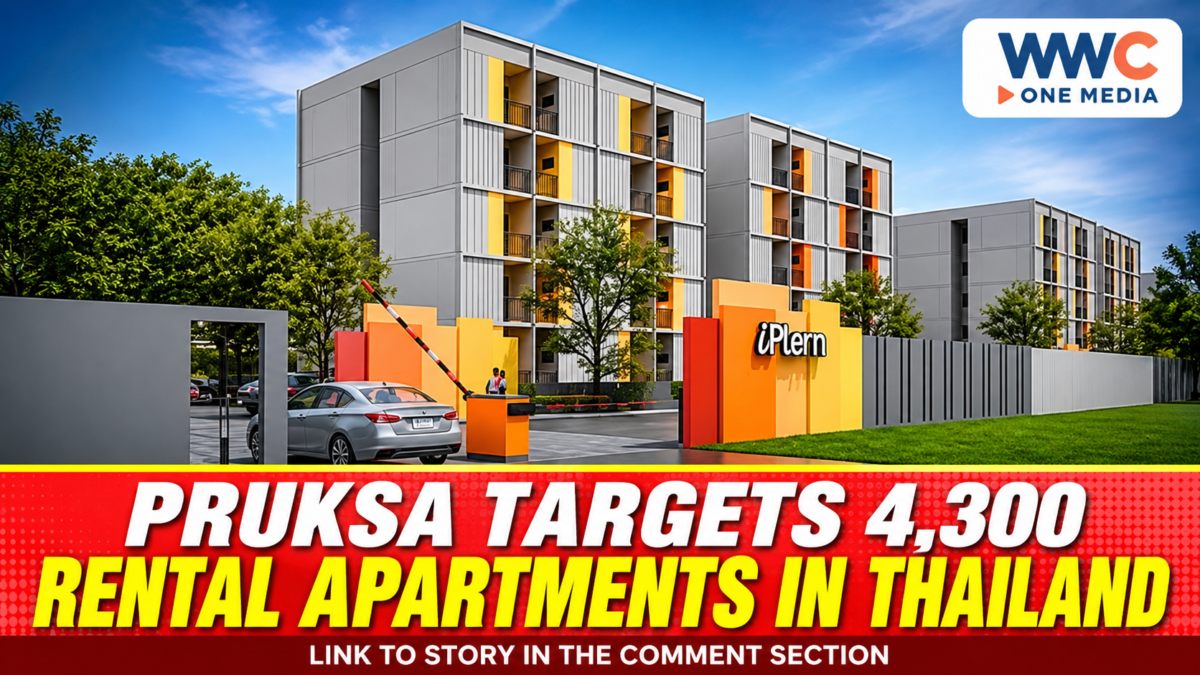
Thailand’s Pruksa Holding is expanding into rental housing with a plan to develop 4,300 apartment rooms across 60 buildings, positioning its iPlern brand as a new source of recurring income. In a company announcement dated Aug. 14, 2026, the property group said six buildings were already operating at full occupancy, with additional openings planned through the second half of 2026 and into 2027. psh.co.th+1
The expansion comes as Pruksa works to diversify its business beyond selling houses and condominiums. Instead of relying only on property transfers and new project launches, the company wants a larger portfolio of assets that can generate rental income over time.
The plan also offers a glimpse of how established developers are approaching the housing market: building or converting assets for long-term use, rather than depending entirely on buyers who must qualify for home loans.
iPlern’s 4,300-room plan is the actual target
Pruksa’s Aug. 14 announcement sets out the scale of its initial iPlern Branded Apartment development: 60 buildings containing 4,300 rooms across six strategic locations.
The company identified three broad markets for its rental apartments: employment centres, educational areas and the Eastern Economic Corridor (EEC). The intended tenants include different income and employment groups, with the portfolio designed to serve a range of rental needs.
The announced monthly rental range is 3,000 baht to 10,000 baht. That places the planned apartments in a segment aimed at tenants seeking lower-cost accommodation rather than premium condominium living.
Pruksa reported that six buildings were already operating as of the announcement. These comprised two buildings in Rangsit, three in Lam Luk Ka and one in Bo Win, with occupancy reported at 100%.
The company also outlined a construction and opening schedule: another 34 buildings were planned for the second half of 2026, followed by 20 buildings in 2027. Those figures describe the announced programme, not confirmation that every scheduled building has since opened. psh.co.th+1
Why a property developer wants more tenants
Pruksa Holding’s move reflects a change in how the group wants to earn money from its property portfolio.
Its traditional real estate business develops houses, townhouses and condominiums for sale. Rental apartments operate differently: instead of receiving most of the income when a property is sold, the owner or operator collects payments from tenants over the lease period.
That can create a more regular revenue stream, although it also requires ongoing property management, maintenance, tenant acquisition and attention to occupancy levels.
Pruksa’s corporate website identifies IPLERN Company Limited, which operates under the iPlern name, as a subsidiary of Inno Home Construction (IHC). The rental real estate business is part of the group’s wider effort to generate recurring and sustainable income. Pruksa Holding (PSH)
The company is also developing other rental property formats, including warehouses and office space. These are intended to serve businesses such as e-commerce operators, logistics companies, SMEs, startups and franchise operators.
The broader strategy is therefore not limited to residential apartments. Pruksa is seeking to make more productive use of its property and construction capabilities through assets that can earn income over time.
The rent range and occupancy figures show the business model
The 3,000-baht-to-10,000-baht monthly rental range is a key part of iPlern’s positioning.
A lower rental price can make accommodation accessible to workers and students near employment and education centres. A wider range also allows the company to serve tenants with different budgets and housing requirements.
But affordability alone does not determine whether an apartment business is successful. Location, transport access, building condition, utilities, security and property management all influence whether tenants stay and whether rooms remain occupied.
The six operating buildings reported as fully occupied provide an early indication of demand at those locations. They do not, by themselves, establish that the same occupancy level can be sustained across the planned 60-building portfolio.
Pruksa has forecast a net yield of approximately 7% to 8% for iPlern. This is the company’s stated expectation, not a guaranteed return or an independently verified result. Actual performance will depend on rental collections, operating expenses, maintenance, financing and the pace at which new buildings become occupied. psh.co.th
Pruksa is reshaping its business as housing sales face pressure
The rental expansion is taking place alongside a broader portfolio adjustment.
In its 2025 financial review, Pruksa described a difficult residential market in Bangkok and surrounding provinces. The company cited slow economic growth, rising living costs, high household debt and tighter mortgage approvals as factors affecting homebuyers.
Its filing also reported that the total value of residential presales in Bangkok and surrounding provinces declined by 17% year on year in 2025. Condominium presales fell by 23%, while townhouse presales declined by 15%. Market SEC
Those conditions help explain why a developer may seek income beyond traditional residential sales. When potential buyers struggle to secure financing, rental housing can serve a different customer group: people who need a place to live but are not ready or able to purchase a property.
Pruksa’s own six-month 2026 listed-company snapshot shows that recurring-income businesses, including rental apartments and smart warehouses, have become part of its reported business portfolio. The snapshot recorded total revenue of 7,548.78 million baht and net profit of 197.39 million baht for the first half of 2026. LSS Media+1
For readers following the wider housing market, WWC has examined how Filipino Millennials and Gen Z are reassessing the choice between renting and homeownership. The circumstances differ between Thailand and the Philippines, but the affordability question is relevant to both markets.
What the expansion could mean for Thailand’s rental market
If Pruksa delivers the planned buildings and maintains occupancy, iPlern could give the group a larger recurring-income base while adding rental supply in selected employment and education locations.
For tenants, the potential benefit is additional accommodation at a stated monthly price range below many premium urban rental offerings. The practical value, however, will depend on where the buildings are located and what tenants receive for the rent they pay.
For the company, the challenge is operational. A portfolio of 60 buildings requires consistent maintenance, leasing, tenant services and cost control. A building that is completed but remains vacant does not generate the rental income expected from an occupied property.
The strategy also needs to be viewed alongside the wider property market. WWC previously examined the proposal to turn unsold condominium inventory into more affordable homes in the Philippines. That is a different market and a different business model, but it illustrates the importance of matching available housing with what households can afford.
Another relevant issue is the risk developers face when demand weakens. WWC has also reported on cancelled condominium purchases and the pressure on Metro Manila’s residential inventory. Pruksa’s rental strategy is not a direct response to that Philippine situation, but it provides a useful comparison of how property companies can diversify their income sources.
What happens next?
The next milestone is whether Pruksa delivers the additional buildings within its announced schedule.
The company’s August statement planned 34 more buildings for the second half of 2026 and another 20 in 2027. Updated disclosures will be needed to establish how many have actually opened, how many rooms are available and whether occupancy has been sustained beyond the initial six buildings.
The other key measure will be financial performance. Investors and tenants alike will have reason to watch whether rental collections support the company’s projected yield after operating and maintenance costs.
Pruksa’s 4,300-room plan is a significant expansion of its rental-housing business. But its long-term success will depend less on the number of buildings announced than on whether those buildings remain occupied, well-managed and financially sustainable.
Frequently Asked Questions
1. How many rental apartments is Pruksa planning?
Pruksa announced an initial plan for 4,300 rental rooms across 60 buildings under its iPlern Branded Apartment business.
2. How much will iPlern apartments cost to rent?
The company announced an approximate monthly rental range of 3,000 baht to 10,000 baht, depending on the apartment and location.
3. Where are Pruksa’s iPlern apartments located?
The first six operating buildings identified in the company announcement were in Rangsit, Lam Luk Ka and Bo Win. The wider plan covers six strategic locations, including employment and education centres and the Eastern Economic Corridor.
4. Are all 60 iPlern buildings already operating?
No. The Aug. 14 announcement said six buildings were operating, with 34 more planned for the second half of 2026 and 20 for 2027. The schedule should not be mistaken for confirmation that all buildings have opened.
5. What rental return does Pruksa expect from iPlern?
Pruksa forecast a net yield of approximately 7% to 8%. This is a company projection, not a guaranteed return or confirmation of the portfolio’s realised performance.