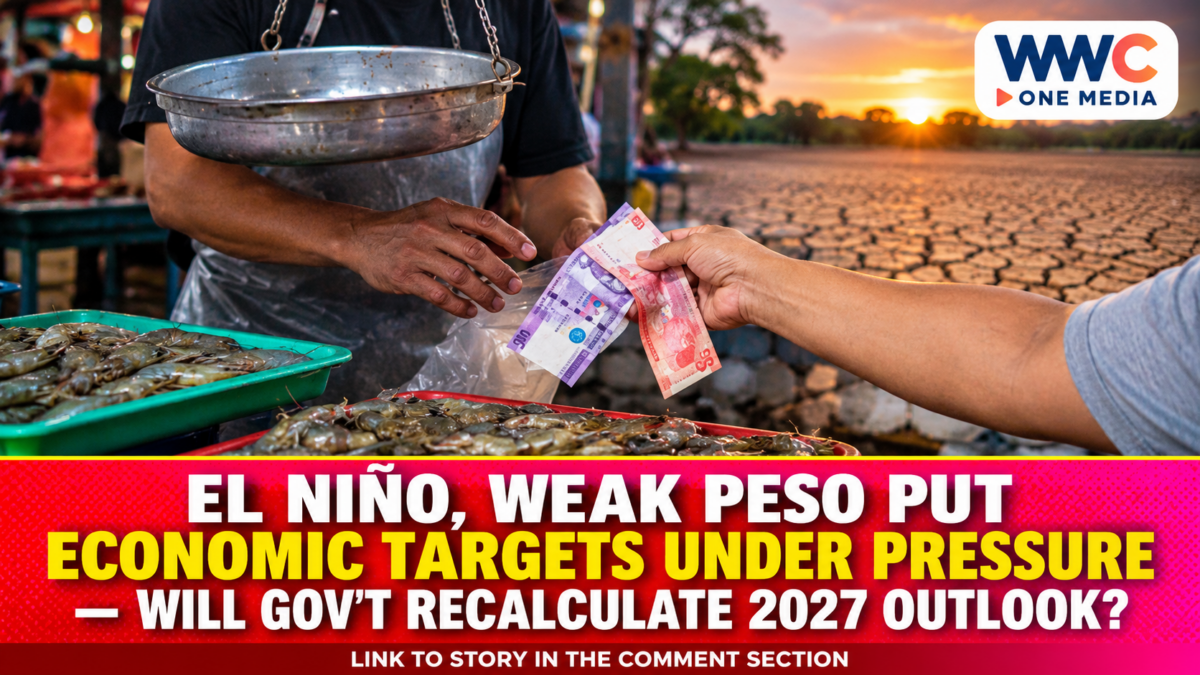
The Philippine government’s economic assumptions are facing a tougher test as a very strong El Niño threatens agricultural production and the peso trades beyond the exchange-rate range used in the country’s medium-term fiscal projections.
The developments are important for the Development Budget Coordination Committee (DBCC), which sets the government’s economic growth assumptions, inflation forecasts, exchange-rate projections and fiscal parameters used in national budget planning.
As of Nov. 16, 2026, the official projections published by the government still provide for economic growth of 3.5% to 4.5% in 2026 and 5% to 6% annually from 2027 to 2030. But the latest inflation, currency and climate indicators raise questions about whether those assumptions adequately reflect the risks confronting the economy. Department of Budget and Management+3
The issue goes beyond adjusting numbers on a government spreadsheet. Economic assumptions influence how much revenue the government expects to collect, how much it can spend, how it manages borrowing and how it prepares assistance for sectors exposed to higher prices and climate-related disruptions.
The DBCC’s Existing Projections Face a Different Economic Environment
The DBCC’s 193rd meeting, whose updated assumptions were published on July 8, 2026, approved a medium-term economic programme covering 2026 to 2030.
Under that framework, the Philippines was expected to achieve:
- 2026 GDP growth: 3.5% to 4.5%.
- 2027 GDP growth: 5% to 6%.
- 2026 inflation: 6% to 7%.
- 2027 inflation: 4% to 5%.
- 2026 to 2030 exchange-rate assumption: ₱60 to ₱62 against the US dollar.
These figures are planning assumptions, not guaranteed economic outcomes.
The government also projected that economic growth would recover after moderating in 2026, while inflation would gradually ease over the following years.
However, the economic environment has since presented additional challenges, particularly the combination of elevated consumer prices, currency pressure and worsening climate conditions. Department of Budget and Management+2
For policymakers, the question is whether the existing assumptions remain sufficiently realistic to guide spending and revenue decisions.
The Peso Has Moved Beyond the Government’s Exchange-Rate Assumption
One of the clearest indicators of the changing economic environment is the Philippine peso.
The Bangko Sentral ng Pilipinas (BSP) reported a peso equivalent of ₱63.5590 per US dollar on Nov. 13, 2026.
That level was above the DBCC’s ₱60-to-₱62 exchange-rate assumption for 2026 and the succeeding years.
The distinction matters because the exchange rate influences the cost of imported commodities, fuel, industrial inputs and other products purchased using foreign currencies.
A weaker peso can increase the local-currency cost of imported goods, particularly when international prices remain elevated.
Businesses that depend on imported machinery, raw materials and production equipment may also face higher operating expenses.
For households, the effects can eventually reach retail prices, depending on the extent to which companies pass higher costs on to consumers.
However, the Nov. 13 exchange rate is a particular day’s reference figure, while the DBCC assumption represents an annual average. The two should not be treated as identical measurements.
Nevertheless, the difference provides an important reason for economic planners to reassess the external conditions underlying their projections. Bangko Sentral ng Pilipinas+1
Very Strong El Niño Could Complicate the 2027 Growth Recovery
The climate situation adds another layer of uncertainty.
In its Nov. 4, 2026 press release, the Philippine Atmospheric, Geophysical and Astronomical Services Administration (PAGASA) confirmed that a very strong El Niño was present in the tropical Pacific.
The agency expected the phenomenon to persist until the first half of 2027, potentially reaching its peak by the end of 2026.
Its October assessment identified five provinces experiencing meteorological drought, 11 provinces under dry spell conditions and 10 provinces experiencing dry conditions.
For November, PAGASA expected below-normal to way-below-normal rainfall over most parts of the country.
Several provinces could also experience meteorological drought or dry-spell conditions before the end of the month. Pagasa+1
These conditions could affect agricultural output, particularly in communities dependent on rainfall and irrigation.
Lower agricultural production can reduce farmers’ incomes, disrupt food supply chains and contribute to higher prices for certain commodities.
The effects are not limited to agriculture. Water shortages can affect manufacturing, electricity generation and other economic activities that depend on reliable water supplies.
WWC ONE MEDIA previously examined the agricultural risks in its report on Central Visayas’ potential ₱490-million agricultural losses as El Niño intensifies.
The situation also highlights why local preparedness matters. In Cebu, water conservation and efforts to reduce distribution losses have become part of the response to possible supply disruptions.
For the national economy, prolonged dry conditions could make the government’s projected recovery more difficult if agricultural production and related economic activities weaken.
Inflation Is Another Major Concern for Economic Planners
The pressure on the peso and the threat of reduced agricultural output come as inflation remains elevated.
The BSP’s published economic indicators placed October 2026 inflation at 7.8%, above the DBCC’s 6% to 7% inflation assumption for the full year.
The comparison requires some caution because the DBCC figure is an annual-average projection, while the October figure represents inflation for a particular month.
Even so, the latest reading indicates that price pressures remain a significant concern for households and businesses.
Food prices deserve particular attention because prolonged rainfall deficits can affect agricultural production, transportation requirements and the availability of certain commodities.
Higher imported costs can also contribute to domestic inflation when businesses adjust their prices to reflect more expensive inputs.
On Nov. 13, the BSP’s Monetary Board increased its target reverse repurchase rate by 50 basis points to 5.50%.
The overnight deposit and lending facility rates were adjusted to 5% and 6%, respectively.
The monetary policy adjustment was intended to tighten financial conditions and contain inflationary pressures. Bangko Sentral ng Pilipinas+1
This creates an additional challenge for economic planning.
Higher interest rates can help manage inflation expectations, but they can also increase borrowing costs for businesses and households.
The government must therefore consider how inflation control, investment activity and economic growth interact when reviewing its fiscal and economic assumptions.
For additional context, WWC ONE MEDIA previously examined the Philippines’ weakening growth outlook and rising inflation.
Why Revisiting Economic Assumptions Matters
The DBCC’s projections influence more than the government’s headline growth target.
They help establish the financial framework used in preparing national budgets, estimating tax collections and determining how much the government can allocate to public programmes.
For example, a weaker peso could change assumptions about imported goods, foreign-currency obligations and government procurement costs.
Meanwhile, higher inflation could affect the purchasing power of budget allocations, particularly for programmes involving food assistance, infrastructure and public services.
A prolonged El Niño could also require additional government spending for agricultural support, irrigation, water management and disaster preparedness.
These pressures could affect the government’s fiscal position if spending requirements increase while economic activity and revenue collections fall short of expectations.
The Department of Budget and Management’s fiscal projections already recognise the importance of balancing government spending with deficit reduction.
The July DBCC programme projected a fiscal deficit equivalent to 5.4% of GDP in 2026, declining gradually to 3.5% by 2030.
Maintaining that path while responding to climate and economic shocks will require careful spending decisions. Department of Budget and Management+1
A review of assumptions would not necessarily mean that the government must abandon its longer-term growth ambitions.
Instead, it would allow policymakers to determine whether the current projections adequately reflect changing economic conditions and whether additional adjustments are needed to preserve fiscal credibility.
What Happens Next?
The next important development will be whether the DBCC formally updates its macroeconomic assumptions and fiscal programme in response to the latest economic indicators.
As of Nov. 16, the publicly available July 8 DBCC statement remains the official basis for the figures discussed in this report. No subsequent approved revision was identified in the primary records reviewed.
The government will need to consider several indicators in its next assessment:
- The peso’s performance against the US dollar.
- Monthly inflation and food-price movements.
- Agricultural production and the extent of El Niño-related damage.
- Actual economic growth and government revenue collections.
- The fiscal requirements of climate adaptation and emergency assistance.
The coming months will be important because PAGASA expects the very strong El Niño to persist into the first half of 2027.
The central challenge is ensuring that economic projections remain realistic enough to support responsible budget planning without undermining the country’s longer-term development objectives.
Frequently Asked Questions
1. What is the DBCC?
The Development Budget Coordination Committee is the government body responsible for coordinating macroeconomic assumptions, growth targets and fiscal programmes used in national budget planning.
2. What is the Philippines’ economic growth target for 2026?
The DBCC’s published target is 3.5% to 4.5% GDP growth for 2026.
3. What peso exchange rate did the DBCC assume?
The July 2026 DBCC projections used an exchange-rate assumption of ₱60 to ₱62 per US dollar from 2026 through 2030.
4. How could El Niño affect the Philippine economy?
Prolonged rainfall deficits could affect agricultural production, water availability, food supply and industries that depend on reliable water resources.
5. Has the DBCC officially changed its 2027 economic targets?
No subsequent approved revision was identified in the official records reviewed as of Nov. 16, 2026. The published 2027 GDP growth target remains 5% to 6%.