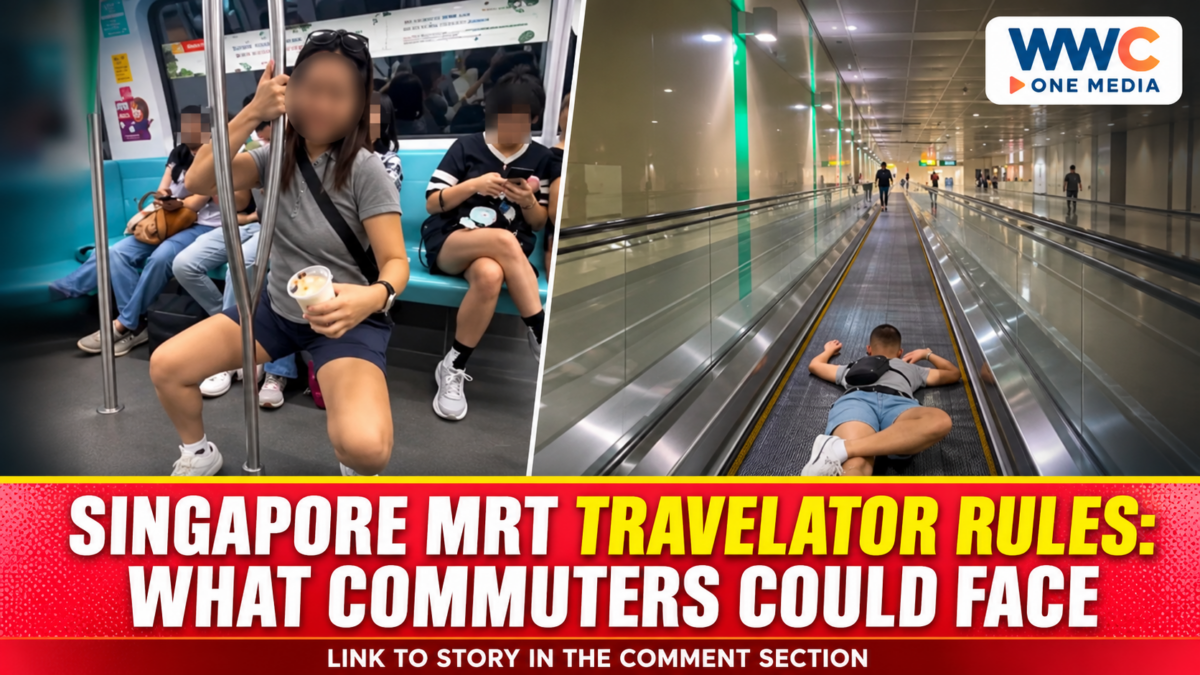
Singapore’s public transport rules place clear limits on how commuters can use escalators and travelators, with violations carrying fines of up to S$500 under the Rapid Transit Systems Regulations.
The rules are drawing attention amid online discussions surrounding videos of unusual behaviour on Singapore’s public transport network. However, the circumstances surrounding the latest circulating footage, including the identity of the person involved and where and when it was recorded, have not been independently established through an official statement.
The distinction matters. A video circulating online does not automatically establish that a person has committed an offence, and allegations about an individual’s identity should not be treated as confirmed information.
Nevertheless, Singapore’s existing transport regulations provide a clear explanation of what passengers are allowed to do on moving walkways and why certain behaviour can result in enforcement action.
What Singapore’s Travelator Rules Actually Prohibit
Regulation 23 of Singapore’s Rapid Transit Systems Regulations specifically addresses the misuse of escalators and travelators within railway premises.
Under the provision, passengers cannot sit on the steps or pallets of moving equipment without reasonable excuse. They are also prohibited from sitting or riding on the handrails.
The regulation further requires passengers to use the equipment for its intended purpose: travelling from one end to the other using the escalator stairway or travelator pallet.
Travelling against the direction of a moving escalator or travelator is also prohibited.
These provisions are important because travelators are designed to move passengers safely through transport facilities, not to serve as platforms for activities that could interfere with their operation.
A passenger who uses the equipment outside its intended function may create unnecessary risks for themselves and other commuters.
Could a Travelator Stunt Lead to a Fine?
<PRIVATE_PERSON>Singapore’s Rapid Transit Systems Regulations provide for a maximum fine of S$500 for offences involving the misuse of escalators and travelators.
The penalty is not automatic simply because a video attracts attention online. Authorities would need to establish the relevant circumstances and determine whether an offence under the regulations had occurred.
The distinction between unusual behaviour and an actual regulatory violation is important.
For example, Regulation 23 identifies specific prohibited actions, including sitting on the moving surface or riding on the handrail. The legal assessment must therefore be based on the conduct established by the evidence rather than assumptions made by viewers.
The regulations also contain a separate provision addressing passengers who cause nuisance on railway premises.
This gives transport authorities a framework for dealing with behaviour that affects the commuting environment.
Singapore Is Strengthening Its Approach to Commuter Behaviour
Singapore’s approach to public transport conduct extends beyond the operation of escalators and travelators.
In a March 5, 2025, announcement, the Land Transport Authority said it would strengthen enforcement against nuisance and disruptive behaviour across the public transport network.
The initiative followed the progressive introduction of additional signage beginning in December 2024.
The signs encourage passengers to maintain reasonable noise levels, occupy only one seat and avoid sitting on train floors.
The authority also explained that commuters displaying prohibited nuisance behaviour could receive a Notification of Offence under the Rapid Transit Systems Regulations.
For each prohibited act covered by the relevant enforcement framework, the maximum penalty is S$500. More serious offences, including soiling railway premises, carry a maximum penalty of S$5,000.
Public transport operators may also remove disruptive commuters or involve the police in more serious situations.
The policy reflects an important principle: public transport facilities are shared spaces, and individual behaviour should not compromise the comfort and safety of other passengers.
Is Filming Videos on Singapore’s MRT Allowed?
Filming at public transport facilities is not automatically prohibited in Singapore.
In an Aug. 5, 2024, media reply, the Land Transport Authority clarified that photography and videography are generally permitted at MRT stations, trains and bus interchanges.
However, individuals must ensure that their activities do not interfere with transport operations, inconvenience other commuters or violate their privacy.
The authority also explained that transport staff may conduct checks when there are concerns about operational security or potentially malicious activities.
Where necessary, staff may stop filming activities and request the deletion of photographs or video recordings.
There is also an important distinction involving commercial content.
Individuals intending to use photographs or videos for commercial or other non-personal purposes must obtain prior written approval from the relevant public transport operators.
This means that content creation can take place within public transport facilities, but it does not give individuals unrestricted permission to interfere with equipment or inconvenience passengers.
Why Travelator Safety Deserves More Attention
Moving walkways are commonly treated as ordinary conveniences, particularly in busy transport facilities where passengers are trying to reach connecting platforms, exits and other destinations.
However, their moving surfaces and mechanical components require passengers to use them appropriately.
Sitting, lying down or engaging in activities outside the equipment’s intended purpose can introduce avoidable hazards.
Loose clothing, bags and other personal belongings can also become concerns around moving machinery.
From a public safety perspective, the issue is not whether an activity attracts attention or becomes popular on social media. The more important consideration is whether it creates risks or interferes with the movement of other passengers.
Singapore’s transport regulations provide a legal framework for addressing such situations without relying on online criticism to determine responsibility.
What Happens Next
The circumstances surrounding the latest circulating footage remain unverified through publicly available official records reviewed for this report.
No conclusion should therefore be drawn about the identity of the person shown, whether the footage depicts the same individual involved in an earlier incident, or whether authorities have initiated an investigation into the latest video.
What is established is that Singapore already has regulations governing the proper use of travelators and escalators.
Commuters are expected to use these facilities for their intended purpose, avoid obstructing other passengers and follow transport safety requirements.
For anyone travelling through Singapore’s MRT network, the message is straightforward: moving walkways are transport facilities, not recreational equipment.
Following the rules helps protect both individual passengers and everyone sharing the journey.