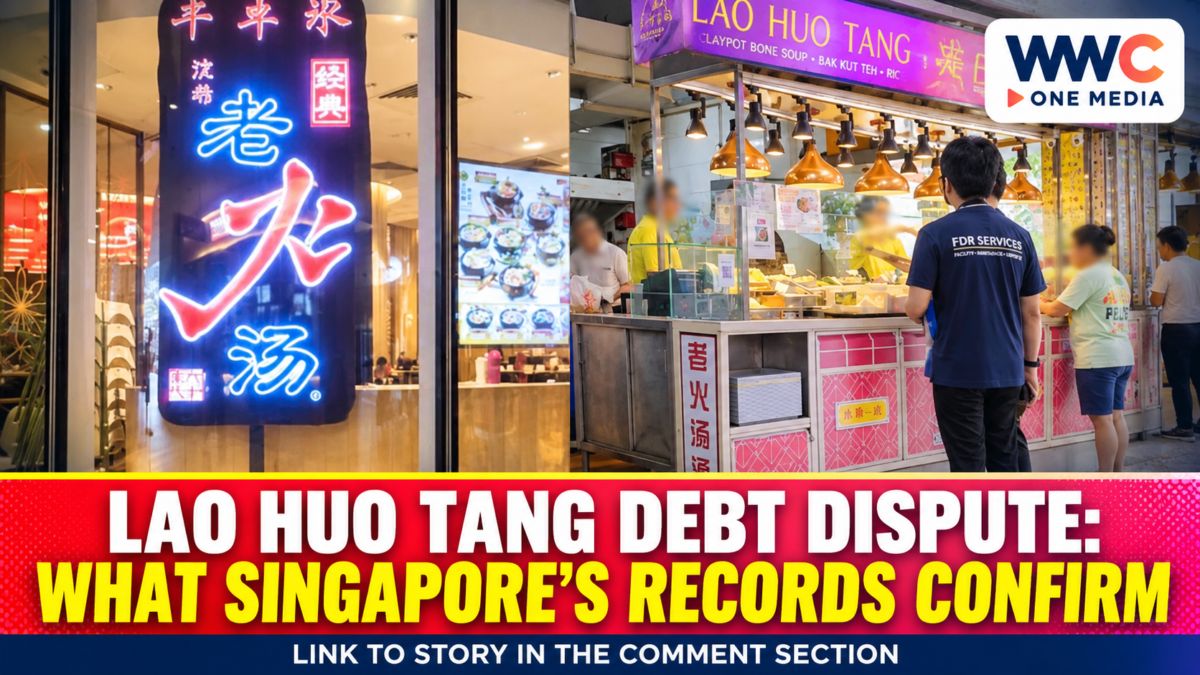
The growing debt dispute involving Singapore’s Lao Huo Tang restaurant group raises important questions about supplier payments, business accountability and the legal process for recovering commercial debts. But there is a distinction that readers need to understand: a debt collection claim is not the same as a debt established by a court.
The reported claims involving suppliers and debt recovery agencies should not be presented as proven liabilities of Lao Huo Tang, its founder, or any individual company without supporting invoices, company acknowledgements, court judgments or other primary evidence.
Singapore has a regulatory framework governing third-party debt collection. The Debt Collection Act 2022 took effect on Dec. 1, 2023, introducing licensing requirements for debt collection businesses and approval requirements for individuals working as debt collectors. Ministry of Home Affairs+1
What Singapore’s debt collection law requires
The Ministry of Home Affairs explained that the law was introduced to regulate the debt collection industry, establish entry standards and provide enforcement measures against problematic conduct.
Under the framework, companies carrying out debt collection activities generally need a valid police licence unless they fall within an exemption or class-licensing arrangement. Individuals deployed by licensed debt collection companies must also obtain police approval.
The Singapore Police Force explains that debt collection activity includes finding a debtor and requesting, demanding or collecting money owed. This means the regulatory framework covers more than simply sending payment reminders. Ministry of Home Affairs+1
Why an agency’s claim is not a court judgment
Commercial suppliers may pursue unpaid invoices through negotiations, lawyers, debt recovery companies or court proceedings.
However, the amount a creditor or recovery agency says is outstanding does not automatically establish that the named company owes that amount. The underlying contracts, invoices, delivery records, payment history and identity of the contracting parties matter.
This distinction is particularly important when several companies operate under connected brands. A business relationship, shared management or common branding does not by itself establish that one company is legally responsible for another company’s obligations.
For readers, the central question is not simply how much a recovery agency says it is pursuing. It is whether the relevant legal entity has acknowledged the liability or whether a court has determined it.
The difference between debt recovery and winding up
A creditor may seek to recover an unpaid commercial debt without immediately asking a court to wind up a company.
Winding up is a separate legal process. It places the company into liquidation, with a liquidator administering its affairs and dealing with creditor claims under the applicable insolvency rules.
That distinction matters because a winding-up order involving one company does not automatically mean every business associated with the same restaurant group is insolvent or must close.
The legal status of each company must be assessed separately. A parent company, subsidiary, brand operator and individual director do not automatically share the same liabilities.
What the law means for businesses and suppliers
Singapore’s licensing framework places obligations on third-party debt collection businesses. It also provides a regulatory route for dealing with misconduct by companies and collectors.
The Ministry of Home Affairs said the legislation allows authorities to take action against regulatory breaches, including suspension or revocation of licences and cancellation of approvals. Ministry of Home Affairs+1
For suppliers, the practical lesson is the importance of maintaining complete documentation. Purchase orders, delivery confirmations, invoices, payment terms and written communications can help establish the identity of the buyer and the amount being claimed.
For restaurant operators, clear company structures and accurate financial records are equally important. When several businesses operate under related brands, suppliers need to know which legal entity is placing orders and responsible for payment.
The wider food-and-beverage sector has also faced business restructuring and operating challenges. WWC has previously examined Crystal Jade’s receivership and the distinction between receivership and liquidation, financial and compliance questions involving Mary Chia Holdings and payment and management issues at Haus Coffee. These are separate cases, but they illustrate why business obligations and the legal identity of each company matter.
What happens next
The key documents needed to establish the specific Lao Huo Tang supplier claims include the original invoices, purchase agreements, delivery records, written acknowledgements of outstanding balances and any court filings or judgments addressing the disputed amounts.
Without those records, the reported figures should remain attributed claims rather than established debts.
The same standard applies to any claim involving an individual director or founder. A person’s position in a company does not, by itself, prove personal responsibility for that company’s commercial obligations.
Frequently asked questions
1. Does a debt collector’s claim prove that a company owes money?
No. A claim must be supported by relevant records and may be disputed. A debt collector’s reported figure is not automatically a court-established liability.
2. Does Singapore regulate debt collection companies?
Yes. The Debt Collection Act 2022 took effect on Dec. 1, 2023. It established licensing requirements for debt collection businesses and approval requirements for debt collectors, subject to applicable exemptions and class-licensing arrangements. Ministry of Home Affairs+1
3. Can a restaurant company’s debts automatically become its owner’s personal debts?
No. Personal responsibility depends on the applicable legal basis and evidence. Being a director or shareholder does not automatically make someone personally liable for every company debt.
4. Does winding up one company mean an entire restaurant group must close?
No. A winding-up order applies to the specific legal entity named in the proceedings. Other companies must be assessed separately.
5. What documents can establish an unpaid supplier debt?
Relevant documents may include signed agreements, purchase orders, invoices, delivery confirmations, payment records, written acknowledgements and court decisions.