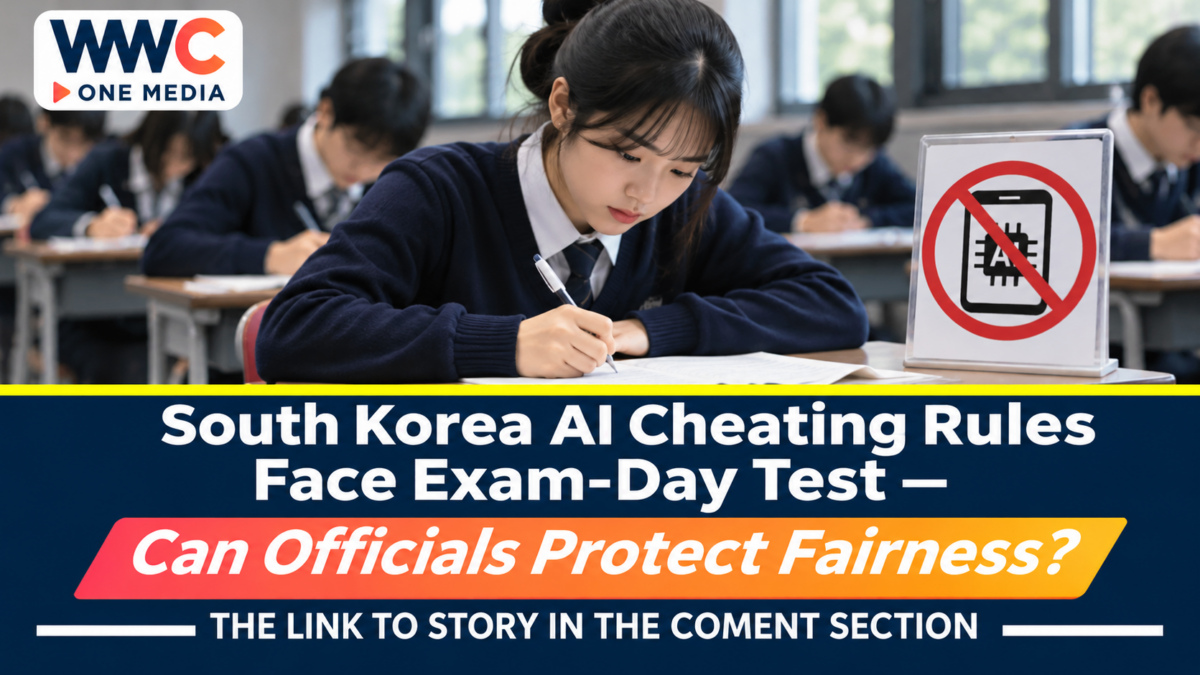
SEOUL, Nov. 15, 2026 — South Korea’s Ministry of Education has warned candidates that smart glasses, mobile phones and other prohibited electronics can invalidate their national college entrance examination, scheduled for Nov. 19. The ministry’s newly published guidance comes amid public accounts of an artificial-intelligence-assisted cheating confession in a separate professional examination, but the original police statement and complete first-person recording were not independently obtained for this report.
That distinction matters. The government’s published restrictions and the scheduled university entrance exam are established facts. The identity, precise scores, methods and criminal liability of the candidate discussed in the latest reports remain matters requiring direct documentation, not conclusions to be borrowed from news coverage.
South Korea AI Cheating Rules Are Explicit About Devices
In a Nov. 6 public information notice, the education ministry distinguished between using or wearing a smart device during the College Scholastic Ability Test and merely bringing or possessing a prohibited device. It said the former can invalidate the current examination and bar participation in the following year’s test, while possession of prohibited electronics can invalidate the current examination.
The official examination guidance identifies mobile phones, smartwatches, smart glasses, tablets, electronic earphones and other communications-capable devices among prohibited articles. It also bars items with electronic displays and various rechargeable devices. Candidates who inadvertently bring prohibited objects are instructed to surrender them to supervisors before the first session.
The guidance is more specific than a general warning not to use AI. Under the rules, an applicant could breach examination conditions by keeping a restricted device even without proving that a chatbot produced an answer.
Analysis: That approach places prevention ahead of questions about whether software actually changed a test score. But enforcement also requires consistent checks and clear information so that ordinary candidates understand what they may carry.
The National Entrance Exam Is Scheduled for Nov. 19
The education ministry’s formal timetable places the examination for the 2027 academic year on Thursday, Nov. 19, 2026. It schedules score notifications for Dec. 11.
The exam is a separate process from certification tests for professional occupations. Rules published for the College Scholastic Ability Test should not automatically be described as the exact penalties governing a tax-accountant qualification examination.
For context, WWC has examined the pressure surrounding South Korea’s university entrance examinations. That earlier analysis concerns educational choices and competition, not proof that particular applicants engaged in misconduct.
The approaching examination date creates a practical deadline for communicating device restrictions, training invigilators and resolving uncertain cases. It does not justify assuming that a national cheating outbreak has been established.
Government Says Smart-Glasses Misconduct Can Carry Serious Consequences
South Korea’s Nov. 6 notice also says refusing a supervisor’s request to examine smart glasses can result, following review, in invalidation and a ban from the following year’s test. Deliberate use of smart glasses to cheat may prompt complaints to investigators and possible criminal consequences.
The ministry’s standing examination notice cites the relevant higher-education rules and explains that certain deceptive conduct could amount to obstruction of official duties under criminal law. These statements describe possible legal consequences, not convictions of any particular individual.
The ministry published a separate notice on Nov. 9 announcing the results of a survey concerning smart-glasses-related cheating in school assessments. The publicly opened notice identified the survey and linked a supporting document, but its complete findings were not accessible in the record examined here. No numerical count from that survey is therefore reported.
WWC previously covered South Korea’s separate TOPIK examination sanctions. Those language-testing rules show why an article must identify the specific examination before quoting bans or penalties; they are not automatically interchangeable with college-entrance or professional licensing procedures.
A Reported Professional-Exam Confession Still Requires Verification
Recent accounts describe a top scorer in a national tax-accountant qualification examination admitting to using electronic equipment and generative AI, and say police assigned the matter for investigation. Those reports were the starting tip, not the primary evidence supporting the details in this article.
A full first-person recording, an original authenticated police announcement and the examining authority’s formal findings were not independently opened. Accordingly, this article does not name the candidate, reproduce a purported confession, repeat exact examination marks or claim that a court has established criminal responsibility.
Analysis: An allegation, a voluntary admission, an investigation, an administrative disqualification and a criminal conviction have different meanings. A careful account should identify which stage the official record confirms rather than collapsing the entire process into one verdict.
The reported episode also poses a wider institutional question: whether examination security rules and training can keep pace with smaller, more capable connected devices. That is a question for documented policy assessments, not speculation about every high-scoring candidate.
What Schools and Employers Can Learn
Artificial intelligence can help people study, analyse information and practise skills. The boundary changes when an examination prohibits external assistance and requires answers to be produced independently.
Analysis: Credible evaluation systems need transparent rules before testing, procedures for dealing with suspicious results, and fair opportunities for candidates to respond. Banning devices is one measure; careful investigation and proportionate sanctions are others.
For Philippine institutions, the relevant comparison is governance rather than a claim that identical Korean rules apply locally. WWC’s examination of AI governance in Philippine classrooms outlines a different challenge: integrating useful technology while protecting academic integrity and student access.
An employer relying on a professional credential also needs assurance that qualifying assessments have reliable safeguards. But no official record reviewed here supports a blanket claim that Korean professional qualifications are invalid or that AI cheating is widespread among their holders.
What Happens Next
The university entrance examination remains scheduled for Nov. 19. Its administrators can publish updated enforcement information and, after the event, report any documented violations under the applicable procedures.
For the separate tax-accountant case, the next decisive records would be an authenticated police notice, a decision by the qualifying authority and any formal judicial proceedings. Until then, the confirmed public policy is the government’s anti-device examination guidance, not a completed finding against a named candidate.
Frequently Asked Questions
Is wearing smart glasses allowed in South Korea’s university entrance exam?
No. The education ministry’s Nov. 6 guidance says using or wearing prohibited smart devices can invalidate the examination and lead to disqualification from the following year’s test.
When is South Korea’s next college entrance exam?
The official schedule sets it for Nov. 19, 2026, with score notifications on Dec. 11.
Is using AI to study the same as using it during an examination?
No. Preparation and unauthorised assistance during a controlled test are different activities. The specific examination’s published rules determine what is permitted.
Has the reported tax-accountant cheating case resulted in a conviction?
No conviction was established from the primary records opened for this report. The reported confession and investigation require direct authentication before further conclusions are drawn.