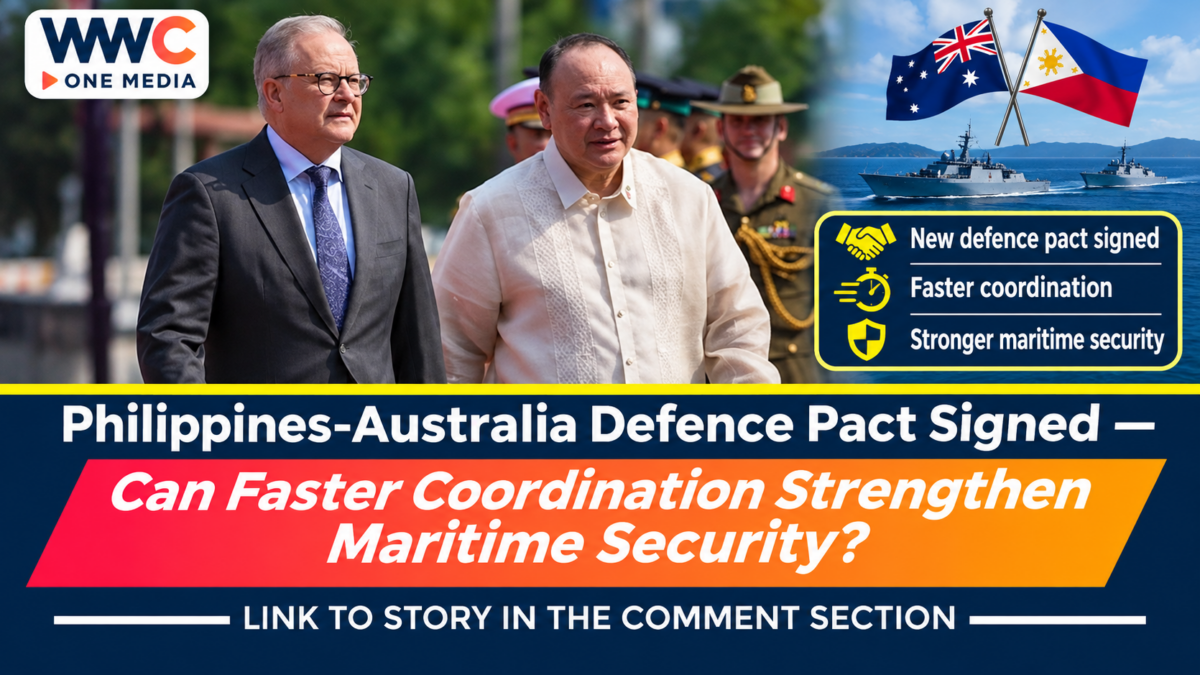
MANILA, Nov. 15, 2026 — The Philippines and Australia signed a new defence cooperation arrangement in Manila on Sunday, with Australian Prime Minister Anthony Albanese witnessing the ceremony following a visit to HMAS Stalwart. The agreement updates their decades-old cooperation framework and identifies maritime awareness, information-sharing, planning, exercises and defence infrastructure as priorities.
The immediate significance lies less in creating a new alliance than in making an existing partnership easier to use. Australian government announcements confirm the signing and outline the priorities, but the full text of the new arrangement and a project-by-project budget have not been released in the official records reviewed.
Philippines-Australia Defence Pact Builds on Existing Agreements
The new Defence Cooperation Arrangement modernises the bilateral memorandum dating to 1995. At an Aug. 7 meeting in Darwin, Australian Defence Minister Richard Marles and Philippine Defence Secretary Gilberto C. Teodoro Jr. had agreed that an updated framework would supersede the earlier memorandum.
Their reciprocal Status of Visiting Forces Agreement, signed in 2007 and effective since 2012, addresses legal questions including entry procedures and jurisdiction. It remains a separate instrument.
The signing announcement did not describe a new mutual-defence treaty.
Analysis: Reducing coordination obstacles could matter most during time-sensitive exercises, maritime incidents and disaster responses. Whether that improvement materialises depends on the detailed procedures agreed and used by the two defence establishments.
Surveillance, Training and Infrastructure Are the Practical Priorities
Australia’s Nov. 15 announcement names maritime awareness and activities, information-sharing, strategic dialogue, planning, training, interoperability and defence infrastructure development as areas covered by the arrangement. Maritime awareness means gathering and sharing information about activity at sea, which can help officials make better-informed decisions.
Albanese also announced additional Australian support for maritime-domain awareness and capabilities, including drones, equipment, operator training and improved detection of maritime and cyber threats. The wider Southeast Asia Maritime Partnerships programme is regional; the statement does not assign every announced drone or dollar of spending exclusively to the Philippines.
In an official Manila press conference, Albanese said Australia and the Philippines undertake up to 200 defence-cooperation activities involving between 2,500 and 3,000 Australian Defence Force personnel. Those figures describe the cooperation he discussed, not new troops assigned under the agreement.
It comes alongside Japan’s separate radar and surveillance-drone assistance to the Philippines. The Japanese assistance is a separate programme.
Philippine Control of Defence Sites Remains Central
The Aug. 7 ministerial statement welcomed progress on an initial group of defence infrastructure projects and discussed possible additional works in the Philippines. It explicitly reaffirmed that the Philippines would maintain full sovereignty over its sites.
That assurance is important when foreign forces train or help develop facilities. Cooperation on a Philippine military site does not, by itself, establish foreign ownership or unrestricted access. Individual project conditions require further documentation.
At their August meeting, the ministers also highlighted exercises including Balikatan, Pitch Black and Carabaroo in 2026, and Exercise Alon in 2027. The updated pact offers a framework for such cooperation rather than proof that every proposed activity has been completed.
Analysis: Infrastructure is useful only if it produces operational capability: maintained facilities, usable equipment, reliable communications and trained personnel. A signing ceremony is therefore a starting point, not a measure of completed readiness.
South China Sea Concerns Give the Pact Regional Significance
Their August joint statement expressed concern about Chinese vessel conduct towards Philippine vessels and the risk of escalation in the South China Sea. Those were the governments’ stated concerns, not a determination that every disputed incident had been independently established by a court.
Both countries reiterated the importance of the United Nations Convention on the Law of the Sea and the 2016 South China Sea arbitral award. WWC previously examined Manila’s position that construction on disputed reefs cannot change maritime entitlements, a legal issue distinct from Sunday’s operational cooperation agreement.
Asked on Nov. 15 whether the new pact was directed against China, Albanese said it was not aimed at any one country and emphasised sovereignty, international law and freedom of navigation. His public answer should be considered alongside, not replaced by, the security concerns recorded in the August statement.
The balance reflects Australia’s wider diplomacy. Canberra continues to manage its relationship with Beijing even as it strengthens security partnerships, a tension discussed in WWC’s coverage of Albanese’s prospective China engagement.
Four-Country Defence Plans Are Separate From Sunday’s Signing
On Nov. 10, Australia, Japan, the Philippines and the United States released a joint statement about their Oct. 28 defence ministers’ meeting in Cebu. They committed to establish a Combined Coordination Center in the Philippines and to expand exercises, policy consultations and cooperation on defence investments.
The four-country initiative and bilateral arrangement are separate undertakings. No opening date or budget was announced.
Analysis: Linking information-sharing across partners could improve coordination, but greater activity also requires safeguards against miscommunication. Published operating rules and evidence of effective joint exercises would provide a better test than assuming a new centre has already become operational.
What Happens Next
The next useful documents will be the published text or implementation guidance for the signed arrangement, specific project approvals and confirmed schedules for exercises and infrastructure work. The August ministerial statement envisaged Exercise Alon and another bilateral defence ministers’ meeting in the Philippines in 2027.
The immediate confirmed development is Sunday’s signing. How quickly it improves maritime monitoring, disaster-response coordination and practical defence readiness remains to be demonstrated through the governments’ subsequent actions.
Frequently Asked Questions
When did the Philippines and Australia sign the new defence arrangement?
The signing took place in Manila on Nov. 15, 2026, and was confirmed in an Australian government announcement the same day.
Does the new agreement create a mutual-defence treaty?
The official releases describe an updated cooperation framework, not a new automatic military-defence obligation between the two countries.
Do Australia and the Philippines already have a visiting-forces agreement?
Yes. Their reciprocal Status of Visiting Forces Agreement was signed in 2007 and entered into force in 2012. It is separate from the new arrangement.
What could change in the West Philippine Sea?
The governments intend closer maritime awareness, training and information-sharing. Whether those plans improve response times or operational capability will depend on implementation.