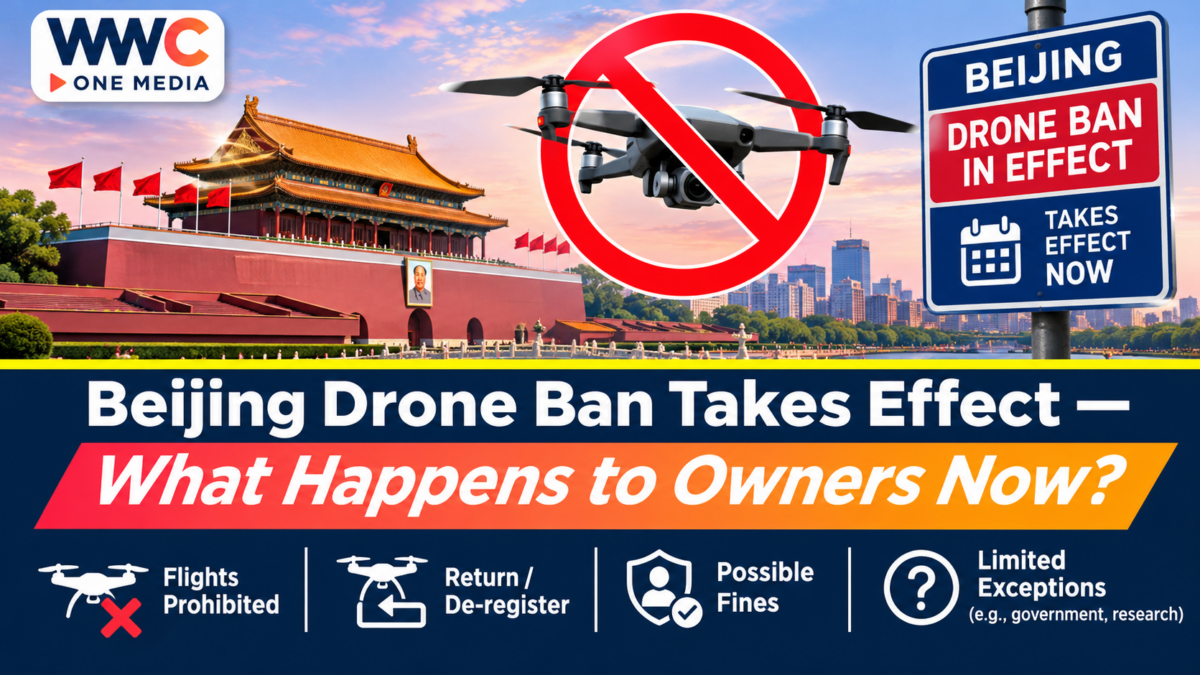
BEIJING, Nov. 15, 2026 — The Beijing drone ban entered into force on Sunday, making it unlawful for most individuals and businesses to keep, store, fly or bring unmanned aircraft into China’s capital. The revised municipal regulation also restricts core drone components and provides exceptions for activities that pass a public-security assessment.
The change matters because the city has moved beyond a conventional no-fly zone. A person who keeps a recreational drone inside a home or business now faces a different legal risk from someone who flies it without authorisation, and the subsidy window for disposing of registered equipment ended on Nov. 14.
Beijing drone ban now covers possession, not just flying
The municipal legislature approved the revised rules on Sept. 11 and scheduled them to take effect on Nov. 15. Article 3 classifies the entire Beijing administrative area as controlled airspace for unmanned aircraft and prohibits drone flight operations there under the general rule.
That same article prohibits possession and storage of unmanned aircraft and designated core components. It also forbids transporting or carrying those items into the municipality. The restriction is not confined to the centre of the city or to airspace around government buildings.
Article 4 separately bars selling or renting drones and their core components to organisations or individuals in Beijing. E-commerce operators must take measures to comply, meaning a sale arranged online is not automatically outside the rule.
The law covers Beijing, not all of China.
Fines and confiscation: what the regulation says
Article 8 sets different penalties for different violations. Unauthorised flights can result in an order to stop, confiscation of the aircraft and a fine of 1,000 to 10,000 yuan.
For prohibited possession, storage, carriage or sales, police can confiscate the drone or core components. Individuals may face fines from 500 to 5,000 yuan; organisations may face 5,000 to 50,000 yuan.
The legislation also addresses businesses that fail to enforce the sales restriction. Market regulators can order corrections and impose fines on e-commerce operators, with higher ranges applicable to platform operators.
These are statutory penalties, not confirmed enforcement actions.
Buyback subsidies ended before implementation
Beijing created several routes for owners of previously registered drones to comply before the new rules began. Residents could sell their equipment to government-recognised buyers, surrender it for recycling, send it outside the city through a designated postal programme, or arrange to take it outside Beijing themselves before the deadline.
The municipal legislature’s public explanation specified that qualifying buyback transactions completed from Sept. 12 through Oct. 31 were eligible for subsidies equal to 30% of the sale price, capped at 3,000 yuan per drone. From Nov. 1 through Nov. 14, the subsidy dropped to 15%, capped at 1,500 yuan.
Qualifying recycling payments were 200 yuan per drone in the earlier period and 100 yuan from Nov. 1 to Nov. 14. A verified postal-disposal route offered free shipping outside Beijing within its stated window.
Those windows have now closed. They should not be advertised as financial assistance still available on Nov. 15. Noncompliant owners should seek current police guidance.
Who may qualify for an exception?
Article 6 provides a special-assistance system for limited needs. These include counterterrorism and public-order work, emergency rescue, major events, school or research activity, production, and agriculture or forestry operations.
Permission is not automatic simply because a business or institution works in an eligible industry. The municipal public-security authority, together with relevant departments, must carry out a safety assessment and apply the special-management process.
Approved organisations must maintain safety controls for purchasing, transporting, storing and using aircraft and components. Flight activity covered by special arrangements must still comply with national requirements.
This is why describing the law as banning absolutely every drone in Beijing would be misleading. The ordinary-ownership rule is broad, but the enacted text expressly preserves narrowly supervised uses.
Why it matters for businesses and the wider region
The 2026 legislation replaced an earlier Beijing framework that took effect on May 1. That earlier version required real-name registration and information checks for existing owners and already restricted sales and flight operations. The September revision eliminated the previous general route for retaining verified equipment inside the city.
Beijing’s legislature framed the restrictions as a response to the capital’s low-altitude security risks. It also assigned duties across public security, transport, emergency management, industry, education and other agencies, reflecting how drone operations can affect multiple public functions.
The issue extends beyond Beijing’s borders. WWC’s earlier reports on a drone-related interruption at a Taiwanese airbase and Taiwan’s enforcement of restricted-airspace drone rules provide separate regional examples of why authorities regulate unmanned aircraft around sensitive locations. Those incidents do not establish the cause of Beijing’s legislation.
Another distinction is between civilian security controls and broader industrial policy. WWC has separately examined China’s defence mobilisation legislation and its treatment of emerging technologies. The present municipal regulation addresses activities and equipment inside Beijing; it does not, by itself, establish a national prohibition on drone manufacturing.
Analysis: The trade-off is clearer now than when the rules were first announced. Reducing the number of unapproved aircraft inside the capital may simplify enforcement, but schools, manufacturers and research organisations requiring drones must rely on a formal approval route. Whether that system is workable will depend on its administration, not merely the text of the ban.
What happens next
Police and other authorities are expected to enforce the Nov. 15 rules, including the prohibition on keeping previously registered drones in the municipality. No official post-implementation enforcement totals were verified.
The next measurable developments will be official enforcement statistics, published guidance for special-use applications, and any updated instructions for owners who missed the disposal deadline. The enacted law provides the baseline; later administrative records will show how it operates in practice.
FAQ
Can you own a drone in Beijing from Nov. 15, 2026?
Ordinary possession and storage of drones and designated core components are prohibited throughout the municipality, subject to legally authorised special arrangements.
Can tourists bring drones into Beijing?
No general tourist exemption appears in Article 3. The rule prohibits transporting or carrying drones and their core components into Beijing.
What is the fine for keeping an unauthorised drone?
For prohibited possession or storage, the enacted regulation allows confiscation and a fine of 500 to 5,000 yuan for individuals. Penalties for organisations differ.
Can universities or emergency services still operate drones?
Certain activities may qualify for special management after assessment by public-security authorities and relevant departments. Eligibility alone does not constitute permission.
Can owners still claim the earlier buyback subsidy?
The published disposal subsidy periods ended on Nov. 14, 2026. Owners should check for any new official arrangement rather than rely on the expired scheme.