
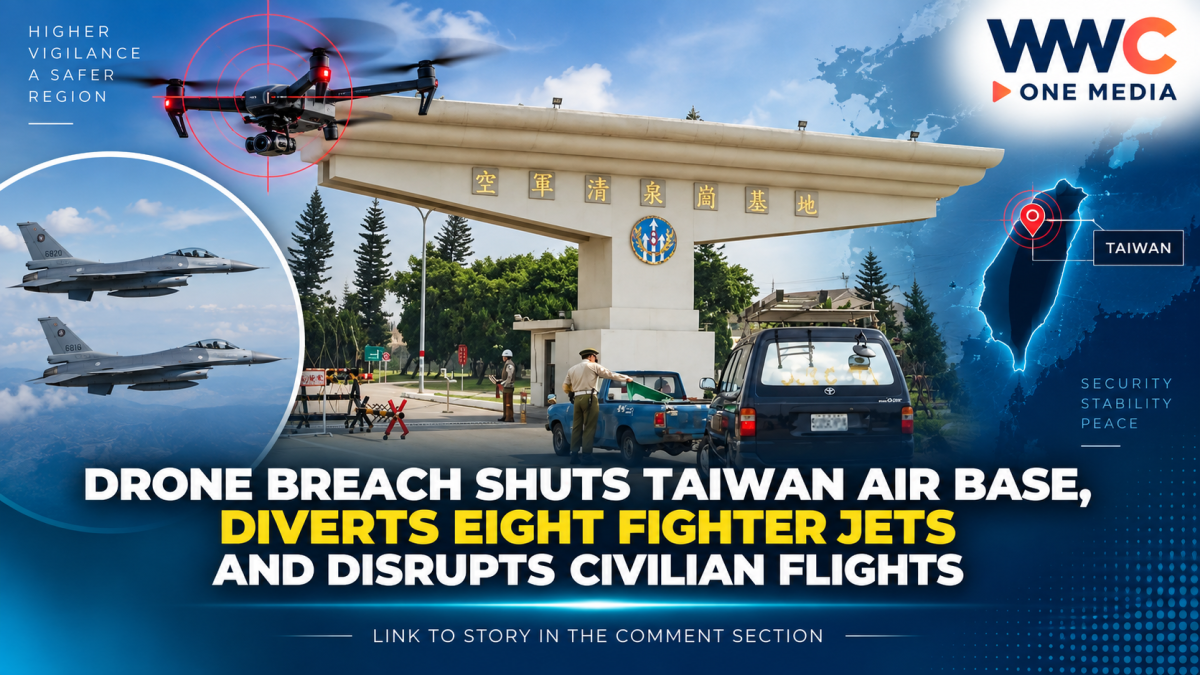
TAICHUNG, Taiwan — A single unauthorized drone triggered a major aviation disruption in central Taiwan after entering restricted airspace near a military air base, forcing authorities to temporarily halt flight operations, divert eight fighter jets and disrupt civilian flights.
The incident at Ching Chuan Kang Air Base, which shares its runway with Taichung International Airport, has raised fresh questions about drone security around critical military and civilian infrastructure.
Taiwan’s Air Force said the drone activity was detected near the airport at 7:37 p.m. on September 8, prompting an immediate suspension of takeoffs and landings. Flight operations resumed at 8:02 p.m. after authorities confirmed the drone had left the controlled area.
Eight Fighter Jets Forced to Divert
The timing of the intrusion made the incident particularly disruptive.
Clear weather had allowed the Air Force to conduct scheduled night training, with eight Indigenous Defense Fighter jets already in the air.
Once the drone was detected, the control tower declared an emergency closure, forcing all eight aircraft to divert and land at Hsinchu Air Base instead of returning to Taichung.
Taiwan’s military said the incident affected eight military aircraft, while civilian aviation operations were also disrupted.
Passenger Flights Also Hit
The airspace closure did not affect only the military.
A passenger flight arriving from Macau was forced to circle in the air while authorities dealt with the drone intrusion before it was eventually cleared to land.
Taiwan’s Air Force and other local reports said two civilian flight movements were affected during the temporary shutdown.
The incident highlights the unusual vulnerability of Ching Chuan Kang, where military and civilian aviation operations share the same airfield.
A drone near an approach or departure path can create a serious hazard, particularly when aircraft are operating at low altitude with limited room to manoeuvre.
Police Search Fails to Find Drone or Operator
Airport personnel initially spotted the drone activity, prompting the military to notify Taichung police.
Officers were dispatched to search the affected area, including Sishih Borough, but were unable to locate either the drone or its operator.
Police remained in the area until the military issued an all-clear and said patrols would be increased as authorities continue trying to identify the person responsible.
The case has been handed to Taiwan’s Aviation Police Bureau for investigation.
Flying a Drone There Could Cost Up to NT$1.5 Million
Taiwanese authorities warned that the suspected drone flight could carry severe penalties.
The restricted no-fly zone around the airport extends 2.6 kilometres, and unauthorized drone operations within the area are illegal.
Authorities said violators could face:
- Revocation of their drone operator licence
- Fines ranging from NT$300,000 to NT$1.5 million
- Confiscation of the drone and related equipment
The Civil Aeronautics Administration has previously warned drone operators to check restricted and prohibited flight zones before flying.
Why Wasn’t the Drone Immediately Taken Down?
The incident has also sparked questions about Taiwan’s anti-drone capabilities.
Taiwan Association for Security and Development chairman Chi Tung-yun said military airports in Taiwan are equipped with anti-drone systems developed by the National Chungshan Institute of Science and Technology.
However, he said the existing “soft-kill” systems are largely limited to the immediate confines of airport facilities.
According to Chi, the drone in this incident was operating near a flight path outside the base itself, raising questions about whether counter-drone protection should be expanded to surrounding restricted safety zones.
The incident has therefore exposed a difficult security challenge: detecting a drone is only part of the problem. Authorities must also determine how to safely neutralise it without creating additional risks to aircraft, people or property.
Drone Incidents Are Becoming a Growing Aviation Threat
The Taichung incident is part of a wider global problem.
As consumer and commercial drones become cheaper and more widely available, airports and military installations are facing an increasing number of airspace intrusions.
Even a small drone can create a serious hazard if it collides with an aircraft, particularly during takeoff and landing.
Taiwan’s Public Television Service reported that authorities recorded 72 penalties for drones entering prohibited or restricted zones from 2025 through the first half of 2026, with many incidents involving sensitive areas such as airports, reservoirs and science parks.
A Bigger Security Concern for Taiwan
For Taiwan, the incident carries additional significance.
Ching Chuan Kang Air Base is an important military facility and operates alongside Taichung International Airport, meaning any airspace security breach can immediately affect both national defence operations and commercial passengers.
The temporary shutdown demonstrated how quickly a relatively small unmanned aircraft can disrupt multiple operations.
Within 25 minutes, one drone intrusion had:
- Shut down airport flight operations
- Diverted eight fighter jets
- Affected two civilian flight movements
- Forced a commercial aircraft to wait before landing
- Triggered a police search
- Prompted an aviation security investigation
Authorities have not publicly identified the drone operator, and the investigation remains ongoing.
The Bottom Line
A drone may be small, but its impact can be enormous.
The unauthorized intrusion near Taiwan’s Ching Chuan Kang Air Base temporarily shut down a critical military and civilian airport, diverted eight fighter jets and disrupted passenger flights.
The suspect remains unidentified, but the incident has already intensified questions about how Taiwan protects its airports and military facilities from the growing threat posed by unauthorized drones.
One drone. Twenty-five minutes of restricted airspace. Eight fighter jets diverted. Civilian flights disrupted.
And for Taiwan’s aviation and military authorities, the bigger question now is whether the country’s existing anti-drone defences are ready for the next intrusion.
WWC ONE MEDIA J.M.D




Leave a Reply