
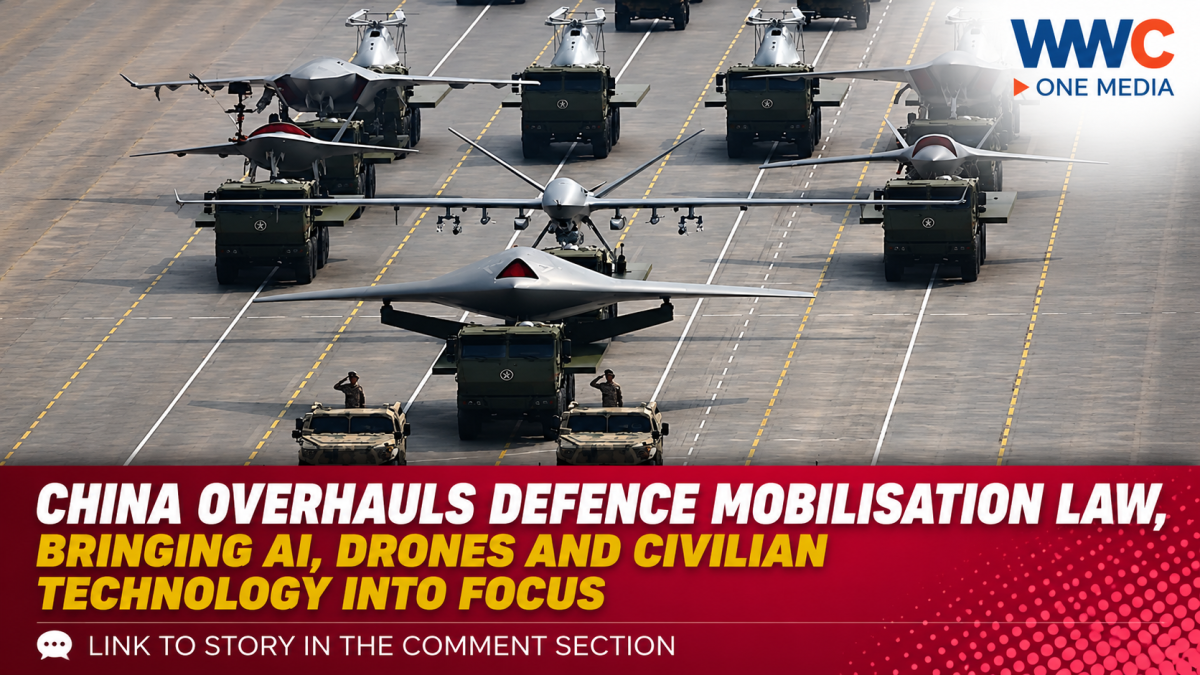
BEIJING — China has significantly expanded its legal framework for national defence mobilisation, with a revised law placing new emphasis on advanced technology and the ability to rapidly convert economic and social resources into defence capabilities.
The revised National Defence Mobilisation Law, approved by China’s top legislature on August 28, is the first major update since the law was enacted in 2010. It will take effect on October 1, 2026.
The change comes as modern conflicts increasingly rely on drones, artificial intelligence, cyber capabilities, data and other technologies that blur the traditional boundary between civilian and military systems.
AI and drones move closer to China’s mobilisation framework
One of the most notable additions is a provision stating that China will promote the application of advanced technologies in national defence mobilisation and develop mobilisation capabilities in emerging fields.
The law itself does not provide a complete list of the technologies covered. However, military-law expert Xie Dan told the South China Morning Post that the provision could encompass areas including AI, unmanned systems such as drones, cyberspace, electromagnetic technologies, navigation, biotechnology, maritime and space technologies, and quantum technology.
That potentially gives Beijing a legal framework for drawing on technologies and specialist expertise developed outside the traditional defence sector when mobilisation is ordered.
From peacetime resources to defence capabilities
The revised legislation defines national defence mobilisation as measures taken in response to threats to China’s sovereignty, unity, territorial integrity, security and development interests.
Its stated objective is to enable a rapid transition between peacetime and wartime and convert economic and social strength into national defence capabilities.
The framework covers far more than military personnel.
It includes planning, reserve personnel, strategic material stockpiles, military research and production, civilian resources, defence-related infrastructure and compensation arrangements.
Private companies and technology could become strategically important
The revised law also strengthens the connection between civilian industry and defence mobilisation.
China’s legislation provides for mobilisation-related preparations involving military production and support capabilities, including equipment, materials, technology, data and software. Companies involved in relevant defence supply chains can be required to maintain the capabilities and specialist personnel necessary to expand production or provide support during mobilisation.
This is particularly significant for China’s enormous technology and manufacturing sectors.
A company developing drones, AI systems, communications equipment, navigation technology or other dual-use technologies could potentially become strategically relevant during a national mobilisation scenario.
Analysts cited by SCMP said the experience of the Russia-Ukraine war, where drones and other relatively inexpensive unmanned systems have played a major role, has reinforced the importance of rapidly deployable technologies in modern warfare.
The law also covers civilian resources
The changes extend beyond technology.
The revised framework contains provisions covering the requisition and expropriation of civilian resources, along with compensation. It also establishes requirements related to defence duties, military production and logistics.
The legislation says organizations and citizens have obligations to complete legally prescribed defence-mobilisation preparations during peacetime. Once mobilisation is formally implemented, designated organizations and individuals must carry out their assigned responsibilities.
That does not mean China has entered a wartime mobilisation state. Rather, the legislation establishes the legal mechanisms that could be used if Beijing were to declare a national or local mobilisation.
Why the timing matters
The overhaul comes at a period of heightened geopolitical tension in the Asia-Pacific.
Taiwan’s defence ministry recently warned that China’s military activity around the island was intensifying and said Beijing was studying lessons from recent conflicts, including the effectiveness of drone warfare and weaknesses in logistics and air-defence systems.
Taiwanese reporting has also highlighted provisions concerning the mobilisation of personnel, transportation, communications, energy and medical resources in a national defence emergency.
However, the revised Chinese law does not itself announce preparations for an imminent conflict. Its stated purpose is to strengthen the country’s defence-mobilisation system and allow a faster transition from peacetime to wartime if authorities determine that mobilisation is necessary.
A broader military-civilian strategy
The changes are consistent with China’s long-running effort to integrate civilian technological and industrial capabilities into national defence.
The revised law specifically calls for improvements in the country’s information and intelligent capabilities for defence mobilisation and encourages the development of emerging-field mobilisation capabilities.
That could become increasingly important as future conflicts depend not only on traditional weapons but also on software, satellite systems, data networks, autonomous platforms, supply chains and advanced manufacturing.
The result is a defence-mobilisation model that is increasingly about the whole technological and economic ecosystem, rather than the armed forces alone.
What happens next?
The revised law contains 14 chapters and 82 articles and takes effect on October 1, 2026. Chinese authorities have said the next phase will involve establishing supporting regulations and ensuring implementation of the new framework.
For China’s technology companies, manufacturers and other organizations connected to strategically important industries, the biggest question may now be how the new rules are translated into detailed regulations.
And that could determine just how far Beijing’s new mobilisation framework reaches into China’s civilian economy.
WWC ONE MEDIA J.M.D




Leave a Reply