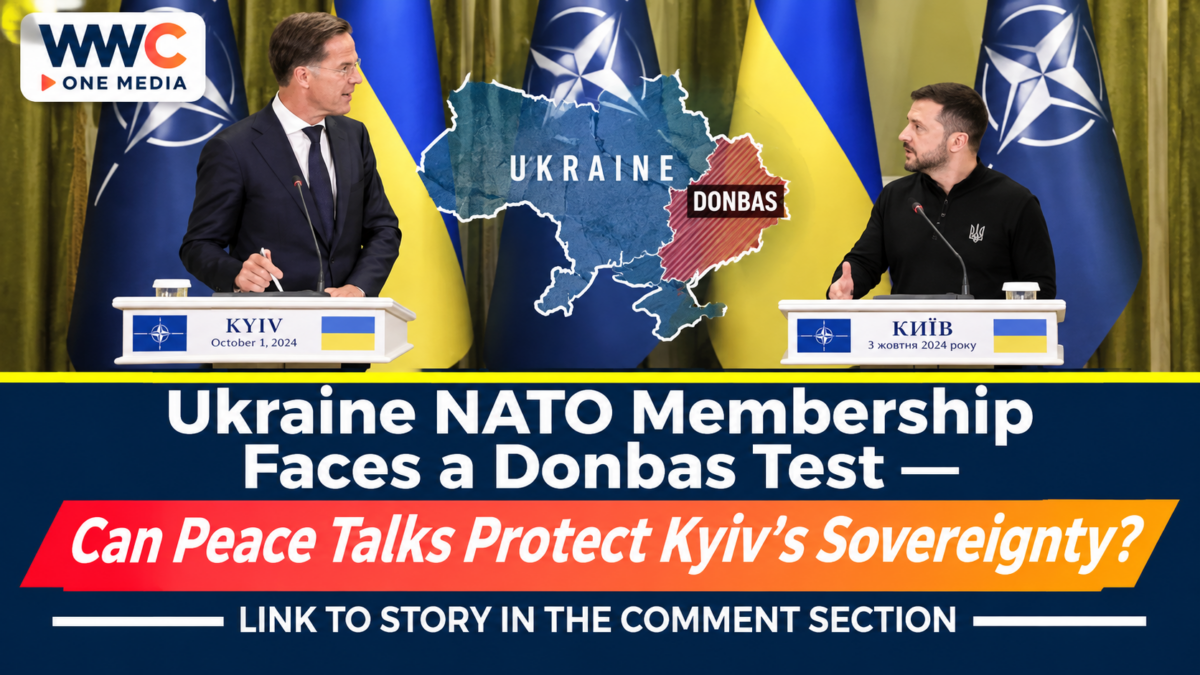
KYIV, Nov. 15, 2026 — Ukraine’s pursuit of NATO membership remains unresolved as US-mediated negotiations with Russia continue, with Kyiv seeking firm security guarantees and European governments insisting that any settlement respect Ukrainian sovereignty. Official statements published after this week’s diplomatic meetings confirm discussions about future security arrangements, but no agreement admitting Ukraine to NATO or transferring territory has been announced.
A reported question linking Ukraine’s withdrawal from Donbas with possible NATO membership has intensified attention on the issue. The complete official transcript of that reported exchange was not available for independent verification; the documented question is whether the alliance could legally and politically make such an arrangement work.
Ukraine NATO Membership Is Not Washington’s Decision Alone
NATO’s founding treaty allows European countries to be invited to join through agreement among existing members. Its published enlargement rules specify consensus in the North Atlantic Council and subsequent accession procedures, including national ratification requirements.
That means a suggestion by American negotiators, even if formally confirmed, would not itself constitute an invitation or guarantee Ukrainian membership. Every ally would have to accept the outcome through the alliance’s procedures.
The alliance’s June 3 joint press conference in Kyiv provides an unusually direct explanation. Secretary General Mark Rutte distinguished NATO’s political commitment to Ukraine’s eventual membership from the practical absence of unanimity among allies at that time.
The political path has been outlined for years. NATO’s official Ukraine policy says the allies recognised a future for Ukraine in the alliance, while retaining the condition that members agree and requirements are met. Its published position also confirms that Ukraine is not currently protected by the collective-defence guarantee for members.
Donbas and Security Guarantees Are Different Negotiating Questions
The Donbas question concerns land, civilians, administrative authority and the extent of control exercised by the parties to the war. NATO membership, by contrast, would involve an international treaty commitment undertaken by the alliance’s members.
Merging them into a single proposed exchange would therefore create at least two decisions requiring different participants: Ukraine’s decision about its territory and the allies’ decision about accession. Neither could be settled merely by an American negotiator putting a hypothetical question on the table.
The European Commission’s Nov. 10 statement after consultations in Abu Dhabi expressly emphasised sovereignty, territorial integrity and independent decision-making. It also called for credible long-term guarantees to support a durable settlement.
Analysis: A security arrangement becomes useful only when the parties explain what obligations they would accept, how it would operate and what happens after a violation. Undefined assurances could leave the central uncertainty unresolved, even if diplomatic statements sound encouraging.
WWC’s earlier analysis of territorial concessions in the renewed Ukraine peace talks addresses the wider challenge. The present question is narrower: whether a proposed security benefit could ever replace Ukraine’s own choice about land.
Article 5 Is Not the Same as a Political Assurance
NATO describes its collective-defence principle as an obligation among members to respond when an ally is attacked. Ukraine remains a partner rather than a member, so cooperation on defence equipment and training does not automatically extend that treaty protection to Ukrainian territory.
The difference also matters for proposals described as “NATO-like” guarantees. A bilateral agreement with one government would depend on its own text and enforcement provisions. It should not be labelled NATO membership, and it cannot automatically bind the other allies.
Rutte’s June remarks described growing technical cooperation between Ukrainian forces and NATO, including military standards, industrial links and counter-drone capabilities. That practical integration is important but distinct from a completed accession.
Analysis: Policymakers may be able to strengthen support while formal accession remains blocked. Nevertheless, the credibility of any substitute mechanism depends on enforceable commitments rather than the similarity of its wording to an alliance treaty.
Europe Wants a Role in Any Final Arrangement
Europe’s involvement is now established in the public record. On Nov. 10, representatives of European institutions and governments joined Ukraine, the United States and NATO for consultations in Abu Dhabi ahead of further negotiations involving Russia.
The statement identified lasting peace, security guarantees and management of future escalation as common objectives. It did not report agreement on territorial changes or any NATO invitation.
Ukraine’s presidential news archive also records Nov. 12 discussions about bringing European participants more fully into the process. A Nov. 13 presidential statement described expected progress towards a prisoner exchange and further diplomatic engagement. An expected exchange, however, is not a completed release.
WWC’s report on Europe’s newly organised role in the Ukraine negotiations examines which European representatives may take part. For the proposed security framework, participation is significant because European states would likely have responsibilities in supporting or implementing parts of any agreement.
The earlier G7 discussions about Ukraine and European participation provide another perspective on why diplomatic coordination matters. These consultations should not be confused with agreement on a common final settlement.
What the Negotiations Still Have Not Settled
Publicly accessible primary records do not establish that Washington made a binding offer of NATO membership for a Donbas withdrawal. Nor do they show acceptance by Ukraine, unanimous allied approval or a final Russia–Ukraine peace agreement.
The reporting around a possible exchange illustrates why precision matters. A question raised in talks, a written proposal, a signed agreement and actual implementation are four different stages. Presenting one as another would mislead readers about both the military and legal consequences.
Analysis: A serious settlement would need clarity on territorial administration, the protection of affected people, monitoring and enforcement, future arms support, and who has authority to approve each obligation. These requirements make a simple exchange formula far harder to implement than to discuss.
What Happens Next
The next meaningful evidence would be an authenticated Ukrainian account of the reported question, a formal US negotiating text, an attributable NATO position and any published agreement on security guarantees. Each would answer a different part of the problem.
As of Nov. 15, the verified position remains that talks are continuing, Ukraine has not joined NATO and the allies have not announced a territorial settlement. The central test is whether diplomacy produces enforceable security arrangements without treating Ukraine’s consent as optional.
Frequently Asked Questions
Has Ukraine joined NATO?
No. NATO’s official policy identifies Ukraine as a partner rather than a member and says its membership requires allied agreement and fulfilment of conditions.
Can the United States offer NATO membership by itself?
No. NATO invitations require consensus among existing allies, followed by accession procedures. A US negotiating suggestion cannot bind every member.
Has Ukraine agreed to surrender Donbas for NATO membership?
No such agreement was established in the opened primary records. The specific reported negotiating exchange awaits independent authentication from a complete official transcript or recording.
What are NATO-style security guarantees?
The term can describe proposed support resembling aspects of collective defence, but its practical meaning depends on a written agreement. It is not automatically equivalent to NATO membership.