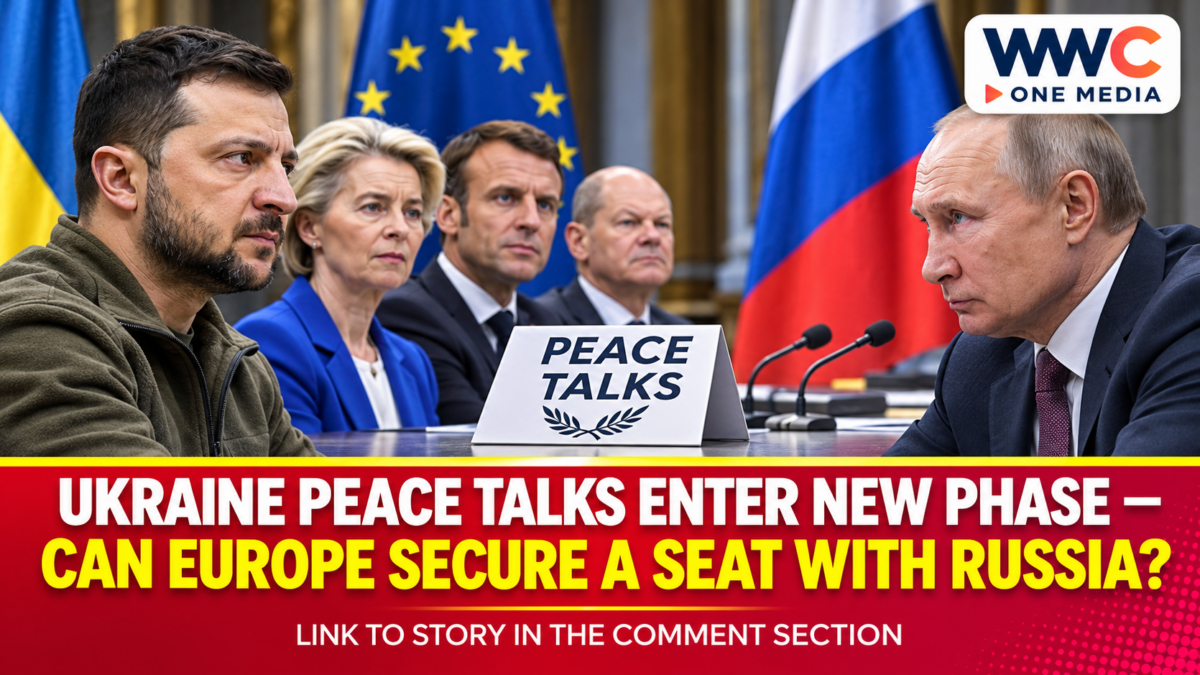
DUBLIN, Ireland — Nov. 15, 2026. European leaders have agreed on a negotiating team for the next phase of Ukraine peace talks, following renewed US-mediated discussions involving Ukrainian and Russian representatives. The European Council’s Nov. 13 announcement and Ukraine’s statements this week show an effort to give European governments a fuller role in talks that could shape security across the continent.
That does not mean direct Europe–Russia negotiations have already produced an agreement. Public statements distinguish between consultations involving European officials and the still-developing format for negotiations with Moscow. The question now is whether expanded participation can help deliver credible security arrangements without deciding Ukraine’s future over Kyiv’s objections.
Ukraine peace talks move beyond an exclusively trilateral format
Ukraine’s president, Volodymyr Zelenskyy, addressed a European political gathering on Nov. 12 after Ukrainian and Russian representatives had met in Abu Dhabi with US involvement. He said European representatives had been part of the diplomatic process in separate discussions, but had not yet participated when Russian negotiators were at the table.
The distinction is central to the next phase. European governments can exchange proposals with Washington and Kyiv without necessarily negotiating directly with Moscow. Turning that consultation into a common negotiating format requires agreement on participation, an agenda and the authority of the people at the table.
An official Nov. 10 statement recorded a meeting among representatives of the European Union, France, Germany, Italy, the United Kingdom, Ukraine, the United States and NATO in Abu Dhabi. Their discussions addressed possible security guarantees, national sovereignty and ways to limit the risk of renewed fighting after a settlement.
These discussions extend an earlier diplomatic effort covered by WWC in its report on the renewed Russia–Ukraine talks in Abu Dhabi. The important new development is Europe’s effort to define how it will participate, rather than simply receive updates.
Europe agrees who will speak in the negotiations
On Nov. 13, European Council President António Costa said European leaders had agreed that EU institutions and the E5 countries of the Coalition of the Willing would constitute Europe’s team for the Ukraine negotiations. He also said those representatives would operate in close coordination.
This is a political coordination decision, not a peace settlement. Naming a negotiating team helps European governments prepare common positions, but it does not settle differences over borders, guarantees or relations with Russia.
Costa emphasised that Ukraine alone has the authority to decide matters involving its own territory and sovereignty. The EU’s role, meanwhile, includes Ukraine’s European future and potential reconstruction, while security guarantees require coordination with NATO and the Coalition of the Willing.
For European governments, the challenge is to discuss their own security responsibilities without treating Ukraine’s sovereignty as a bargaining item they can trade independently. For Ukraine, the challenge is to ensure that consultation becomes meaningful participation when decisions are made.
Why security guarantees remain the difficult part
The joint statement issued after European leaders met Zelenskyy in Dublin on Nov. 12 welcomed the resumed peace process and reaffirmed support for Ukraine’s sovereignty and territorial integrity. It also committed the EU to continued involvement and assistance.
The Nov. 10 Abu Dhabi statement described credible security guarantees and ways to manage escalation as objectives of the diplomatic effort. These are proposals and principles, not a published mechanism that has already been accepted by the warring parties.
There is a practical difference between agreeing that future peace should be durable and specifying how to respond if fighting resumes. A credible arrangement would need clarity about responsibilities, coordination and the actions that parties are actually willing to undertake. The public records reviewed here do not announce final answers to those questions.
WWC previously examined the concern that Europe could be sidelined in US–Russia negotiations. The official European decision provides a firmer institutional response, although it does not yet demonstrate that Moscow accepts the proposed format.
Prisoner exchange discussions show a separate path
A Ukrainian presidential statement on Nov. 13 identified a planned prisoner exchange as a humanitarian outcome of the latest diplomacy. Zelenskyy said preparations for further multilateral meetings were another important result.
That is meaningful, but it should not be confused with an implemented exchange or an agreed ceasefire. The statement expresses an expectation of releases; it does not provide completed exchange records or a final timetable.
Humanitarian negotiations can advance even while the wider political settlement remains unresolved. They involve immediate questions about people in custody, whereas a peace agreement would require decisions about security arrangements and the conditions for ending the fighting.
The distinction was also central to WWC’s earlier coverage of the prisoner-swap understanding after the Abu Dhabi meetings. Any later announcement should therefore be judged on whether people have actually been released, not solely on the scale of a proposed exchange.
What this could mean for diplomacy
Analysis: Europe’s participation may make any eventual arrangement more workable because European institutions and governments would have to help implement parts of the postwar framework. But a larger negotiating group can also make agreement harder if participants differ on sequencing and acceptable commitments.
The central test is whether direct engagement produces concrete, mutually understood terms while protecting Ukraine’s right to make decisions about its future. Meetings alone cannot measure success, particularly when public records identify principles but do not establish a jointly accepted settlement.
The European Council has also scheduled discussion of Ukraine’s financing needs at its Nov. 26–27 meeting. That financial discussion is separate from direct negotiations with Russia, yet it matters to the practical support available to Ukraine as diplomacy continues.
What happens next
As of Nov. 15, the public record establishes European preparations and ongoing consultations, not a completed Russia–Europe negotiating session or final peace deal. The next developments to examine are an official negotiating schedule, confirmation of who attends meetings with Russia, any concrete security-guarantee text and evidence that agreed humanitarian measures have been carried out.
Until those details are published, claims of a diplomatic breakthrough would be premature. The emerging framework creates an opportunity for a wider discussion, but the outcome remains uncertain.
Frequently asked questions
Are European countries taking part in the Ukraine peace talks?
Yes. Official statements confirm European involvement in consultations and plans for broader participation. Ukraine said on Nov. 12 that European officials had not yet been at the table when Russian representatives were present.
Has Europe agreed to negotiate directly with Russia?
European leaders have organised their negotiating team and welcomed broader diplomacy. The records reviewed for this article do not establish that a direct Europe–Russia negotiating session has already concluded.
Who decides Ukraine’s territorial future?
The European Council has stated that Ukraine alone has the legitimacy to decide questions concerning its territory and sovereignty.
Is a prisoner exchange confirmed as completed?
Ukraine announced preparations and expectations for a major exchange, but the reviewed statements do not document its completion.