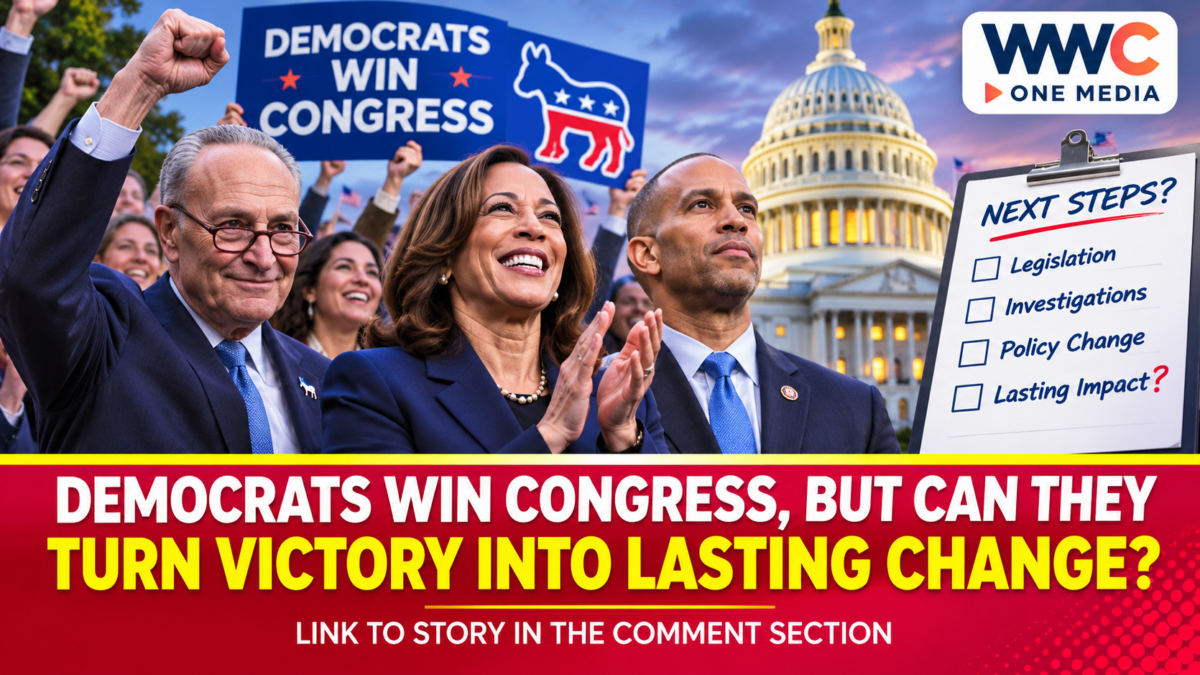
WASHINGTON, United States — Nov. 15, 2026. Democratic leaders are preparing to assume control of both chambers of the US Congress following the Nov. 3 midterm elections, with affordability and government oversight at the centre of their announced priorities. Their next challenge is translating those commitments into legislation under a Republican president who retains the power to veto bills.
The Democrats midterm victory has changed the expected balance of power in Washington, but it has not settled what the incoming majority can deliver. Official statements issued since election day show broad agreement on lowering household costs, alongside practical questions about party unity, negotiation and the limits of congressional authority.
Democrats midterm victory shifts the agenda, not the presidency
The Democratic National Committee described gains across federal, state and local races in its Nov. 6 post-election memorandum. That document is the party’s own assessment, not a substitute for certified election returns. The Federal Election Commission explains that individual states certify election results and federal compilations follow later.
House Democratic Leader Hakeem Jeffries formally sought his colleagues’ support for Speaker on Nov. 4. On Nov. 9, Jeffries and Senate Democratic Leader Chuck Schumer outlined priorities they intend to pursue when the new Congress begins on Jan. 3, 2027.
For perspective, WWC previously covered the Democrats’ congressional election victory and its implications for the Trump presidency. The immediate issue is whether those gains produce changes households experience.
The election did not change the occupant of the White House. That means Congress and the president may disagree on spending, legislation and administration oversight, creating opportunities for negotiation but also for deadlock.
Affordability becomes the first public test
The Democrats’ Nov. 9 joint leadership statement identifies the cost of living and access to healthcare as central priorities. In separate public remarks that day, Jeffries discussed groceries, fuel, housing and healthcare as areas where households face pressure.
Those statements are political commitments, not enacted policy. Bringing down prices or easing household costs would require specific proposals, their passage through Congress and—where legislation is necessary—presidential approval or a successful veto override.
Republican Senate leader John Thune, speaking on Nov. 9, acknowledged a disappointing election and said inflation and household expenses remained significant concerns. He also expressed a willingness to work across party lines while opposing policies Republicans reject.
The overlap presents a possible opening. Disagreement may concern which measures would help, their cost and beneficiaries. Those questions remain open rather than settled by the election result.
A majority does not guarantee a legislative breakthrough
A congressional majority enables its leaders to set agendas, organise committees and advance bills, subject to the rules of each chamber. It does not give lawmakers unrestricted power to enact their preferred programme.
The Senate’s published rules provide that ending debate on most legislation generally requires support from three-fifths of senators duly chosen and sworn, normally 60 votes. Other procedures and exceptions apply, so this threshold should not be treated as universal for every Senate decision.
The presidency creates another barrier. A measure that passes both chambers can face a presidential veto, which Congress can override only with the constitutionally required two-thirds vote in both chambers.
That arithmetic encourages a distinction between promises that can be advanced through congressional oversight or budgeting negotiations and promises requiring new laws. Democratic leaders will have to choose which initiatives justify prolonged confrontation and which could attract bipartisan support.
Internal priorities could shape the governing coalition
Democrats are not one uniform policy bloc. The New Democrat Coalition, a group of House lawmakers, endorsed Jeffries’ Speaker bid on Nov. 10 and said it expected more than 140 members in the incoming Congress. That is a coalition projection, not a final count.
A large internal bloc can influence legislative strategy, particularly when members have different policy preferences and constituencies. Such differences need not mean a breakdown; they are common features of a coalition that must negotiate bills within its own caucus.
WWC has already examined the Democratic debate over Senate leadership. For an incoming governing majority, the relevant question is less whether disagreements exist than whether members can agree on workable legislation and a credible order of priorities.
The official statements reviewed do not establish a single, detailed legislative package agreed upon by all Democratic factions. It would therefore be premature to describe any particular tax, wage or healthcare proposal as the caucus’s settled programme.
Oversight will bring opportunity and political risk
Congressional control also affects the ability to investigate executive agencies and demand records. The existing House rules describe committee powers to hold hearings and issue subpoenas under specified procedures.
That provides a route for scrutiny of government decisions, but an investigation is not proof of misconduct. Hearings, document requests and allegations must be distinguished from substantiated findings and court judgments.
WWC previously analysed the five areas Democrats may scrutinise through congressional oversight. The institutional question now is whether investigators can pursue evidence-based examinations without allowing confrontations to displace legislative work on the economic issues their leaders have identified.
Republicans also remain an important part of that process. Thune’s Nov. 9 remarks indicate openness to selected cooperation alongside firm opposition on disputed matters. A productive Congress will therefore depend partly on how both parties exercise their respective powers.
What happens next
The incoming Congress is scheduled to convene on Jan. 3, 2027. Democratic representatives and senators must organise their leadership and committees, choose initial measures and establish how they will deal with the White House.
The clearest short-term indicators will be published legislative proposals, committee priorities, cross-party negotiations and whether measures advance beyond announcements. Long-term success is harder to judge: legislation can take time to affect household bills, and economic outcomes depend on forces beyond any one party’s control.
Analysis: The Democrats’ electoral gains create an opportunity, not a guarantee of durable support. Showing measurable progress on affordability while exercising oversight fairly may be more persuasive to voters than treating election-night margins as a permanent political mandate.
Frequently asked questions
Did Democrats win control of both chambers in the 2026 midterms?
Democratic leaders are preparing to lead both the House and Senate following the Nov. 3 elections. Final certified figures are issued by state election authorities and should not be confused with election-night projections.
When does the new US Congress start?
The 120th Congress is scheduled to begin on Jan. 3, 2027. The new members will organise leadership and committees as they begin their terms.
Can Democrats pass laws without President Trump’s support?
They can pass bills through Congress if procedural and voting requirements are met. But the president may veto legislation, and overriding a veto requires two-thirds support in each chamber.
What issues are Democratic leaders prioritising?
Their Nov. 9 joint statement prioritises affordability, healthcare, oversight and their opposition to the Iran war. These are stated political goals, not proof that specific bills have passed.
Why could their midterm success prove difficult to sustain?
The party must reconcile priorities across its membership, navigate Senate procedures and deal with presidential powers. Whether public support lasts will depend on future actions and outcomes, which cannot yet be known.