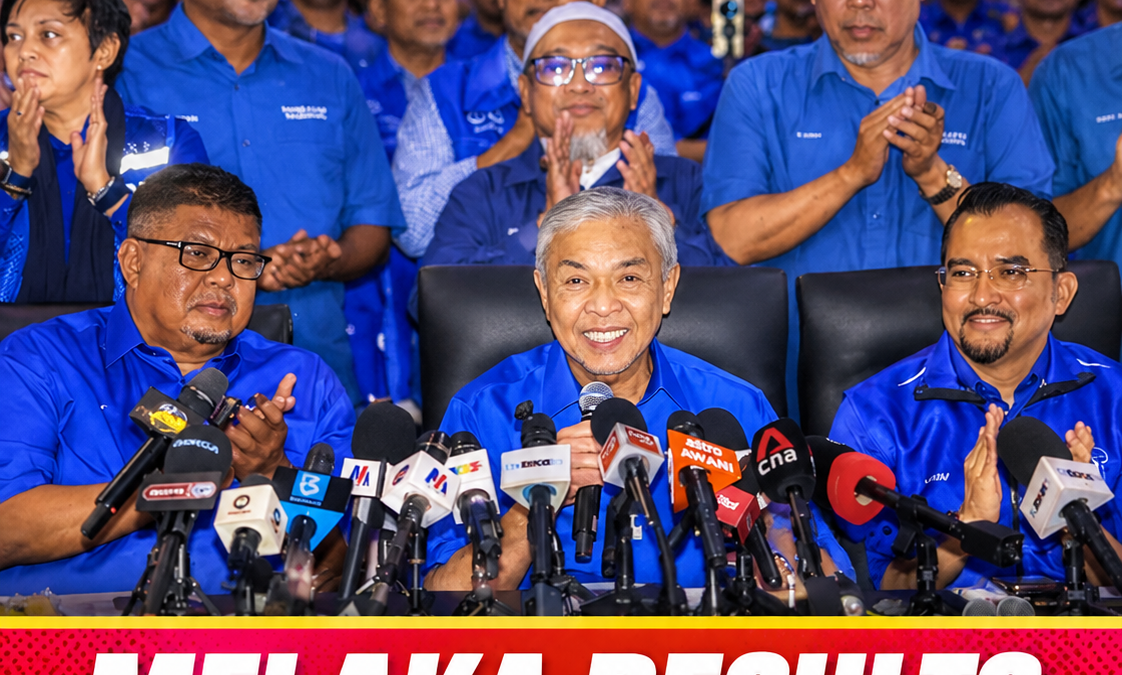
Melaka’s 16th state election has delivered a commanding legislative position for Barisan Nasional (BN), which secured 21 of the state’s 28 assembly seats on Nov. 14, 2026, while its election partner Perikatan Nasional (PN) captured three.
The final distribution leaves Pakatan Harapan (PH) with four seats and gives the BN–PN partnership 24 seats, more than the 19 needed for a two-thirds majority in the Melaka State Legislative Assembly. EC+2
The result has consequences beyond the formation of the next state administration. It gives BN a substantial independent mandate while placing PN in a position to contribute to a governing bloc with a supermajority.
For Malaysia’s national political landscape, however, the result should be interpreted carefully. A state election can reveal the strength of political alliances, but it does not automatically predict how voters will behave in a federal general election.
Melaka Election Results: BN Dominates the 28-Seat Assembly
The Election Commission’s final announcement placed BN firmly ahead of its competitors.
The distribution was:
| Coalition | Seats won |
|---|---|
| Barisan Nasional | 21 |
| Perikatan Nasional | 3 |
| Pakatan Harapan | 4 |
| Total | 28 |
BN’s 21 seats represent 75% of the assembly. PN’s three seats bring the combined BN–PN total to 24, equivalent to approximately 85.7% of the available seats.
The difference between a simple majority and a two-thirds majority is significant.
In a 28-seat assembly, 15 seats are enough to command a simple majority. Nineteen seats are required to reach the two-thirds threshold.
BN therefore has enough seats to form a majority government without depending on PN’s three representatives. Nevertheless, their combined position gives the partnership a substantially larger legislative presence.
The election involved 79 candidates across the 28 constituencies, as confirmed in the Election Commission’s candidate-nomination statement. spr.gov.my+1
Why the BN–PN Partnership Matters More Than the Seat Count
The election arrangement itself provides important context.
Before polling, BN contested 23 constituencies while PN contested five. The two groups therefore divided the electoral field rather than running competing candidates in every constituency.
That arrangement was publicly discussed by BN chairman and UMNO president Datuk Seri Dr Ahmad Zahid Hamidi during the campaign. Ahmad Zahid+1
The final outcome gives both sides different political positions.
BN emerged as the dominant coalition, winning 21 seats. PN secured three representatives, giving it a smaller but meaningful presence in the incoming assembly.
For BN, the result demonstrates that its candidates secured enough constituencies to govern with a majority on their own.
For PN, participation in the alliance provides a route into the state’s governing arrangement without requiring it to become the largest electoral force.
This distinction is important when assessing the partnership’s future.
A coalition can have a strong combined majority while its component parties retain different levels of influence and political priorities.
WWC ONE MEDIA previously examined the changing relationship between UMNO and Malaysia’s political alliances in its report on UMNO’s position inside Anwar Ibrahim’s government and its preparations for GE16.
Ab Rauf Yusoh Emerges as the BN–PN Chief Minister Candidate
Leadership continuity is another major issue following the result.
On election night, Ahmad Zahid announced that BN and PN had agreed to nominate Datuk Seri Dr Ab Rauf Yusoh as their candidate for Melaka chief minister.
The announcement was made following the coalition’s electoral victory at the BN operations centre in Melaka.
Zahid also said that an appointment letter would be sent to the Yang di-Pertua Negeri Melaka. umno-online.my
The distinction between a political nomination and a formal appointment is important.
The coalition’s announcement establishes its preferred candidate, but the constitutional appointment process remains a separate matter.
Ab Rauf’s continued leadership would provide administrative continuity, particularly in areas where projects and government programmes require consistent implementation.
It would also give the incoming administration an opportunity to demonstrate whether its enlarged legislative position can translate into effective public service delivery.
For residents, the more important question is not simply who occupies the chief minister’s office. It is whether the administration can improve employment opportunities, infrastructure, tourism and local economic conditions.
PH’s Four Seats Leave It With a Smaller Legislative Position
PH secured four constituencies, leaving it with a significantly smaller share of the 28-seat assembly.
The result means the coalition will have a limited numerical position compared with the combined BN–PN bloc.
However, a smaller opposition presence does not remove the importance of legislative scrutiny.
Questions about public expenditure, state development projects, administrative performance and the delivery of government commitments remain relevant regardless of which coalition holds the majority.
The four PH representatives will have an opportunity to raise constituency concerns and examine the incoming administration’s decisions.
A strong majority also creates greater responsibility for the governing bloc.
When one political partnership holds 24 seats, the public will reasonably expect it to demonstrate coordination, accountability and measurable progress.
This is particularly important because a large majority does not automatically guarantee effective administration.
Could the Melaka Result Influence Malaysia’s GE16?
The political implications extend beyond the state, especially as Malaysian parties continue positioning themselves ahead of the next general election.
BN and UMNO have previously discussed the timing of GE16 and the possibility of strengthening their electoral position.
However, the Melaka result should not be treated as proof that the same political arrangement will necessarily succeed nationwide.
State elections involve local candidates, constituency issues and different political calculations.
Federal elections involve a much broader electorate and competition across parliamentary constituencies throughout Malaysia.
The result nevertheless provides an opportunity for BN and PN to assess their cooperation.
It also raises questions about how the two coalitions will manage candidate selection, constituency negotiations and political representation in future contests.
For additional context, WWC ONE MEDIA has examined the internal pressures surrounding Perikatan Nasional’s organisational position.
The wider economic environment will also matter as political parties compete for public confidence. Malaysia’s 2027 budget and its household and fiscal priorities provide another important part of that national political backdrop.
What Happens Next?
The immediate priority is the formation of the new Melaka administration and the completion of the chief minister appointment process.
The BN–PN partnership will also need to establish how its representatives will work together in the assembly.
The incoming administration will face expectations involving infrastructure, investment, tourism, employment and public services.
For BN, the challenge is to turn its 21-seat victory into visible results.
For PN, the challenge is to demonstrate that its participation in the partnership brings meaningful representation and constructive contributions to state governance.
For PH, the next phase will involve maintaining an effective opposition presence despite its reduced number of seats.
The broader political question is whether the cooperation demonstrated in Melaka can develop into a more durable arrangement ahead of Malaysia’s next national election.
The result has established the numbers. The performance of the new administration will determine what those numbers ultimately mean for Melaka’s residents.
Frequently Asked Questions
1. Who won the 2026 Melaka state election?
Barisan Nasional won 21 of the 28 state assembly seats, making it the largest political force in the incoming assembly.
2. How many seats did PN win in Melaka?
Perikatan Nasional secured three seats.
3. Did BN and PN secure a two-thirds majority?
Yes. Their combined 24 seats exceed the 19 seats needed for a two-thirds majority in the 28-seat assembly.
4. Who was nominated as Melaka chief minister after the election?
BN chairman Ahmad Zahid Hamidi announced Datuk Seri Dr Ab Rauf Yusoh as the BN–PN candidate for chief minister. This nomination should be distinguished from the formal appointment.
5. Does the Melaka election determine Malaysia’s next prime minister?
No. It determines representation in the Melaka state assembly, not the composition of Malaysia’s federal government.