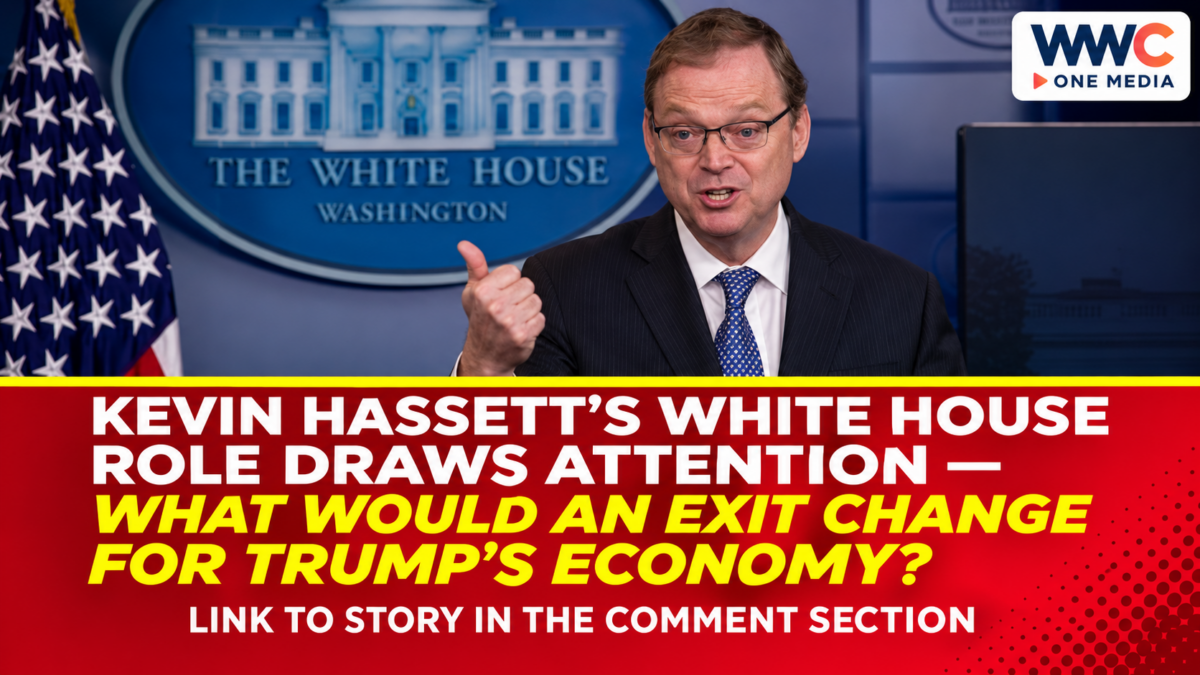
MANILA, Philippines — Nov. 14, 2026. Kevin Hassett remains identified as director of the White House National Economic Council in current official government material, as speculation about a possible departure puts attention on the machinery behind President Donald Trump’s economic decisions. A Nov. 13 report of a denial by Hassett and the White House has circulated, but a directly accessible official statement confirming that specific exchange was not located for this review.
The distinction matters because the National Economic Council coordinates economic policy across departments. A change at its top could alter how advice reaches the president without automatically changing tax laws, tariffs, Federal Reserve decisions or the powers of the Treasury Department.
Kevin Hassett White House Role: What the Records Confirm
The White House’s July 1, 2026 annual personnel report lists Hassett as assistant to the president for economic policy and director of the National Economic Council. It records an annual salary of US$195,200 for that position. This is a historical personnel snapshot rather than a live roster of appointments on Nov. 14.
Hassett’s 2026 public financial disclosure also identifies him in the council director position. He electronically signed that annual report on June 24, 2026. Its appointment information identifies January 2025, while its termination-date field was blank when the document was filed.
More recently, a White House release discussing the October employment report identified Hassett as National Economic Council director and reproduced his public commentary on job-market conditions. This is evidence that the administration continued to present him in that role after the July staffing report.
None of those documents is a signed employment agreement guaranteeing service through a particular future date. The distinction between holding office, denying a report and committing to stay indefinitely is important.
Why the National Economic Council Matters
The council’s role is fundamentally about coordination. Economic choices often cross several agencies: a trade decision can affect tariff collections, factory costs, supply chains and diplomatic negotiations, while an energy measure can intersect with federal spending and industrial policy.
An original White House memorandum dated Jan. 21, 2025, jointly issued by Hassett and the acting director of the Office of Management and Budget, illustrates that coordinating function. It provided guidance to federal departments about an executive order affecting certain energy-related disbursements.
That memorandum was an administrative instruction within a defined policy process. It was not proof that Hassett personally controlled every expenditure or independently set trade and monetary policies.
Analysis: Whoever leads the council has influence over which issues receive attention and how disagreements between agencies are presented. Yet a personnel change does not by itself repeal legislation, cancel contracts or settle unresolved negotiations.
Jobs and Inflation Are the Economic Backdrop
The White House’s November employment commentary highlighted 165,000 jobs added in October 2026 and an unemployment rate of 4.1%, while presenting the result as evidence of progress under the administration. Its release also included Hassett’s positive interpretation of the figures.
Those are the administration’s selected figures and assessment; a political statement about economic strength should not be confused with a complete evaluation of wages, prices, labour-force participation or household living costs.
For investors and businesses, the relevant questions remain whether employment gains are sustained, whether inflation changes purchasing power and how companies respond to the cost of capital. An adviser can influence how an administration frames those indicators, but cannot directly determine their next readings.
The distinction also applies to forecasts. Strong reported hiring in a single month does not guarantee faster growth in the following quarter, just as one weak reading would not independently prove a recession.
Trade Decisions Extend Beyond One Adviser
Economic policy has international consequences. Treasury officials and trade negotiators hold separate statutory and administrative responsibilities, while the president makes decisions subject to the legal framework governing trade measures.
WWC’s examination of Trump’s US-China trade discussions describes a separate November dispute over economic commitments. That ongoing diplomatic subject would not automatically be settled by a White House staffing announcement.
Analysis: A leadership transition at the council could change the pace or style of internal coordination. Assessing whether policy actually shifted would require subsequent executive orders, agency notices, negotiated agreements or legislation—not just an announcement about who attends meetings.
This matters for Philippine exporters because US tariff and demand conditions can influence overseas orders. It would be unsound, however, to attach a particular peso movement or export loss to unconfirmed speculation about one adviser.
The Federal Reserve Is a Separate Decision-Maker
Hassett previously chaired the White House Council of Economic Advisers, with official historical records giving service dates from Sept. 13, 2017 to June 30, 2019. That earlier position is distinct from his current National Economic Council job.
The Federal Reserve also operates under a different institutional structure. Its monetary-policy committee—not the White House economic council—votes on the federal funds rate. A change in White House personnel is therefore not itself an interest-rate decision.
WWC has covered Federal Reserve Chair Kevin Warsh’s approach to policy communication and the continuing dispute involving Federal Reserve Governor Lisa Cook. Those are separate institutional matters, not evidence that Hassett has resigned or that a replacement has been chosen.
Analysis: Investors should distinguish a personnel rumour from an implemented policy action. Bond markets may respond to expectations, but any precise impact on interest rates requires actual market data and a defensible causal analysis.
What Happens Next
The decisive records would be a formal White House personnel announcement, a direct statement issued by Hassett, or a subsequently updated government directory. Until such evidence emerges, naming a successor or announcing a confirmed exit would go beyond the primary record.
For now, the official documents establish his position and continuing participation in the administration’s economic messaging. They do not independently authenticate the private Nov. 13 exchange with journalists or lock in his future tenure. The practical test is whether government policy documents change—not whether an unverified forecast of staff turnover gains attention.
Frequently Asked Questions
What is Kevin Hassett’s official White House job?
The July 2026 personnel report identifies him as assistant to the president for economic policy and director of the National Economic Council. A later White House release also uses that title.
Has Hassett officially announced that he is leaving?
No original resignation announcement was authenticated in the official records inspected. Reports of a Nov. 13 denial likewise require a directly accessible first-party statement to satisfy a strict primary-record standard.
Does the National Economic Council set Federal Reserve rates?
No. Federal Reserve monetary-policy decisions are made through the central bank’s own statutory process and voting committee.
Would replacing an economic adviser automatically change US tariffs?
No. Any change in tariff policy must be established through the relevant presidential, agency or legislative action rather than assumed from a personnel change.