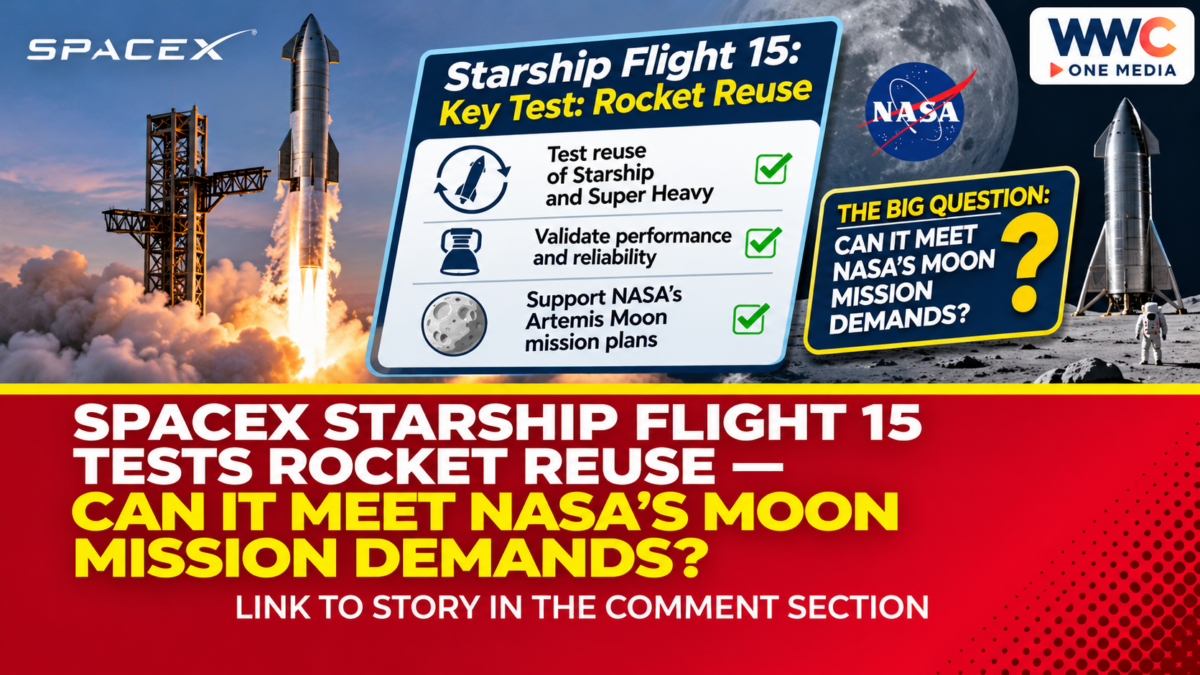
UNITED STATES — Nov. 14, 2026. SpaceX’s Starship Flight 15 entered its planned test window on Nov. 13 at Starbase, Texas, with US aviation authorities reserving separate airspace periods for launch and the spacecraft’s return. The mission brings a central engineering challenge into focus: developing a powerful rocket is one task, but reliably recovering its stages and preparing them for another flight is another.
The Federal Aviation Administration’s operational plan confirms the scheduled activity, not the full results of every manoeuvre. A complete mission assessment requires the operator’s flight data and any subsequent regulatory findings. The wider stakes are documented: NASA is developing Starship as part of its human lunar landing programme, whose requirements go well beyond reaching orbit.
SpaceX Starship Flight 15: What the Official Schedule Establishes
The FAA’s Nov. 13 air traffic operations plan lists Starship Flight 15 at Starbase with a primary launch window of 22:45 UTC on Nov. 13 to 00:40 UTC on Nov. 14. It separately lists a re-entry window beginning 20:56 UTC on Nov. 14, extending into Nov. 15. These are planned airspace-management intervals, not proof that the spacecraft completed its return during those periods.
In Philippine time, the listed launch window begins on the morning of Nov. 14. The date differs for Philippine readers.
Contemporary accounts describe a liftoff and difficulty recovering the Super Heavy booster. But no complete first-party post-flight account was accessible. An independent article should therefore avoid certifying the booster failure mechanism, satellite deployment count or spacecraft landing result on secondary reporting alone.
Launching Is Only One Part of Full Reusability
Starship consists of a Super Heavy launch booster and an upper-stage spacecraft. SpaceX’s documented goal is a system capable of repeated missions, rather than treating major rocket stages as disposable hardware after every launch.
A reusable programme must demonstrate several separate capabilities: controlled ascent, stage separation, the return of each vehicle, safe recovery and inspection before another mission. Successfully completing one of these activities does not establish that the others have been achieved.
Analysis: Recovery is commercially important because a rocket that must be rebuilt after every flight cannot offer the same potential production savings as a vehicle that can be inspected, refurbished and flown again. Yet reusability has its own costs, including inspection work, replacement parts and recovery infrastructure. Repeated performance is the business test.
WWC has examined the significance of SpaceX’s aerospace supply chain and reusable-launch components. That discussion concerns supplier economics rather than Flight 15’s outcome, but it illustrates why increased flight frequency affects more than the rocket manufacturer.
Why NASA Is Watching the Starship Programme
NASA’s Oct. 23 update confirms that SpaceX and Blue Origin are both working on human landing systems for future Artemis lunar missions. The agency changed its mission architecture so Artemis III will involve testing rendezvous and docking capabilities in low Earth orbit, rather than carrying out the previously assigned crewed Moon landing.
NASA’s revised approach targets a return of astronauts to the Moon in 2028. SpaceX must satisfy requirements related to its crew cabin, operations and safe transportation before a lunar landing mission can be considered ready. Those requirements are not completed simply because an uncrewed Starship test leaves the launchpad.
The agency also announced additional SpaceX crew-cabin demonstrations, intended to give NASA more insight into the design and reduce risk before astronauts use the system. The revision does not assign an exclusive lunar landing to either provider.
WWC’s previous coverage of SpaceX’s continuing relationship with NASA and government customers offers commercial background. NASA’s safety requirements are distinct from company revenue.
What Earlier Safety Reviews Tell Us
The FAA’s publicly posted statements show how it handles previous Starship mishaps. For Flight 12 in May 2026, the regulator required a SpaceX-led mishap investigation subject to FAA oversight. Its statement described an investigation as a way to identify a root cause and corrective actions.
That earlier case is not a finding about Flight 15. It shows that returning to flight may require separate safety work.
A launch-window notice serves a different purpose from an accident investigation. The former helps air traffic authorities manage aircraft around a launch or re-entry hazard area. The latter examines evidence about what happened and whether future operations can proceed safely.
Analysis: Safety oversight and commercial schedules must be evaluated separately. A target date alone cannot resolve a technical anomaly.
The Business Case Depends on Repeat Performance
The economic attraction of a larger reusable rocket is the possibility of moving more material to orbit while reducing the need to manufacture a wholly new vehicle each time. Those potential benefits remain conditional on reliable operations and sustainable refurbishment costs.
Starship’s development also has implications for satellite deployment and the companies making propulsion, structures, electronics and ground equipment. But an experimental flight does not by itself establish a company’s launch revenue or prove that any individual supplier has won a new contract.
WWC’s separate examination of SpaceX’s earnings and capital-investment ambitions provides wider business context. Those projections do not verify Flight 15 results or launch costs.
For Philippine readers, no primary record connects Flight 15 to changes in local Starlink prices or connectivity.
What Happens Next
A proper Flight 15 assessment needs SpaceX’s original mission recap, time-stamped flight milestones, confirmation of any payload activity and the final disposition of the booster and spacecraft. Any FAA-required investigation or other safety determination should also be inspected before reporting a technical cause.
NASA’s published Artemis milestones offer a separate benchmark: the space agency needs verified demonstrations of the systems it intends to use for human operations. Reaching orbit advances testing, but reliable recovery, repeat flights and a safe lunar-lander architecture remain separate challenges.
Until the full official flight report is available, Flight 15 should be assessed by documented objectives rather than declared a complete victory or a complete failure.
Frequently Asked Questions
When was Starship Flight 15 scheduled?
The FAA listed a primary launch window beginning at 22:45 UTC on Nov. 13, 2026, with a separate re-entry window on Nov. 14–15. A window is not confirmation of an individual flight milestone.
Did SpaceX recover both stages successfully?
The accessible first-party material examined for this article did not provide a complete authenticated recovery report. A definitive outcome needs SpaceX’s flight recap or an official investigation record.
Why does Starship matter to NASA?
NASA is developing Starship as one of its human landing system options for future Artemis lunar missions, with a revised programme targeting a crewed Moon return in 2028.
Does one test flight certify Starship for astronauts?
No. Human spaceflight requires additional engineering demonstrations, operational reviews and safety assessments beyond a single uncrewed launch.