MANILA, Philippines — Nov. 14, 2026. The Bangko Sentral ng Pilipinas (BSP) has an established risk-based rule requiring additional scrutiny of cash payouts exceeding ₱1 million within a banking day, while a newly reported holiday exemption has yet to be matched to a directly accessible central-bank memorandum. The distinction matters for depositors and businesses preparing large year-end payments: the documented rule and a reported temporary suspension cannot be treated as the same legal instruction.
BSP Circular No. 1230, dated Feb. 27, 2026, describes how banks assess these withdrawals and when an existing customer review can be used. Until a signed new issuance is inspected, the reported Nov. 13-to-Jan. 31 relaxation should be regarded as a claim requiring confirmation, not a blanket permission to withdraw unlimited physical cash without checks.
BSP Cash Withdrawal Rules: What the Circular Actually Says
The central bank’s Circular No. 1230 amended its regulation on large-value payouts by setting the enhanced due diligence, or EDD, trigger at more than ₱1 million, including the equivalent amount in foreign currency. The calculation covers a single withdrawal or several cash payouts within one banking day.
The earlier Circular No. 1218, issued in September 2025, had used a ₱500,000 threshold. The 2026 change is therefore a documented increase in the amount at which the additional review is triggered; it is not an unconditional right to collect any amount of banknotes immediately.
The regulation applies to BSP-supervised financial institutions. It also permits institutions to use lower internal cash-transaction limits when justified by their money-laundering, terrorism-financing and proliferation-financing risk assessments or by a customer’s financial profile.
That distinction matters at the branch counter. Banks may request different documents depending on customer risk and transaction history.
Customer Reviews Are Not Required Anew Every Time
Circular No. 1230 specifies that enhanced due diligence is conducted at the customer level. A bank need not repeat the entire exercise for each qualifying withdrawal when it has already completed appropriate checks on the customer.
The BSP’s earlier Memorandum No. M-2026-005, dated Feb. 6, instructed banks to streamline review of usual business transactions and train branch personnel so legitimate payouts are not unnecessarily delayed. It also described proportionate treatment for interbank cash needs, loan disbursements and other transactions consistent with an institution’s knowledge of its customers.
This does not eliminate the need to verify activity that falls outside an expected pattern. A previously reviewed company that suddenly requests an unusually large, unexplained cash payout may still face questions. The decision depends on the evidence and the bank’s risk-based procedures.
Businesses can coordinate expected cash needs and documents with their branches, though approval is not guaranteed.
The Holiday Exemption Still Needs Its Signed Record
A report published on Nov. 14 describes a temporary suspension of automatic enhanced due diligence for cash withdrawals exceeding ₱1 million from Nov. 13, 2026, through Jan. 31, 2027. But an original BSP memorandum establishing those dates and its precise conditions was not located in the official documents directly examined for this article.
Consequently, the dates, scope, covered institutions and possible exceptions must remain provisional. They should not be substituted for Circular No. 1230 when explaining what a depositor is legally entitled to do today.
Even a temporary review exemption would not necessarily end other anti-money-laundering duties.
A customer should ask the bank for its current written advisory and the specific BSP issuance it implements. If an authenticated holiday memorandum becomes available, its operative language—not an abbreviated headline—should determine the revised guidance.
Why Banks May Still Ask Questions About Cash
Circular No. 1230 directs supervised institutions to monitor higher-risk transactions. If a bank cannot satisfactorily complete enhanced due diligence, or reasonably believes conducting it could alert a customer to a suspicious review, the regulation calls for a suspicious-transaction report and closer account monitoring.
The circular also requires institutions to consider red flags, risk indicators and suspicious patterns identified by competent authorities. Those safeguards address how cash may be used to move or conceal illicit funds; the size of a withdrawal alone does not establish criminal conduct.
WWC has separately covered the anti-money-laundering compliance challenge facing Philippine banks in 2027. That broader regulatory context helps explain why customer convenience and transaction monitoring must be considered together rather than treated as competing absolutes.
The cash-withdrawal review threshold should also not be confused with every separate reporting threshold or with rules for carrying banknotes across national borders. Those involve different legal questions and should be checked against their applicable regulations.
Why the Philippines Still Needs Both Cash and Digital Transfers
Analysis: Physical currency remains useful for payments where recipients cannot readily accept electronic transfers. However, moving a large amount of banknotes creates handling, storage and security concerns that traceable electronic payments can reduce in some circumstances.
WWC’s report on the rising share of Philippine digital payments examines the country’s gradual shift toward electronic transactions. That trend does not mean every vendor, worker or community can already operate without cash.
The practical question for a business is whether a transfer, cheque or digital payment can satisfy the recipient’s needs while providing an adequate record. Where physical cash is necessary, advance coordination with a bank and proper supporting documents may help avoid delays.
The same distinction appears in WWC’s coverage of InstaPay and PESONet transaction growth. Such networks still require fraud safeguards.
Neither easier cash access nor a growing digital network guarantees that a particular transaction is safe. Both channels require proportionate controls and clear customer guidance.
What Happens Next
The decisive next document is the signed BSP memorandum reportedly suspending automatic reviews over the holiday period. An updated bank advisory tied to that memorandum would also help establish how the exception works in practice and whether any requirements remain unchanged.
Until then, the directly verified rule is Circular No. 1230’s more-than-₱1-million risk-based EDD trigger, with customer-level assessments and stronger monitoring where risks warrant it. Readers should not act on the reported Jan. 31 expiry date without checking the central bank’s original notice.
Frequently Asked Questions
Are cash withdrawals above ₱1 million banned in the Philippines?
No. Circular No. 1230 establishes an enhanced-due-diligence trigger, not a universal prohibition on every larger cash payout. Banks may require supporting information and apply their own risk-based controls.
Does the ₱1 million threshold apply per transaction?
It covers a single cash payout or multiple cash payouts aggregated within one banking day. The regulation calls for customer-level rather than automatically repeated transaction-by-transaction review.
Has BSP officially waived the checks until Jan. 31, 2027?
A temporary exemption has been reported, but the signed original memorandum was not directly authenticated for this article. Customers should confirm the current requirements with their bank and BSP’s official issuance.
Can my bank request documents even below ₱1 million?
Yes. BSP permits supervised institutions to adopt lower cash-transaction limits based on their risk assessment and the customer’s financial profile.
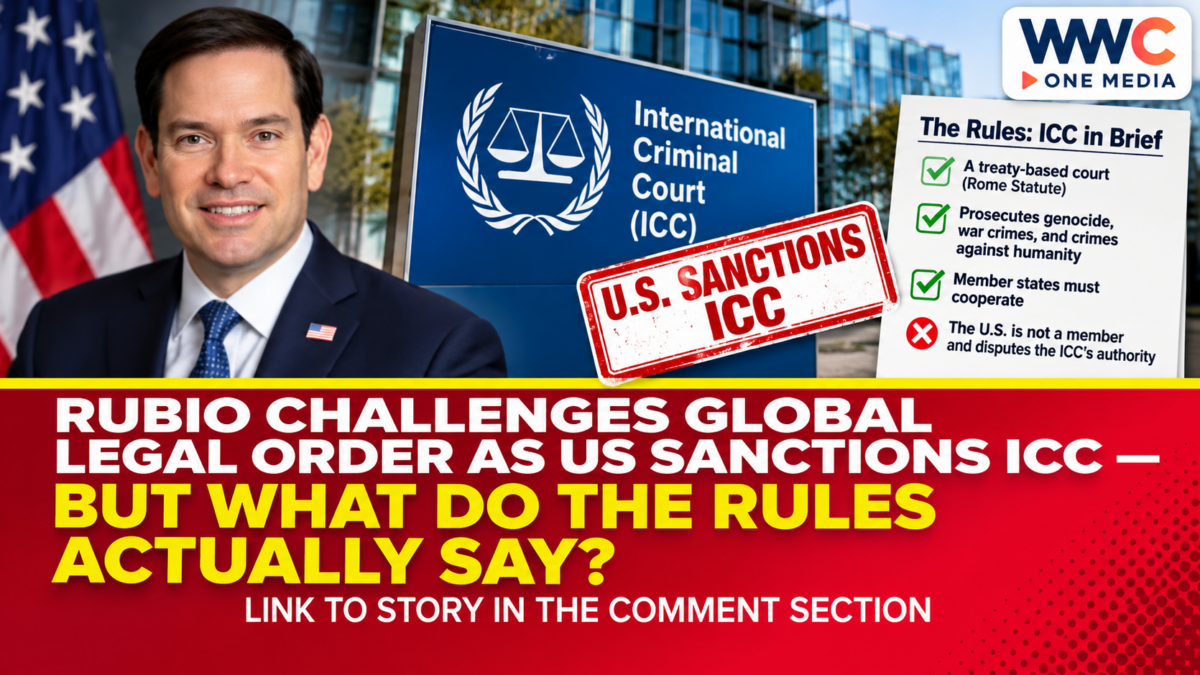
WASHINGTON — US Secretary of State Marco Rubio appeared at the Federalist Society’s National Lawyers Convention on Nov. 13, 2026, while Washington’s sanctions against International Criminal Court personnel remained in force. The event placed a longstanding disagreement over national sovereignty and international criminal jurisdiction in the spotlight, although an authenticated transcript of Rubio’s full remarks was not available for this review.
Rubio’s November Speech Meets an Existing Legal Dispute
The Federalist Society’s published convention programme lists Rubio as the featured speaker for the 25th Annual Barbara K. Olson Memorial Lecture on Friday, Nov. 13, at the Mayflower Hotel in Washington. The programme identifies him as US Secretary of State and National Security Advisor, and includes an event-video listing.
These are details the host publicly documented; they do not, by themselves, verify every sentence later attributed to Rubio or establish that new policy was announced at the lecture.
Reports describing Rubio’s criticism of international institutions may point towards the debate, but a reported preview of prepared remarks is not a substitute for an official transcript or recording inspected and transcribed. No disputed direct quotation is needed to explain the central issue.
US Sanctions Against the ICC Are Already in Place
The US Treasury’s Office of Foreign Assets Control maintains a dedicated International Criminal Court-related sanctions programme. Its public legal framework identifies Executive Order 14203, dated Feb. 6, 2025, and implementing regulations under 31 CFR Part 528.
The sanctions programme has involved designations of individuals and the publication of general licences permitting certain otherwise restricted transactions. In October 2026, OFAC issued additional licences covering specified ICC-related activities, including certain telecommunications and enterprise-software transactions.
That means the sanctions system cannot be reduced to a simple statement that all dealings with the court are prohibited. The effect on a particular transaction depends on the designated parties, the relevant legal prohibition and whether a licence or exception applies.
Earlier WWC reporting on the ICC president’s response to US sanctions explored the institutional conflict. The current primary records provide a narrower but clearer conclusion: sanctions and specific licensing measures coexist, and neither amounts to dissolution of the court.
What the ICC’s Founding Treaty Actually Provides
The Rome Statute created the International Criminal Court as a permanent institution for specified international crimes. The court’s own description identifies genocide, crimes against humanity, war crimes and the crime of aggression within its treaty-defined mandate.
Importantly, the court is designed to complement national criminal justice systems, rather than automatically replace them. Under the principle of complementarity, domestic authorities retain the primary role when they genuinely investigate and prosecute conduct within their jurisdiction.
The treaty also contains rules governing when the court can exercise jurisdiction. Arguments over those rules are not the same thing as a finding that any government or official has violated them. Courts and governments can disagree on interpretation while the text of the treaty remains publicly available.
Washington’s executive order expresses the administration’s objection to ICC action involving US personnel and certain allied officials. The ICC, meanwhile, describes its mandate as treaty-based and limited by jurisdictional and admissibility requirements. These are competing institutional positions, not evidence that one side’s broad political description has become a universal legal determination.
Previous WWC coverage of the ICC prosecutor’s response to Washington illustrates the disagreement. The practical question is which legal authorities apply to particular cases, not whether an international tribunal possesses unlimited power.
Why the Debate Matters to the Philippines
For Filipino readers, the disagreement has a concrete legal dimension. The ICC Appeals Chamber issued a decision on April 22, 2026, confirming jurisdiction in the case involving former Philippine President Rodrigo Roa Duterte, following an appeal by the defence.
The chamber’s public announcement describes the relevant alleged conduct as occurring while the Philippines was a party to the Rome Statute, between Nov. 1, 2011, and March 16, 2019. The decision concerns jurisdiction. It is not a finding that the accused committed the alleged crimes, and the presumption of innocence remains essential.
The ruling shows why membership dates and treaty provisions cannot be replaced by general political statements about sovereignty. Whether particular proceedings are permitted turns on the law and the facts of the case, including the period in question.
Those distinctions also help put WWC’s coverage of how US sanctions relate to the Duterte proceedings into context. Disagreements between Washington and the court may affect diplomacy and the practical operation of international justice, but do not themselves rewrite judicial rulings.
What This Could Mean for Global Institutions
Analysis: Rubio’s appearance at a legal convention arrives amid an existing contest over how national governments should interact with international judicial institutions. The principal policy choices extend beyond speeches: governments can enforce sanctions, grant licences, negotiate arrangements and take positions in diplomatic forums.
Supporters of stronger national control may regard oversight of international institutions as necessary to preserve democratic accountability. Supporters of the ICC may regard cooperation as important to accountability for grave crimes when domestic systems cannot genuinely act. Neither policy perspective eliminates the need to examine jurisdiction, due process and the applicable legal text.
What Happens Next
The immediate evidence to watch is not a speculative forecast about the end of international law. It is any additional official State Department explanation of Rubio’s remarks, new OFAC designations or licences, and decisions issued by the ICC under its procedures.
The Nov. 13 event does not establish that a new sanctions order was signed during the lecture, that the United States joined or left the court, or that any particular ICC prosecution was cancelled. Readers should distinguish future announcements from existing measures before drawing conclusions about changes in US policy.
Frequently Asked Questions
What did Marco Rubio do on Nov. 13, 2026?
He was listed as the featured speaker at the Federalist Society’s Barbara K. Olson Memorial Lecture in Washington, which the organiser identifies as a completed event. This review could not authenticate the exact language of the full speech.
Has the US imposed sanctions related to the ICC?
Yes. OFAC administers an ICC-related sanctions programme based on an executive order and federal regulations. Specific restrictions, designations and exemptions must be checked separately.
Is the International Criminal Court part of the United Nations?
No. It is a treaty-established court with a formal relationship to the UN, rather than an ordinary UN department.
Can the ICC replace domestic courts?
The Rome Statute establishes a complementary role. Genuine national proceedings can affect whether a case is admissible before the ICC.
Does the US dispute change the Duterte jurisdiction ruling?
No automatic change follows. The ICC Appeals Chamber issued its jurisdiction ruling on April 22, 2026; any subsequent development would require its own applicable judicial action.