
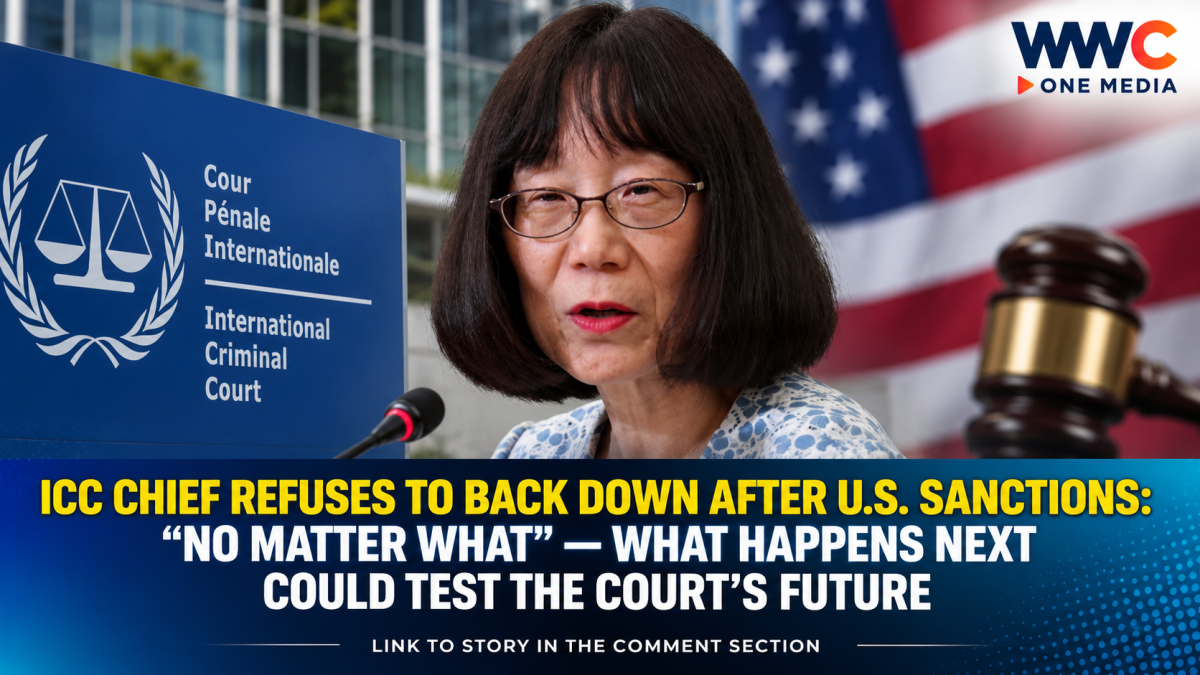
THE HAGUE — International Criminal Court President Tomoko Akane has vowed to continue carrying out her duties despite being targeted by U.S. sanctions, declaring that she remains determined to defend the court’s work amid escalating pressure from Washington.
Speaking online at an event in Tokyo on Sunday, Akane said she remained firm in her conviction and would continue doing her job “no matter what,” even as the sanctions have created serious financial and personal difficulties for her.
Her defiance comes weeks after the United States imposed sanctions on Akane and ICC senior trial lawyer Abdoulaye Seye, marking another major escalation in Washington’s campaign against the Hague-based tribunal.
The latest U.S. measures were announced on Aug. 18. U.S. Secretary of State Marco Rubio said Akane and Seye had directly participated in ICC efforts to investigate or prosecute officials whose governments had not consented to the court’s jurisdiction.
Akane says sanctions will not stop her
Akane has repeatedly rejected the idea that the sanctions should force her to step aside.
In an earlier online press conference hosted by the Japan National Press Club, she said there was “no reason” for her to have been sanctioned and described the situation as a crisis for the rule of law.
She also said she would resist the pressure and urged Japan and other ICC member states to help protect the court’s independence.
Her latest remarks were even more forceful.
According to Japan Times, Akane described the ICC as the world’s “last bastion” of the rule of law and said international support would be necessary for the court to continue operating.
She also revealed that the sanctions had already affected her personally. While she has been able to receive her salary through a local bank, she said she has experienced difficulties with financial transfers and that some companies have refused to conduct transactions with her because of the sanctions.
Why Washington sanctioned Akane
The U.S. sanctions are part of the Trump administration’s broader campaign against the ICC.
Washington has strongly objected to ICC investigations involving U.S. personnel as well as Israeli officials. The court issued arrest warrants in November 2024 for Israeli Prime Minister Benjamin Netanyahu and then-defense minister Yoav Gallant over alleged war crimes in Gaza.
The United States is not a member of the ICC, but the court maintains that it can exercise jurisdiction in certain circumstances, including crimes committed on the territory of a member state.
The U.S. government argues that the ICC has overstepped its authority and threatened American sovereignty.
The sanctions freeze any assets belonging to designated individuals that are within U.S. jurisdiction and restrict their access to the U.S.-linked financial system. They also carry travel consequences for sanctioned officials and their families.
Japan pushes back against the sanctions
The dispute has also put Japan in a delicate position.
Japan has been a strong supporter of the ICC and is its largest financial contributor. The Japanese government described the U.S. sanctions against Akane as “very unfortunate” and reiterated Tokyo’s support for the court and the international rule of law.
Former Japanese Defense Minister Gen Nakatani has gone further, urging Prime Minister Sanae Takaichi’s government to challenge Washington more forcefully.
Nakatani said the sanctions represent an attack on the rules-based international order and argued that Japan should not have to choose between its alliance with the United States and its commitment to the rule of law.
Pressure on the ICC is growing
Akane’s confrontation with Washington comes as the ICC faces broader efforts to isolate the institution.
The current and former presidents of the ICC’s governing Assembly of States Parties recently warned that attempts to undermine or isolate the court could damage the international legal system itself.
They argued that efforts to persuade countries to abandon or weaken the Rome Statute threaten the foundation of the international justice system.
The ICC was established in 2002 as a court of last resort for individuals accused of genocide, war crimes and crimes against humanity when national justice systems are unable or unwilling to genuinely prosecute such offenses.
The court currently has 125 member states, including Japan.
Akane refuses to retreat
Despite the growing pressure, Akane has made clear that she does not intend to abandon her position.
She has described the sanctions as an attempt to suppress justice through external pressure and said the court must continue operating despite threats against its officials.
The ICC has likewise condemned the U.S. measures, warning that targeting judicial officials for carrying out their legal responsibilities threatens the independence of international justice.
For Akane, the confrontation is now bigger than her own position.
It is a test of whether an international court can continue pursuing cases involving powerful governments when those governments reject its authority.
And as pressure from Washington intensifies, Akane’s message remains unchanged: she intends to continue the job — no matter what.
WWC ONE MEDIA J.M.S




Leave a Reply