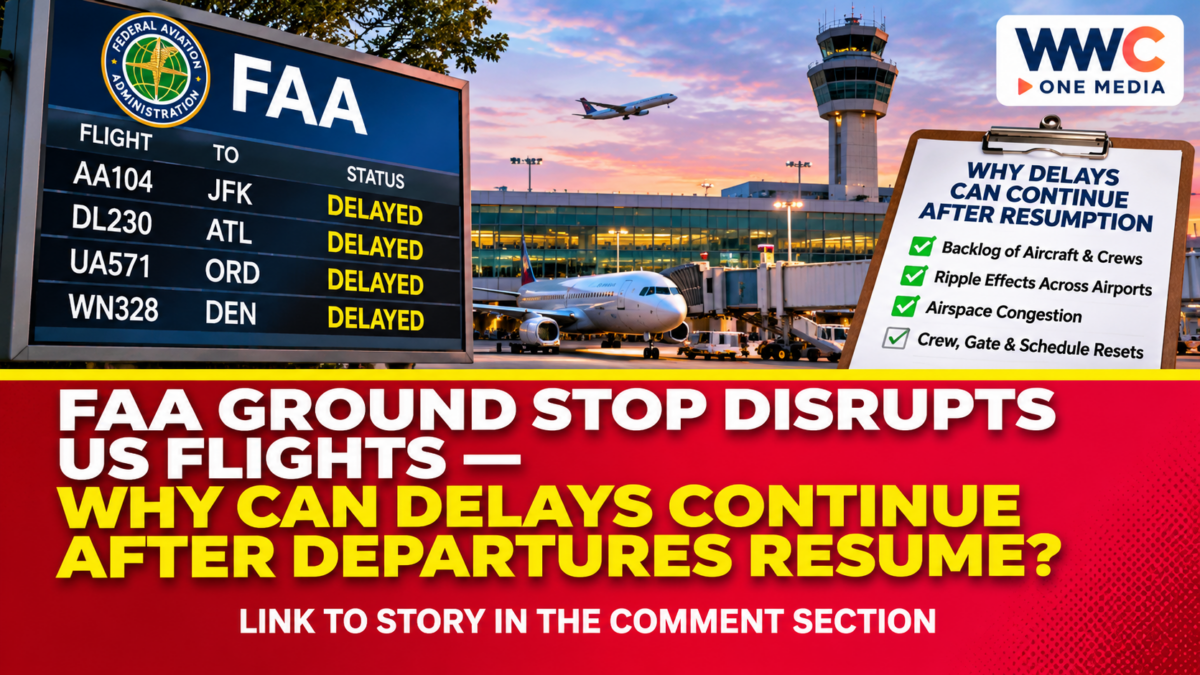
UNITED STATES — Nov. 14, 2026. US air traffic operations faced an extraordinary interruption on Nov. 13 as aviation authorities imposed a nationwide departure restriction amid reported communication problems. Subsequent reports indicated that aircraft departures were allowed to resume, but the exact nationwide cancellation notice and reopening time could not be independently authenticated from an accessible original FAA record during this review.
A ground stop addresses whether a flight may depart at a particular moment; lifting it does not automatically put aircraft, crews and passengers back where they were supposed to be. The FAA’s published operational guidance explains why a traffic restriction can create follow-on delays even after the original restriction ends.
FAA Ground Stop: What the Official Operational Records Establish
The FAA’s Air Traffic Control System Command Center publishes advisories about operational constraints and traffic-management measures. Its Nov. 13 operations plan listed multiple airport programmes, planned constraints and conditions affecting airspace management. Those official materials show how the agency communicates restrictions to air traffic users.
A publicly circulated nationwide advisory was identified as Nov. 13 advisory 111. An accessible, directly inspected copy of that specific advisory and its corresponding cancellation notice was not obtained for this verification. Consequently, this article does not assert an exact nationwide start time, clearance time or total number of grounded departures.
The FAA’s daily air traffic report also directs travellers to operational updates and advises them to check directly with their carriers for flight-specific information.
Why a Ground Stop Is Not the Same as an Airport Closure
A ground stop ordinarily prevents specified aircraft from departing during an operational constraint. The FAA’s guidance on New York airspace describes how aircraft headed for affected airports can be held at their points of origin when weather restricts arrivals.
An airfield might still accept certain arriving flights, support ground handling or operate other essential activities even when departures are temporarily restricted. A nationwide instruction may also contain exceptions or procedures specific to aircraft already in flight.
The precise terms for the Nov. 13 nationwide event must be established from its original advisory rather than inferred from other ground-stop examples.
Airport facilities may remain open even when an airline cannot board a new departure. The correct next step is to obtain confirmation from the airline, not assume that airport access or an arrival is automatically prohibited.
How Delays Spread After Air Traffic Restrictions End
A departure delay can displace an aircraft from its planned schedule. If that aircraft is supposed to operate another flight later in the day, a delayed first leg can affect passengers who were never at the airport where the interruption began.
Crews introduce another constraint. Airlines must meet applicable flight-time and duty requirements, so a delayed aircraft may require a different crew before its next service can depart. Airport gates, ground staff and arrival slots can also become congested as held traffic starts moving again.
Without inspected airline records, there is no sound basis to assign a particular cancellation or diversion total to the outage.
WWC previously examined Philippine flight rescheduling ahead of the ASEAN summit. That is a separate, planned aviation disruption, but it also illustrates why airlines communicate changes by individual flight rather than only through a general industry announcement.
Technology Failure Requires a Precise Explanation
The official operations pages distinguish among weather, staffing, airport demand, runway limitations and equipment-related constraints. A ground stop is a response to a problem; it is not, by itself, a technical report explaining what malfunctioned.
During a complex failure, multiple systems may be examined. Identifying the initiating event, affected components and safeguards requires formal technical evidence. A temporary telecommunications interruption does not automatically mean there was a cyberattack, an aircraft navigation failure or a defect in a recently introduced AI tool.
A similarly important distinction appeared in WWC’s coverage of the Changi Airport check-in technology disruption. That incident concerned passenger-processing equipment, not the US air traffic control network. Both show how the word “outage” can conceal very different systems and consequences.
This draft excludes claims about defective routers, software updates or deliberate interference because those claims were not independently established from an accessible original investigation.
What International Travellers Should Check
Passengers connecting to or through the United States can be affected by schedule changes even when their journey starts outside the country. Whether a particular itinerary was affected depends on the operating airline, flight number, route and timing.
A traveller should check the carrier’s app or website, retain the booking reference and look for direct rebooking instructions. If a connection is missed, the airline’s contract and the applicable passenger-protection rules determine available remedies; a generic announcement about a nationwide ground stop does not prove that every passenger has the same entitlement.
WWC’s earlier report on volcanic-ash disruption on Singapore–Jakarta flights concerned a different hazard, but its travel-planning lesson also applies: operational restrictions can be lifted before every displaced traveller reaches their destination.
For Philippine readers with US connections, the most reliable information remains the airline’s current flight status and any official airport notices specific to the itinerary.
What This Could Mean for Aviation Resilience
Analysis: The central policy issue is whether an air traffic system can continue to provide safe separation and coordination when critical communications become unavailable. Temporarily suspending departures may protect safety, but recovery requires both technical restoration and traffic management.
An effective post-incident review should distinguish the original failure from secondary congestion, establish when communications were restored, and identify which backup procedures worked.
There is no sound basis here to conclude that every affected flight encountered danger or that a single technology vendor caused the incident. Those would require evidence beyond the operational advisories reviewed.
What Happens Next
The most useful further records will be the FAA’s original nationwide cancellation notice, any technical incident statement and dated airline operational summaries. Together, they can establish the reopening time, disruption totals and any confirmed cause.
Until those documents are inspected, the responsible conclusion is narrower: the Nov. 13 ground stop disrupted US departures, but restoring departure permission does not immediately restore a normal national flight schedule.
Frequently Asked Questions
What is an FAA ground stop?
It is an air traffic-management instruction that temporarily holds departures subject to specified restrictions. The affected airports, flights and exceptions depend on the actual advisory.
Did US flights resume after the Nov. 13 outage?
Subsequent reports indicated that the nationwide restriction was lifted. The exact nationwide FAA cancellation advisory was not directly authenticated for this article, so its official release time remains unverified here.
Why can flights stay delayed after a ground stop is lifted?
Aircraft may be out of position, crews may reach duty limits, and gates or arrival slots may be congested. Airlines must rebuild workable schedules.
Does a ground stop prove a cyberattack occurred?
No. A ground stop is a safety or traffic-management response, not a finding about technical cause or criminal activity.