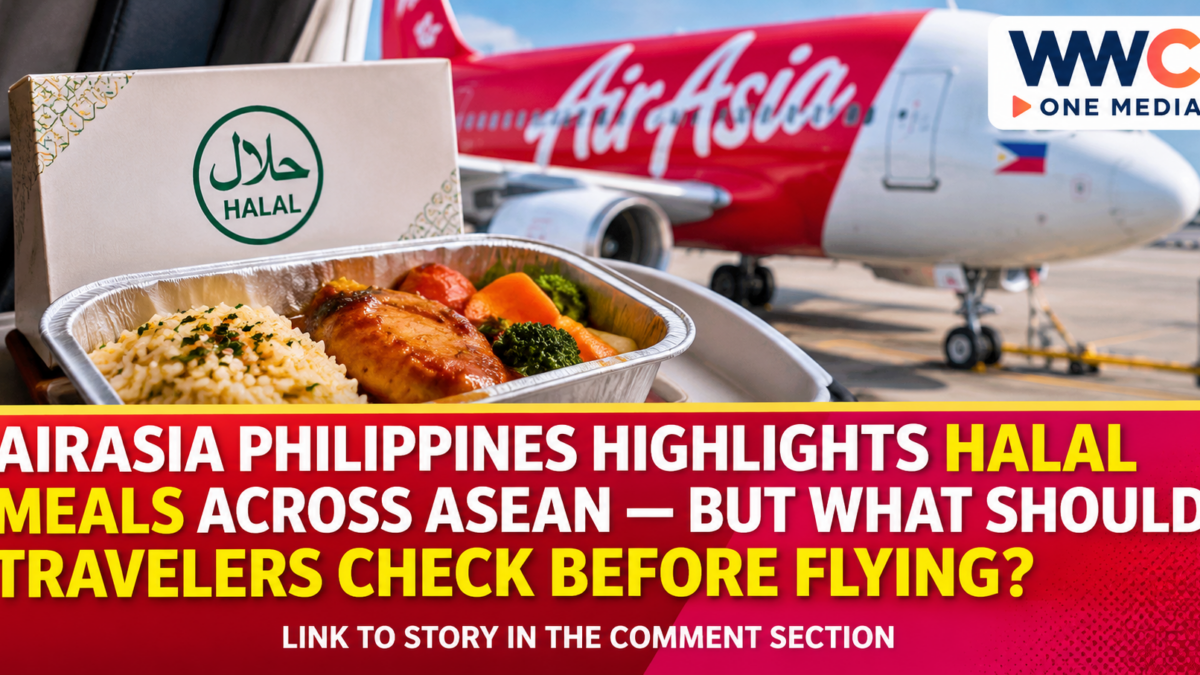
MANILA, Philippines — Nov. 14, 2026. AirAsia Philippines highlighted a selection of halal inflight meals on Nov. 13, placing regional food choices alongside its links to destinations across Southeast Asia. The dishes are offered for pre-booking through Santan, the airline group’s inflight food brand.
The announcement matters beyond the menu. For passengers who follow halal dietary requirements, knowing what can be ordered before departure is part of planning a usable itinerary—not simply choosing what tastes appealing at cruising altitude. Yet an airline group’s large route map should not be mistaken for a guarantee that identical meals are sold on every flight.
AirAsia halal meals: what is actually on the menu?
The November announcement identifies four regional favourites. Malaysia is represented by nasi lemak, featuring coconut rice, chicken rendang and chilli sambal, as well as Uncle Chin’s Chicken Rice, flavoured with ginger and garlic.
The Philippine selection includes beef tapa, while Thai Basil Chicken, associated with ML Noi’s Royal Kitchen, adds a Thai-inspired option. AirAsia describes these dishes as available for pre-booking. It does not publish a flight-by-flight inventory in that announcement.
The airline’s own history also challenges the idea that halal dining is a newly launched service. In a May 2026 menu announcement, AirAsia had already featured Thai Basil Chicken, nasi lemak, chicken rice and Filipino meals, along with drinks and shorter-flight snacks. The November update is better understood as a renewed emphasis on regional choices and passenger needs.
Why the halal commitment dates back further
AirAsia Philippines’ halal positioning has a documented history. In August 2024, the carrier announced a partnership with the Universal Islamic Center and Philippine Halal Trade & Tourism to support halal-friendly travel and related culinary activities.
A further milestone arrived in January 2025, when AirAsia Philippines and the Department of Tourism announced a partnership to promote Muslim-friendly tourism. The airline’s official statement said the department recognised it as the first Muslim-friendly airline in the Philippines for providing halal-certified meal options across domestic and international flights carrying the Z2 flight code.
That recognition concerns the Philippine airline’s offering. It should not be casually extended into a claim that every restaurant, airport outlet or other airline in the AirAsia group has the same certification status.
The distinction between halal-certified and Muslim-friendly also deserves care. Halal certification relates to compliance with applicable standards, including food preparation. Muslim-friendly is a broader description of services intended to accommodate Muslim travellers. One label should not automatically be substituted for the other.
The ASEAN network creates choice, but also complexity
AirAsia’s Nov. 13 statement identifies airline operations in five countries: Malaysia, Thailand, Indonesia, the Philippines and Cambodia. It also describes a network reaching more than 130 destinations, with Philippine links to Malaysia, Thailand and Vietnam.
Connections through Kuala Lumpur, Kota Kinabalu and Bangkok can open further itineraries to destinations including Cambodia, Indonesia, Singapore and Brunei through the Fly-Thru service. Those are network descriptions, not a promise that each city is reachable on one nonstop flight from Manila.
For readers wanting the regional context, WWC ONE MEDIA’s explanation of ASEAN’s evolving regional role provides a broader look at the bloc. AirAsia’s cross-border model illustrates how travel services can connect markets while still requiring passengers to navigate different routes and operating arrangements.
What pre-booking tells passengers—and what it does not
AirAsia markets Santan meals as an optional inflight purchase that can be booked in advance. Its May 2026 Philippine announcement listed pre-booked meals starting at ₱260 and onboard purchases from ₱280. These are historical starting prices from that announcement, not verified prices for the November menu or any particular ticket.
Availability is only one consideration. Travellers who have food allergies or additional dietary restrictions should verify the ingredients and handling information for the exact meal. A halal designation does not, by itself, mean a product is free from allergens or suitable for every other dietary need.
That practical planning fits a broader travel trend: the itinerary is made up of more than the ticket. WWC’s guide to Filipino holiday destination choices examines why travellers also need to compare the full trip experience, rather than focus on a single appealing feature.
Why food matters to Philippine tourism
The airline’s dining strategy is connected to an earlier government tourism effort, not merely to catering sales. The January 2025 partnership established a public commitment to make travel more welcoming to Muslim passengers and visitors to the Philippines.
An official AirAsia release said Santan served 535,000 meals in 2024, compared with 480,000 in 2023. That increase shows reported meal volume rising over those years; it does not establish how many buyers chose halal meals specifically, or how much additional revenue the November promotion will generate.
What this could mean: clear dietary information can reduce uncertainty for travellers deciding whether an airline fits their needs. Consistent availability and understandable booking information may matter as much as having well-known regional dishes on a marketing poster.
Competition for visitors across Southeast Asia creates another reason to improve the experience. WWC’s coverage of Thailand’s tourism challenges explores a neighbouring market facing different pressures. In that competitive environment, accessible service details can help carriers distinguish their offers, although this alone does not prove a measurable gain in market share.
What happens next
AirAsia has presented its November menu as part of an existing Santan offering, not as a dated launch of an entirely new halal catering programme. The next meaningful test is what travellers actually find when selecting meals on their individual flights.
For now, passengers should check their flight code, eligible segments, menu availability, current price and pre-booking conditions before payment. They should confirm any specific halal assurance or dietary concern directly through the airline’s current service channels.
The larger question is straightforward: can a regional airline make its promised food choices as easy to understand and reliably available as its route network is extensive? The published records establish the menu and the longer-running commitment, but do not yet measure uniform availability across the network.
Frequently asked questions
Does AirAsia Philippines offer halal-certified inflight meals?
Yes. AirAsia Philippines’ official releases say it offers halal-certified options on its Z2 domestic and international flights. Passengers should still confirm the available selection on their specific booking.
Which Santan dishes were highlighted in November 2026?
The Nov. 13 announcement highlighted nasi lemak, Uncle Chin’s Chicken Rice, beef tapa and Thai Basil Chicken as regional pre-booking options.
Are the same meals available on every AirAsia flight?
The airline’s November statement does not provide flight-by-flight meal availability. Check the current menu for each relevant flight rather than assuming all routes offer identical selections.
How much does an AirAsia Santan meal cost?
A May 2026 airline announcement listed starting prices of ₱260 for pre-booking and ₱280 onboard in the Philippines. Those figures are not confirmed current prices; use the amount shown for your flight at purchase.
To pick up a draggable item, press the space bar. While dragging, use the arrow keys to move the item. Press space again to drop the item in its new position, or press escape to cancel.
To pick up a draggable item, press the space bar. While dragging, use the arrow keys to move the item. Press space again to drop the item in its new position, or press escape to cancel.