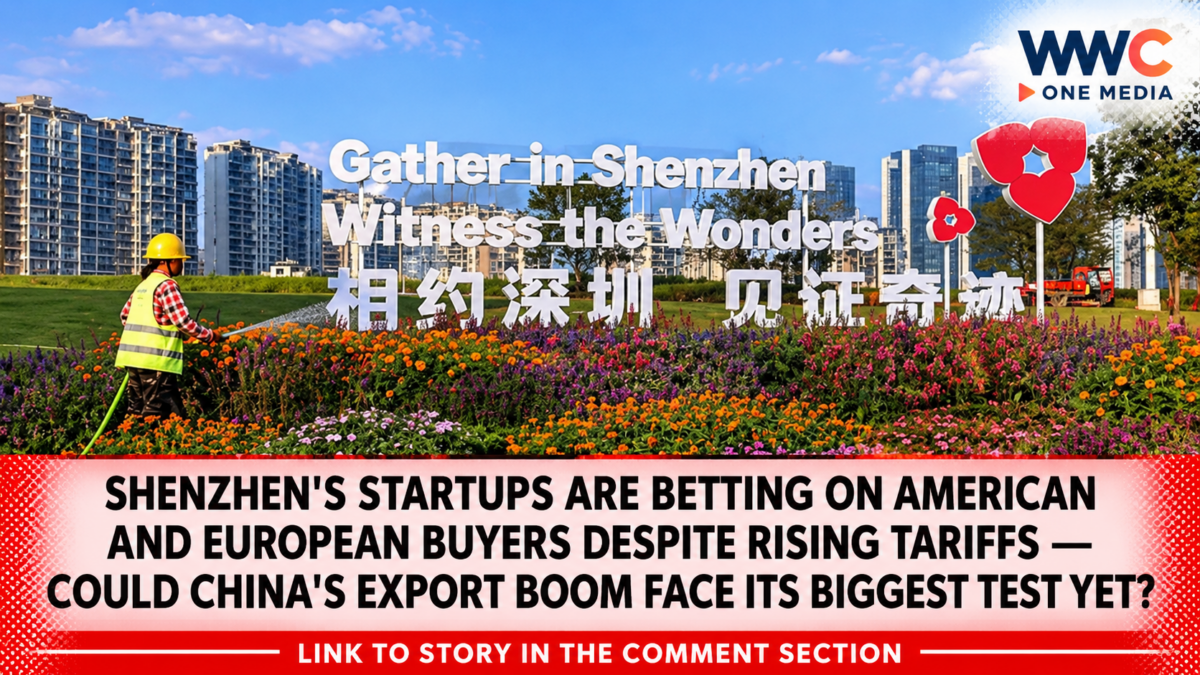
Shenzhen is preparing to welcome world leaders for the 2026 Asia-Pacific Economic Cooperation (APEC) summit, but behind its futuristic skyline and high-tech showcase, China’s next generation of startups is focused on a familiar strategy: selling to customers overseas.
From robotics and portable power stations to sports-recovery devices, electric watercraft and smart consumer technology, young companies in the southern Chinese city are increasingly targeting wealthier foreign markets rather than relying solely on domestic demand.
The strategy reflects a major shift in China’s technology economy. Shenzhen, once known primarily as a global manufacturing centre, is now positioning itself as a hub for innovation, advanced hardware and next-generation industries.
Yet despite rising trade barriers, geopolitical tensions and growing criticism of China’s export strength, many startup founders believe international customers remain more willing and able to pay for their products.
The issue is attracting attention ahead of the APEC Economic Leaders’ Meeting, scheduled for November 18 and 19, 2026, in Shenzhen. The summit will place China’s technology ambitions and its relationship with international trading partners under an even brighter spotlight.
Eight Out of 10 InnoX Startup Projects Target Foreign Customers
One of the clearest examples of Shenzhen’s export-focused startup strategy can be found at InnoX, a hardware incubator in the city’s Liuxiandong neighbourhood.
According to co-founder Carol Yu, approximately 80 per cent of the projects developed by the incubator’s more than 120 startups target overseas customers.
The reason is straightforward: founders believe foreign buyers have stronger purchasing power and a greater willingness to pay for their products.
Among the businesses developing products for international markets is XPolar, a sports-recovery device company founded by Chen Congyi.
Other ventures are working on portable power stations, advanced consumer devices, electric watercraft and products that combine hardware with emerging technologies.
The companies are not simply trying to manufacture cheaper versions of existing products. Many are attempting to develop specialised devices that can compete in higher-value international markets.
For these founders, selling overseas is not just an expansion strategy. It is central to how they plan to build profitable businesses.
Why Shenzhen Startups Prefer Overseas Customers
The growing interest in foreign buyers comes as China’s domestic economy faces several challenges.
Intense competition has forced many businesses to lower prices, putting pressure on profit margins. The country’s prolonged property-sector difficulties have also affected consumer confidence and spending.
Shenzhen’s economic figures illustrate the difference between domestic consumption and export performance.
Retail sales increased by only 2.3 per cent between January and September 2026, while the city’s exports grew by 18.5 per cent during the same period.
The contrast helps explain why many companies are looking beyond China’s domestic market.
For businesses producing specialised technology, customers in wealthier overseas economies may be more willing to purchase premium products.
Richard Yarrow, a fellow at Harvard University’s Asia Center, said officials seeking economic growth have increasingly had to look towards overseas markets.
However, relying on exports also creates risks. Companies become more exposed to tariffs, international regulations, currency movements and changes in consumer demand abroad.
Shenzhen Is No Longer Just China’s Factory Floor
Shenzhen’s transformation is one of China’s most significant economic success stories.
In 1980, the city was designated as one of the country’s first special economic zones under former leader Deng Xiaoping.
Its more business-friendly environment and investment from neighbouring Hong Kong helped transform it into a major manufacturing centre.
The city initially became known for producing garments, toys and other consumer goods. Over time, its industrial capabilities expanded into electronics, telecommunications equipment and advanced technology.
Today, Shenzhen is home to major technology companies, including Tencent and DJI, and has become a key location for robotics, artificial intelligence, aerospace and cybersecurity development.
Its greatest advantage may be the concentration of suppliers, engineers, factories and technical expertise within a relatively accessible manufacturing ecosystem.
For a startup, that can make the difference between having an idea and producing a commercially viable product.
Why Foreign Entrepreneurs and Investors Are Still Looking at Shenzhen
The city’s manufacturing network allows founders to move quickly from product design to prototyping and production.
An entrepreneur developing an electronic device can access component suppliers, engineering specialists and manufacturing facilities without having to build an entire supply chain from scratch.
This is particularly important for hardware startups, which often face higher initial costs and technical barriers than businesses developing software alone.
InnoX helps entrepreneurs through prototyping laboratories, pilot production facilities, supplier introductions and opportunities to attend overseas trade exhibitions.
The incubator was established in 2021 under a Shenzhen municipal initiative. Its co-founders include a former chairman of drone manufacturer DJI.
The model combines public-sector support with private investment. The government helps fund talent development and early-stage innovation, while private investors can provide additional capital as businesses mature.
Shenzhen authorities have also allocated land for companies operating in strategically important industries.
Projects backed by the state in Liuxiandong reportedly total more than 60 billion yuan, covering areas such as robotics, aerospace and cybersecurity.
This support gives emerging companies access to resources that would be difficult for many independent startups to secure elsewhere.
Government Support Helps China’s Technology Startups Move Faster
Shenzhen’s development is part of a broader national effort to move Chinese companies further up the global manufacturing value chain.
Government funding, industrial policies and investment incentives have helped companies expand their capabilities in advanced manufacturing and strategic technologies.
An Organisation for Economic Co-operation and Development study cited in the Reuters report found that Chinese companies in 15 heavy and strategic industries received, on average, three to eight times as much government support as peers in many developed economies between 2005 and 2024.
Such support can accelerate innovation and help companies develop products at competitive prices.
However, it also contributes to international debate over whether government-backed industrial expansion creates unfair competition or excess production capacity.
China has rejected accusations that its growth model is designed to undercut competitors through industrial overcapacity or an undervalued currency.
For Shenzhen’s startups, the immediate priority remains turning technological ideas into products that international customers are prepared to buy.
US and European Trade Barriers Are Changing Business Strategies
Despite their confidence in overseas markets, Shenzhen companies cannot ignore the growing trade restrictions affecting Chinese products.
The United States and European Union have introduced or considered measures that could affect the cost and competitiveness of Chinese-made goods.
For some businesses, tariffs have become a major factor in deciding where to manufacture.
One example is Tarran, an electric cargo-bike company founded by Ben Guo.
The company moved production of certain components, including frames, batteries and controllers, to Southeast Asia in response to high European Union duties affecting its products.
However, smart components and many raw materials continue to come from China.
This illustrates a growing trend among Chinese manufacturers: shifting selected production activities overseas while maintaining important links to China’s established supplier network.
Such moves can help companies manage trade barriers, but they can also increase manufacturing costs and complicate logistics.
For customers, those additional expenses may eventually translate into higher prices.
Rootique Shows How Shenzhen Startups Are Reaching American Consumers
Another example of the city’s international ambitions is Rootique, a scalp-care technology company founded by Denise Wu.
The company has sold approximately 10,000 of its devices, priced at US$148 each, with more than half purchased by customers in the United States.
Wu said the company does not sell its products in China.
The example highlights how some Shenzhen startups are building businesses around specific overseas consumer groups rather than trying to compete in China’s already crowded domestic market.
For companies with specialised products, international demand can offer opportunities that may be harder to find at home.
But success is not guaranteed. Businesses must still navigate foreign product standards, marketing expenses, distribution networks and consumer preferences.
China’s Trade Surplus Passes US$1 Trillion as Export Concerns Grow
Shenzhen’s export ambitions are unfolding against the backdrop of China’s enormous trade surplus.
China’s trade surplus exceeded US$1 trillion during the first 10 months of 2026, putting the country on track to challenge its previous annual record.
The figure has intensified concerns among trading partners that Chinese manufacturers are becoming increasingly dependent on international demand.
The European Union has already taken action in selected sectors, including electric vehicles, and has signalled that it may consider additional measures affecting other industries.
For Shenzhen startups, this creates an uncomfortable contradiction.
Foreign markets offer stronger purchasing power, but the more Chinese businesses depend on overseas customers, the more exposed they become to trade restrictions and geopolitical disputes.
The challenge is especially serious for young companies that may not have the financial resources of established multinational corporations.
Shenzhen’s Technology Boom Could Benefit Southeast Asia
The growing internationalisation of Shenzhen startups could create opportunities for Southeast Asian economies.
Companies looking to reduce exposure to tariffs or diversify production may consider manufacturing partnerships, component suppliers and assembly facilities in countries across the region.
Southeast Asia already plays an important role in electronics manufacturing and global supply chains.
However, relocating production does not automatically eliminate trade restrictions. The origin of components, manufacturing processes and applicable rules of origin can still determine how products are treated by importing countries.
For Southeast Asian economies, the opportunity is to attract genuine investment, develop local suppliers and create skilled employment rather than simply serve as temporary transit points for Chinese exports.
The region could also benefit from access to new technologies in robotics, electric mobility, consumer electronics and industrial automation.
Five WWC ONE MEDIA Reports Exploring China’s Technology and Export Ambitions
Shenzhen’s startup strategy is part of a much larger transformation in China’s technology and manufacturing industries. WWC ONE MEDIA has also examined several developments connected to this shift.
China’s AI hardware industry is experiencing both rapid innovation and growing investor scrutiny, as manufacturers and robotics companies compete to capture a share of the next technology boom.
Read more: China’s AI Hardware Selloff Deepens as Valuation Fears Hit Tech Darlings
Chinese manufacturers are also applying their electric-vehicle expertise to humanoid robotics, using advances in batteries, motors, sensors and artificial intelligence.
Read more: China’s Tesla Imitators Have a New Mission — Build Humanoid Robots Cheap Enough for Consumers
Meanwhile, China’s export-driven manufacturing model faces increasing pressure from trade restrictions, domestic competition and changing currency conditions.
Read more: China’s Cheap-But-Better Strategy Faces a Global Reckoning as Factory Orders Shrink
The country’s expanding international trade surplus has also intensified debate over whether export growth can remain sustainable amid global resistance.
Read more: China’s Trade Surplus Blows Past US$1 Trillion Despite Trump’s Tariffs as Exports Surge
Finally, the growing global competition in artificial intelligence is encouraging Chinese technology companies to seek overseas customers as domestic price competition squeezes local businesses.
Read more: China’s AI Boom Shifts Toward Global Markets as Domestic Competition Squeezes Local Firms
APEC 2026 Puts Shenzhen’s Economic Model Under the International Spotlight
The APEC Economic Leaders’ Meeting on November 18 and 19 will provide Shenzhen with an opportunity to showcase its transformation from a manufacturing centre into a global technology hub.
The city is expected to welcome leaders and representatives from economies across the Asia-Pacific region.
Its futuristic transport systems, technology companies and innovation districts offer a powerful image of China’s ambitions.
But the summit will also take place against a complicated international economic backdrop.
Governments are debating tariffs, industrial subsidies, supply-chain security and the growing influence of Chinese exports.
For Shenzhen’s startups, the outcome of these debates could influence where they manufacture, how they raise capital and which markets they target.
The city’s founders are betting that international buyers will continue to value their products despite the political and economic obstacles.
That confidence is supported by Shenzhen’s manufacturing ecosystem, government-backed innovation programmes and access to specialised suppliers.
However, the long-term test will be whether these companies can build sustainable businesses rather than depending on cheap financing, aggressive expansion or temporary advantages in overseas markets.
Shenzhen has already proved that it can transform ideas into products at remarkable speed. Now its next generation of startups wants to prove that those products can win customers around the world.