
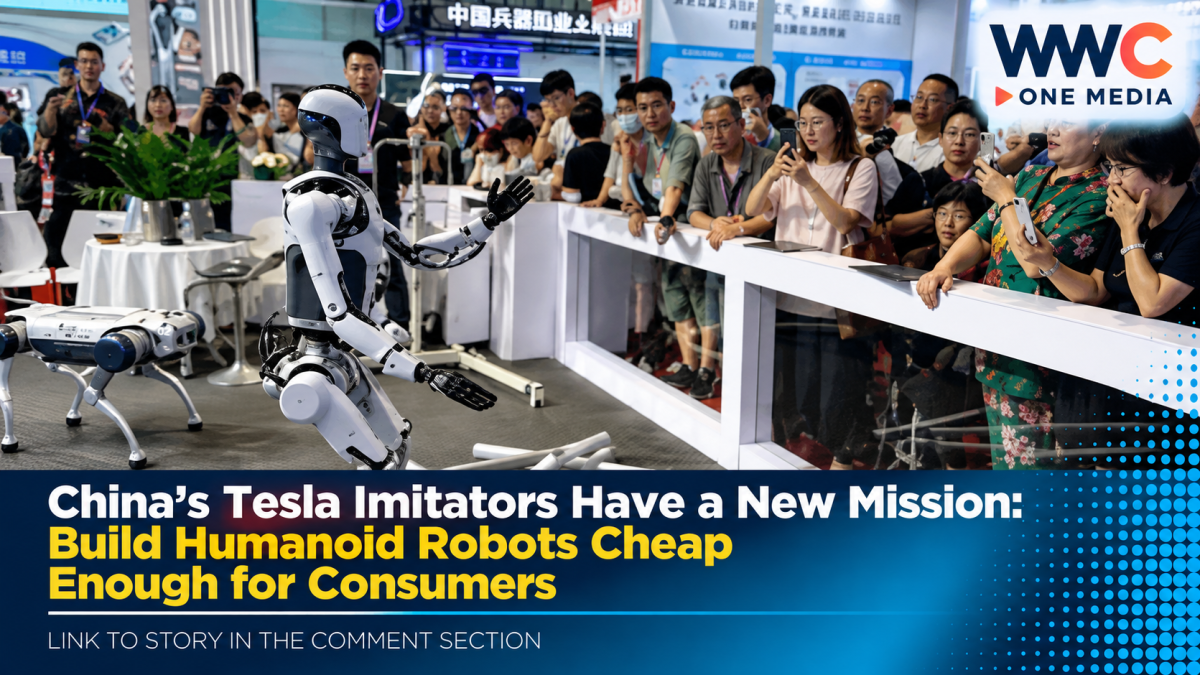
BEIJING — China’s electric vehicle revolution produced a generation of companies often compared with Tesla. Now, many of those same manufacturers are chasing a far more ambitious goal: building humanoid robots cheap enough to move beyond factories and research labs and into the hands of ordinary consumers.
The race is accelerating as Chinese companies leverage expertise developed in electric vehicles — including batteries, motors, sensors, artificial intelligence and mass manufacturing — to cut the cost of humanoid robots.
The ultimate prize is enormous. If companies can produce reliable machines at consumer-friendly prices, humanoid robots could eventually become a new mass-market technology category, following smartphones, electric vehicles and smart home devices.
But there is a major problem: making a robot walk, dance or perform a demonstration is one thing. Making it genuinely useful in everyday life is much harder.
From Copying Tesla to Building the Next Big Machine
China’s EV industry grew rapidly by producing increasingly affordable alternatives to global brands such as Tesla.
Now, that same manufacturing philosophy is moving into robotics.
Companies are betting that China’s supply chain advantage — from batteries and precision motors to cameras, sensors and AI chips — could help bring down the cost of humanoid machines faster than competitors in the United States and elsewhere.
Unitree Robotics has become one of the most visible examples of that strategy.
Its R1 humanoid, introduced as a lower-cost model, has been priced in China from about 29,900 yuan, or roughly US$4,300 to US$5,000 depending on the market and configuration. The machine is capable of movement and athletic demonstrations, but current low-cost humanoids remain primarily developer and research platforms rather than plug-and-play household helpers.
The Big Goal: Robots for Ordinary People
The humanoid industry is now trying to move beyond the factory floor.
Chinese companies are experimenting with machines designed for companionship, home interaction, education, entertainment and eventually household assistance.
UBTECH Robotics, for example, has launched consumer-focused humanoid concepts that emphasize interaction and companionship. Its U1 line reflects a broader push to turn robots into products designed for domestic settings rather than purely industrial environments. However, these machines remain far more expensive than mass-market consumer electronics, with prices reaching well into the tens of thousands of US dollars for higher-end models.
That creates a clear divide in the industry.
Cheap robots exist — but they are not yet capable home assistants.
More advanced robots exist — but most are still too expensive for ordinary households.
The race is now focused on closing that gap.
China’s EV Supply Chain Could Be Its Secret Weapon
Humanoid robots and electric vehicles may appear to be completely different products.
But they share many technologies.
Both require:
- High-performance batteries
- Electric motors
- Sensors and cameras
- Advanced processors
- Artificial intelligence
- Precision manufacturing
- Complex software
- Large-scale supply chains
That overlap gives Chinese EV companies and manufacturers a potential advantage.
Automakers have already spent years learning how to produce electric motors, batteries and electronics at enormous scale. Those capabilities could potentially reduce the cost of robotic components.
Reuters has also reported that Chinese automakers are increasingly expanding beyond cars and into robotics, using their expertise in automation, AI and battery technology to explore entirely new markets.
The Price War Is Moving From EVs to Robots
China’s electric vehicle market became famous for intense competition.
Manufacturers repeatedly lowered prices while introducing new models and technology.
The humanoid robotics industry could eventually follow the same pattern.
Companies are already competing to produce cheaper machines.
Unitree’s low-cost R1 helped push the conversation toward humanoids priced below US$5,000, a level that would have seemed extraordinary only a few years ago.
But price alone does not determine whether a product becomes mainstream.
A US$5,000 robot that can dance may be impressive.
A US$5,000 robot that can reliably clean a house, prepare simple items, assist elderly users and operate safely around children would be revolutionary.
The technology has not reached that point yet.
Dancing Robots Are Easy Compared With Real Work
China’s humanoid robots have generated enormous attention through viral demonstrations.
They can run.
Dance.
Box.
Perform martial arts.
And complete increasingly sophisticated movement routines.
But experts continue to warn that spectacular demonstrations should not be confused with practical intelligence.
The real challenge is teaching a humanoid robot to operate safely and reliably in unpredictable environments.
A factory can be carefully controlled.
A home cannot.
Furniture moves.
Objects fall.
Pets and children behave unpredictably.
Lighting changes.
Rooms are cluttered.
And simple human tasks often require extraordinary levels of dexterity.
Recent reporting on China’s robotics industry has highlighted the same issue: while humanoid robots are becoming more capable, many still struggle with everyday tasks that humans perform almost automatically.
China Is Building at Scale Before Demand Is Fully Proven
One of the biggest questions surrounding the humanoid boom is whether companies are moving faster than the market.
China now has a large and rapidly growing ecosystem of robotics companies, with dozens of manufacturers competing for investment and government support.
Reuters recently reported that Unitree’s rise has become symbolic of China’s broader push into what the industry calls embodied intelligence — artificial intelligence capable of interacting with the physical world. But widespread commercial adoption remains uncertain because of ongoing challenges involving reliability, adaptability and practical usefulness.
That has created comparisons with previous Chinese technology booms.
China has successfully built dominant industries in areas such as solar panels, electric vehicles, batteries and drones.
But aggressive investment can also lead to overcapacity and intense competition.
The humanoid sector could eventually produce a similar shakeout.
The Consumer Robot Dream Is Still a Work in Progress
The industry’s biggest vision is simple to understand.
Imagine a robot that could:
- Carry groceries
- Fold laundry
- Clean rooms
- Assist elderly people
- Retrieve household items
- Monitor a home
- Provide companionship
- Perform simple repetitive tasks
That dream has existed in science fiction for decades.
China’s robotics companies believe falling component costs and rapid advances in AI could finally make it commercially possible.
But today’s reality remains more complicated.
Many humanoid robots currently sold to customers are intended for developers, researchers and companies experimenting with robotic applications.
Even the most affordable models generally require technical expertise and are not designed to arrive at a consumer’s home ready to perform household chores.
A New Technology Battle Is Emerging
The humanoid robot race is also becoming part of a broader competition between China and the United States.
Tesla continues developing Optimus.
American companies such as Figure AI and 1X are pursuing their own humanoid strategies.
Meanwhile, Chinese companies are attempting to win through manufacturing scale and affordability.
The question may eventually come down to the same competition that reshaped the EV market:
Who can build the best technology — and who can build enough of it at a price ordinary people can afford?
China’s advantage could be speed.
The country’s manufacturing ecosystem allows companies to rapidly source components, test designs and move products into production.
Foreign investors and technology executives have increasingly traveled to China to study the country’s fast-moving technology ecosystem, particularly in areas including AI, robotics and electric vehicle manufacturing.
The Next Tesla May Not Be a Car
For Chinese manufacturers, humanoid robots could represent the next major transformation after electric vehicles.
Tesla helped prove that a technology company could change the global auto industry.
Now China’s robotics companies are hoping to prove that mass manufacturing can do the same for humanoid machines.
The competition is already producing cheaper robots.
It is attracting billions in investment.
And it is pushing manufacturers to move faster than ever.
But the industry’s biggest challenge remains unresolved.
Can these machines actually become useful enough for consumers to want them?
For now, China is getting closer to making humanoid robots affordable.
Making them genuinely indispensable will be much harder.
And that may determine whether the current robot boom becomes the next electric vehicle revolution — or simply another spectacular technology race filled with machines that look impressive on stage but struggle to find a purpose in everyday life.
WWC ONE MEDIA J.M.D




Leave a Reply