
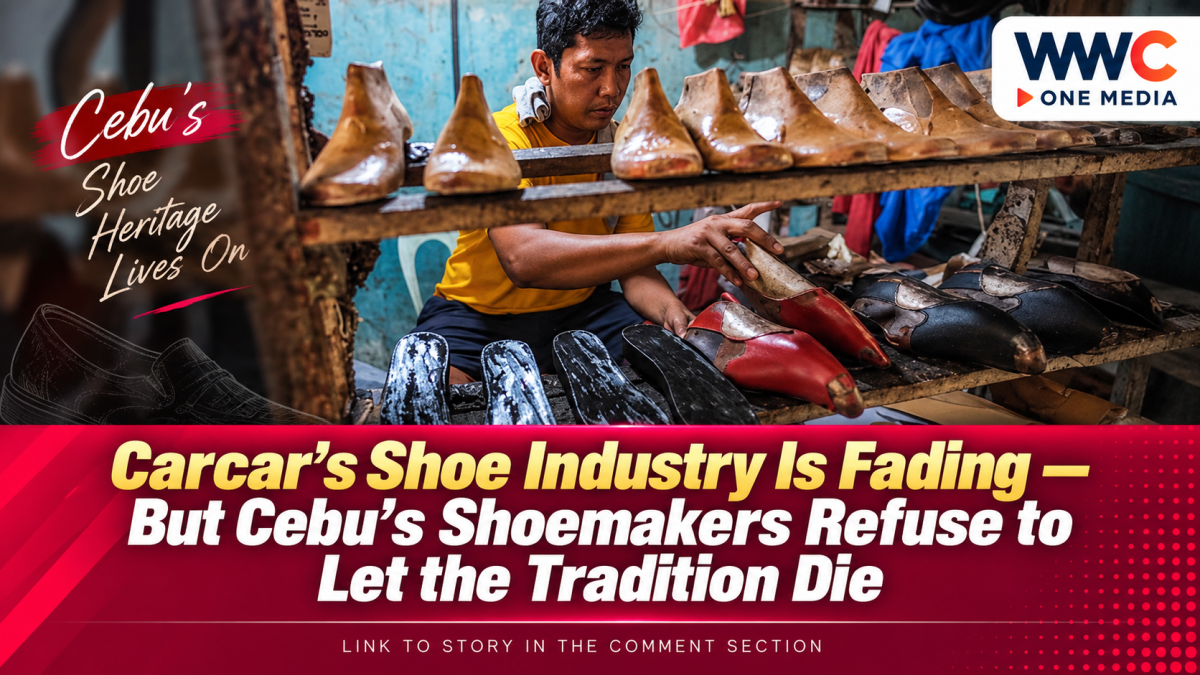
CARCAR CITY, CEBU — For generations, the sound of leather being cut, stitched and shaped into shoes was part of everyday life in Carcar City.
The Cebuano city built a reputation as one of the country’s traditional shoemaking centers, with skilled craftsmen producing handmade footwear that found buyers far beyond their hometown.
Today, however, that once-thriving industry is fighting for survival.
Cheap imported footwear, rising production costs, changing consumer habits and the growth of online shopping have placed enormous pressure on Carcar’s remaining shoemakers. At the same time, fewer young people are willing to learn a craft increasingly associated with an older generation.
But instead of allowing the tradition to quietly disappear, Carcar is trying something different.
It is telling its story.
Through theater, film and renewed efforts by the city government and business-support agencies, residents are attempting to transform the city’s shoemaking heritage from a fading memory into something that can once again inspire a new generation.
When a Shoe Capital Began Losing Its Footing
Carcar’s shoemaking industry did not collapse overnight.
Its decline has been gradual, with small workshops facing a combination of problems that have become increasingly difficult to overcome.
One of the most serious challenges is competition from inexpensive imported footwear.
Small local manufacturers purchase materials in much smaller quantities than large-scale producers, making their production costs higher. That makes it difficult for handmade shoes to compete purely on price.
Then came another major shift: consumers increasingly began buying footwear online.
For local shoemakers, that change has been particularly painful.
A July 2026 SunStar report cited the experience of Sammyr Shoes, which once handled around 100 regular orders but was producing only about 15 orders, mostly safety shoes for construction workers.
Its workforce had also fallen from about 20 employees to just 10.
Behind those numbers is a much bigger problem.
The knowledge required to make the shoes is disappearing with the workers who possess it.
As older craftsmen retire, there are fewer young workers willing to replace them.
And once those skills disappear, they may be extremely difficult to rebuild.
The Industry’s Biggest Threat May Be the Next Generation
Carcar’s shoemaking tradition depends on skills that are learned through experience.
Cutting.
Stitching.
Shaping.
Finishing.
Understanding leather.
Knowing how to turn individual pieces of material into footwear that can withstand years of use.
But younger generations now have far more employment options than previous generations did.
Shoemaking can be physically demanding, time-consuming and less financially attractive than other jobs.
That has created a difficult cycle.
Fewer young people enter the industry.
Older workers retire.
Production declines.
Businesses struggle.
And the industry becomes even less attractive to potential newcomers.
The result is not simply fewer shoes being produced.
It is the gradual disappearance of a piece of Carcar’s identity.
DTI Steps In as Local Industry Struggles
The Department of Trade and Industry in Central Visayas has acknowledged the seriousness of the situation.
DTI 7 Acting Director Esperanza “Hope” Melgar said the local footwear sector faces threats from cheap imported products, rising costs and changing consumer behavior.
The agency has been providing assistance to Carcar’s footwear manufacturers, including business registration support, mentoring, participation in trade fairs, digital marketing assistance and financing opportunities through the Small Business Corp.
More than 20 footwear manufacturers in Carcar City have been profiled for assistance, according to DTI 7.
That support could prove crucial.
Because saving Carcar’s shoemaking industry may require more than simply telling consumers to “buy local.”
Local producers need the ability to compete.
They need access to markets.
They need modern marketing.
They need better equipment and production systems.
And most importantly, they need a reason for young Filipinos to see shoemaking as a viable future rather than a dying occupation.
When a Film Became a Call to Save the Industry
That fight is now reaching an unexpected place: the arts.
Young filmmakers from Carcar produced a short film titled “Target: 1990” for the Cebu Province Linggo ng Kabataan Short Film Festival 2026.
The film won second runner-up for Best Film.
But its creators say winning was not the main objective.
They wanted people to remember Carcar’s shoemaking story.
The title “Target: 1990” carries a symbolic meaning.
It refers to a production target of 1,990 pairs of shoes — a level of output that has become increasingly difficult for local shoemakers to achieve.
The filmmakers are therefore asking a larger question:
Can Carcar return to the strength of its past?
Or does the city need to create an entirely new version of that success?
That distinction matters.
Because reviving the industry does not necessarily mean returning to 1990.
It may mean building Carcar’s next chapter.
Theater Turns a Crisis Into a Story
The community’s attempt to save the tradition has also reached the stage.
During this year’s Halad sa Pagtuo, artistic director Patty Betita and the Kabkaban Festival performance incorporated the story of Carcar’s shoemakers into a theatrical fantasy.
The performance was inspired by the city’s struggle to preserve an industry that has been part of its identity for generations.
For Betita, storytelling became a way to force the community to confront a difficult question:
What is Carcar actually doing to save its shoemaking tradition?
Rather than simply presenting the craft as something from the past, the performance challenged residents to think about what must happen next.
The message was clear:
Heritage cannot survive on nostalgia alone.
It needs people willing to carry it forward.
Carcar Government Looks for a Way Forward
The Carcar City Government, under Mayor Mario Patricio “Patrick” Barcenas, is also engaging local shoemakers to explore ways to innovate, upgrade and strengthen the sector.
That could be a critical step.
The industry cannot survive simply by reproducing the same business model that worked decades ago.
Local shoemakers are competing in a market transformed by mass production, digital commerce and rapidly changing consumer preferences.
To survive, Carcar’s traditional craftsmanship may need to combine with modern tools.
Better branding.
Online selling.
Digital marketing.
Product innovation.
Modern equipment.
And perhaps most importantly, a new generation of craftsmen and entrepreneurs.
The goal should not be to replace the traditional craft.
It should be to give that craft a future.
The Question Is No Longer Whether Carcar Has a Shoemaking Heritage
That part is undeniable.
The question is whether Carcar will still have a functioning shoemaking industry years from now.
The distinction is crucial.
A city can preserve old photographs.
It can build exhibits.
It can produce documentaries.
It can stage performances about its past.
But none of those things can replace the people who actually make the shoes.
For the tradition to remain alive, someone has to sit at a workbench.
Someone has to cut the leather.
Someone has to stitch it.
Someone has to teach the next generation.
And someone has to buy the finished product.
A Heritage Worth Wearing
Carcar’s shoemaking story is ultimately bigger than shoes.
It is about what happens when globalization collides with traditional craftsmanship.
It is about small businesses competing against mass production.
It is about whether consumers still value products made by hand.
And it is about whether young people can find opportunity in traditions their grandparents once depended on.
The irony is that the very thing threatening Carcar’s shoemakers may also provide part of the solution.
The internet helped bring cheap imported footwear into consumers’ homes.
But it can also allow Carcar’s craftsmen to bring their handmade products to customers across the Philippines — and potentially beyond.
The challenge is turning craftsmanship into a competitive modern business without destroying the tradition that makes it special.
Carcar Doesn’t Need to Go Back to 1990
Perhaps that is the real message behind “Target: 1990.”
Carcar does not necessarily need to recreate its past.
It needs to create a future worthy of its past.
The city once became known for shoes because generations of craftsmen mastered a skill and built businesses around it.
Now another generation must decide whether that skill will disappear or evolve.
The answer will not come from nostalgia alone.
It will come from innovation, investment, consumers, government support and young people willing to learn the craft.
For now, Carcar’s shoemaking tradition remains alive.
But it is standing at a crossroads.
One path leads toward a museum piece — a story people remember about the city that once made shoes.
The other leads toward reinvention.
And perhaps the most important pair of shoes Carcar will ever make is not the next one coming off a workbench.
It is the path toward keeping the entire industry alive.
WWC ONE MEDIA J.M.D




Leave a Reply