BEIJING / MANILA — November 3, 2026. China’s manufacturing giants have conquered global markets with a powerful proposition: deliver advanced technology, attractive designs and increasingly competitive quality at prices that established Western brands often struggle to match.
From electric vehicles and smartphones to batteries, home appliances and consumer electronics, Chinese companies are challenging the assumption that premium features must come with premium prices.
But the strategy that helped transform China into a global manufacturing powerhouse is facing a difficult test.
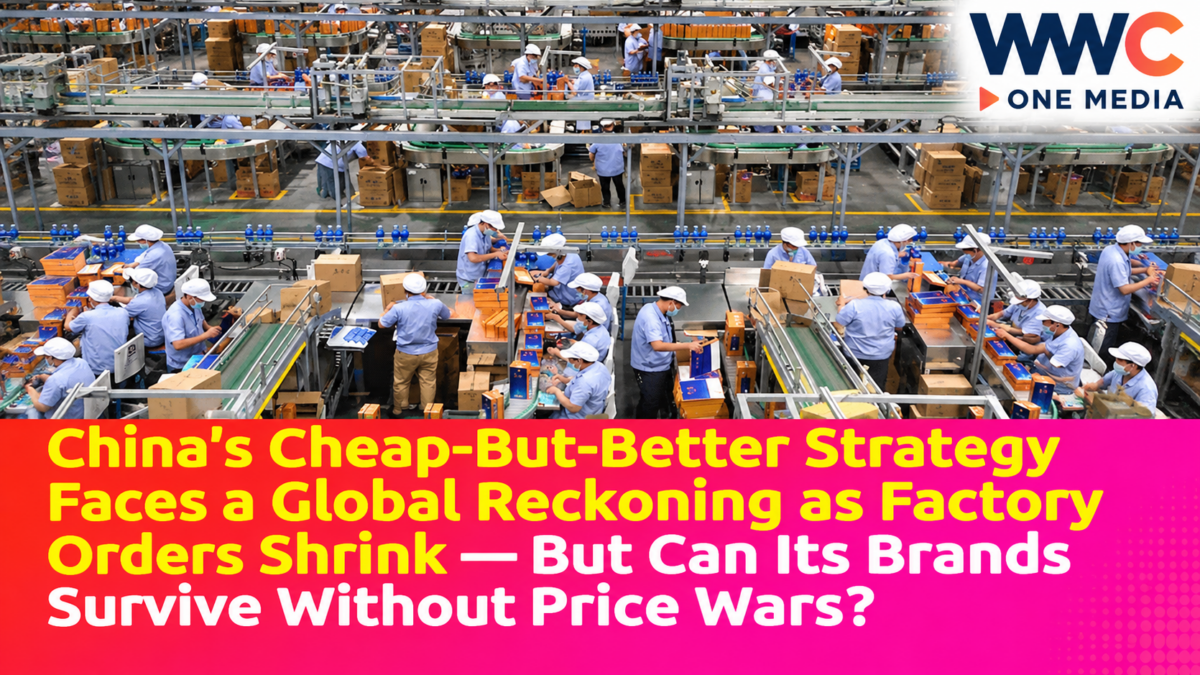
Factories are producing enormous quantities of goods, domestic consumers remain cautious, and competition is forcing businesses to reduce prices even as their expenses remain substantial.
The latest official data show China’s manufacturing sector slipping back into contraction in October, with new export orders also weakening.
Meanwhile, international trade barriers are making it harder for Chinese manufacturers to rely indefinitely on overseas markets.
In a November 2 Bloomberg Opinion column, Juliana Liu examines the challenge facing China’s more-for-less business model, particularly the tension between winning customers through value and building brands capable of earning sustainable profits.
The issue reaches far beyond Chinese manufacturers.
Established American, European, Japanese and South Korean companies are being forced to reconsider whether their brand reputations can continue justifying higher prices.
For consumers, the competition can mean access to more sophisticated products at lower costs.
For manufacturers, however, the financial consequences may be considerably less attractive.
China has become exceptionally effective at making advanced products affordable. But can its businesses build lasting global brands without becoming trapped in a cycle of price cuts, shrinking margins and escalating trade disputes?
China’s More-for-Less Business Model Is Changing Global Competition
For decades, established consumer brands have relied on reputation, product quality and customer loyalty to command higher prices.
Companies invest substantial amounts in research, marketing, distribution and customer service to build that reputation.
Once a brand becomes trusted, some consumers become willing to pay more for its products.
Chinese manufacturers have increasingly challenged this model.
Rather than relying exclusively on low wages and basic manufacturing, many Chinese businesses now develop sophisticated products with features comparable to those offered by established international competitors.
Their advantages can include integrated supply chains, advanced factories, efficient product development and economies of scale.
In electric vehicles, for example, Chinese brands compete through battery technology, digital features, charging performance and affordability.
In consumer electronics, companies such as Xiaomi and Huawei combine hardware with software ecosystems.
In home appliances, manufacturers including Haier and TCL have expanded their global presence.
The strategy creates pressure on established companies to justify their higher prices.
But the difficult question is whether Chinese manufacturers can maintain strong profitability while continuing to offer customers more for less.
Chinese Brands Are Becoming More Valuable Worldwide
China is no longer simply a manufacturing base for foreign companies.
Its businesses increasingly develop and market products under their own names.
A published assessment of China’s 500 most valuable brands places their combined estimated value at approximately $2.13 trillion.
That figure reflects a brand-valuation exercise rather than total sales, corporate earnings or cash held by the businesses.
WWC ONE MEDIA previously explored the changing perception of Chinese brands in China’s Top 500 Brands Are Worth $2.13 Trillion as Global Perceptions Shift — But Could Quality Concerns and Trade Barriers Stop Their Rise?.
The report examined how Chinese manufacturers are moving beyond the perception of producing inexpensive products.
Brands such as BYD, Xiaomi, DJI, Huawei, TCL and Haier have developed reputations for specific technologies and product capabilities.
But rising brand value does not necessarily establish pricing power.
A manufacturer may be widely recognized while still depending on aggressive discounts to attract customers.
The next stage of China’s international expansion may require convincing consumers that its products are worth buying even when cheaper alternatives are available.
China Faces the Difficult Transition From Low Prices to Stronger Profits
One of the biggest challenges involves profitability.
A company can gain market share by selling products at lower prices than competitors.
But if prices fall faster than production costs, profit margins shrink.
This becomes particularly dangerous when an industry has too much manufacturing capacity.
Factories may continue operating to cover fixed expenses, even when demand is weak.
Companies can then compete by offering discounts, additional features or favorable financing terms.
The result may benefit consumers initially.
However, prolonged price competition can reduce investment returns, weaken suppliers and force financially vulnerable companies out of business.
Chinese policymakers have increasingly acknowledged this problem.
The government has introduced measures aimed at discouraging what it describes as disorderly or excessively aggressive competition.
WWC ONE MEDIA examined the policy response in China Moves to Crush “Malicious” Price Competition — And Businesses Are About to Face Tougher Scrutiny.
Chinese regulators have emphasized stronger cost investigations and scrutiny of pricing behavior.
However, distinguishing legitimate efficiency-based discounts from unlawful or economically damaging pricing practices is difficult.
Low prices are not automatically evidence of misconduct.
China’s Factory Activity Falls Back Into Contraction
The latest economic data add urgency to the debate.
China’s official manufacturing purchasing managers’ index fell to 49.3 in October 2026, down from 50.1 in September.
A reading below 50 indicates that more surveyed managers reported deterioration than improvement.
The production component declined to 49.8.
New orders fell to 49.4.
New export orders weakened to 48.7.
The figures suggest that demand was deteriorating both domestically and internationally.
Reuters reported that October marked the third contraction in four months for China’s official manufacturing survey.
The data also came below economists’ expectations.
WWC ONE MEDIA covered the slowdown in China’s Factory Activity Crashes Back Into Contraction as Orders Collapse — But Could a Deeper Economic Slowdown Shake Global Trade?.
The report highlighted how weakening manufacturing activity could affect international trade and Asian supply chains.
However, an important distinction remains.
A PMI below 50 indicates a deterioration in surveyed business conditions.
It does not mean manufacturing output has fallen by 50%, nor does it establish that the entire Chinese economy is in recession.
Private Surveys Show a More Complicated Picture
Not every indicator points to the same degree of weakness.
Reuters reported that China’s RatingDog manufacturing PMI stood at 52.0 in October.
That reading indicated expansion among the businesses covered by the private survey.
The difference matters.
Official and private surveys may have different samples, sector representation and methodologies.
Large state-linked enterprises and smaller export-oriented manufacturers can experience different conditions.
Both readings can therefore be informative without being identical.
Still, the official survey’s weakness raises concerns about whether domestic consumption is strong enough to support China’s enormous industrial base.
The broader challenge is reducing dependence on ever-increasing export volumes while developing a healthier domestic market.
Electric Vehicles Reveal the Risks of the Strategy
China’s automotive industry provides one of the clearest examples of the conflict between industrial strength and profitability.
Chinese manufacturers have developed competitive electric vehicles and plug-in hybrids.
They also benefit from extensive battery supply chains and advanced manufacturing capabilities.
But fierce competition is damaging margins.
Industry figures reported in October showed profits at Chinese automotive manufacturers declining approximately 22.8% during the first nine months of 2026.
That occurred while vehicle exports expanded rapidly.
WWC ONE MEDIA examined the contradiction in China Exports Over 7 Million Cars as Domestic Sales Plunge 22% — But Is Its Auto Industry Heading for a Global Trade War?.
The report described the gap between China’s growing export shipments and weaker domestic vehicle demand.
However, industrywide profit figures should not be interpreted as the performance of every manufacturer.
Some leading companies remain profitable and internationally competitive.
Others face greater financial strain.
The industry’s challenge is ensuring that export growth generates sustainable earnings rather than merely absorbing excess factory capacity.
BYD Shows Both the Opportunity and the Danger
BYD illustrates why China’s strategy remains powerful.
The company has built a strong position in electric and plug-in hybrid vehicles.
Its capabilities include battery manufacturing, power electronics, vehicle design and integrated production.
The Financial Times reported that BYD’s third-quarter revenue increased approximately 14% year on year to 221.5 billion yuan.
Net profit rose about 28% to 10 billion yuan.
Despite that growth, both figures missed market expectations.
International expansion has become increasingly important.
BYD’s vehicle exports nearly doubled to more than 1.3 million units during the first nine months of 2026.
The company also expanded its presence in Europe.
These results demonstrate that Chinese manufacturers can achieve meaningful international growth.
But strong exports do not eliminate competitive pressure.
BYD continues investing in overseas production, distribution and other infrastructure while facing aggressive competition at home.
The key question is whether its overseas business can sustain profitable growth after accounting for those expenses.
Overcapacity Is Becoming a Global Trade Dispute
China’s manufacturing system has developed enormous capacity in electric vehicles, batteries, solar panels and other industries.
That capacity can produce genuine advantages through scale and lower unit costs.
But it can also encourage excessive competition when demand fails to keep pace.
Western governments argue that state support and manufacturing overcapacity distort international markets.
Beijing rejects the view that its export success is primarily the product of unfair subsidies.
Chinese officials emphasize technological innovation, operational efficiency and consumer demand.
Both factors can operate simultaneously.
A manufacturer may have genuine cost advantages while benefiting from public support.
WWC ONE MEDIA examined the competing arguments in China Is Producing More Cars, Batteries and Goods Than Ever — But the Numbers Reveal Why the West’s ‘Overcapacity’ Case Isn’t So Simple.
The analysis highlighted how industrial investment, weak domestic consumption and export growth have intensified the debate.
For international policymakers, the challenge is determining whether trade restrictions address unfair competition or unnecessarily shield domestic industries from more efficient foreign rivals.
Europe’s Trade Barriers Could Change the Equation
The European Union has imposed additional duties on Chinese battery-electric vehicles following an anti-subsidy investigation.
European officials argue that certain forms of government assistance create unfair competitive advantages.
Chinese manufacturers and officials dispute aspects of that assessment.
The measures have complicated the expansion plans of companies seeking greater access to European consumers.
Chinese automakers are responding by emphasizing other products, negotiating trade arrangements and developing overseas manufacturing facilities.
But building factories abroad is not inexpensive.
It can introduce higher labor costs, unfamiliar regulations and significant upfront capital requirements.
The strategy may protect access to some markets.
However, it can also reduce part of the cost advantage that enabled Chinese manufacturers to compete so aggressively in the first place.
That creates another test of the more-for-less formula.
Can companies continue offering attractive prices when they must manufacture closer to overseas customers?
A Low Price Is Not the Same as a Trusted Brand
The most successful global brands are often able to maintain customer loyalty even when competitors offer lower prices.
That ability can support stronger profit margins.
But achieving it requires more than a recognizable logo.
Consumers must trust product quality, safety, durability and after-sales service.
For automakers, this can include reliable repairs, replacement parts and warranty support.
For electronics companies, it can involve software updates, cybersecurity and compatibility with other devices.
Chinese manufacturers have made substantial improvements in many of these areas.
Nevertheless, establishing long-term brand loyalty can take years.
Consumers buying an unfamiliar product may initially focus on price.
Once they have more experience with the brand, their purchasing decisions may depend increasingly on reliability and service.
This shift could create an opportunity for Chinese manufacturers to strengthen pricing power.
But raising prices too quickly could weaken demand.
Is China’s Strategy Sustainable Without Higher Domestic Consumption?
One major risk is the weakness of China’s domestic economy.
The country’s prolonged property-market downturn has affected household confidence and spending.
Many consumers remain cautious about expensive purchases.
When domestic demand weakens, manufacturers may become more dependent on overseas buyers.
That creates exposure to foreign trade policies and economic conditions.
Research by the Mercator Institute for China Studies, known as MERICS, found that Chinese industrial overcapacity has continued pressuring prices and corporate margins.
The institute also reported that Chinese exports have grown faster than imports since 2021.
Exports help sustain factory activity.
But relying on foreign demand becomes more difficult when trading partners introduce tariffs or local-content requirements.
A more balanced economic model could require stronger household consumption, improved social protections and reduced dependence on industrial investment.
Such changes are complex and would take time.
What the Shift Means for the Philippines
Chinese brands are increasingly visible in the Philippine market.
Consumers have access to a growing range of Chinese vehicles, smartphones, appliances and electronics.
Competitive pricing may make some products more affordable.
It can also encourage established manufacturers to improve features or adjust prices.
But the long-term consequences are broader.
Philippine importers, distributors and dealers may benefit from the growth of Chinese brands.
At the same time, domestic businesses and manufacturers can face stronger competition.
Trade tensions between China and other major economies may also redirect products toward Southeast Asia.
For Filipino consumers, lower international prices do not guarantee equivalent reductions in local retail prices.
Currency movements, freight costs, taxes and distribution expenses also matter.
For businesses, the important question is whether Chinese brands can provide reliable products and long-term service support rather than compete on price alone.
China Must Decide What Kind of Global Brand Leader It Wants to Become
China has already demonstrated its ability to manufacture advanced products at enormous scale.
Its companies have transformed competition in electric vehicles, batteries, appliances and electronics.
The next stage may be more difficult.
Winning customers through low prices can build market share.
But maintaining a healthy business requires sufficient earnings to fund innovation, service networks and future investment.
That challenge becomes more severe when factories have excess capacity and overseas governments introduce trade restrictions.
Some leading Chinese brands may successfully move into higher-margin product categories.
Others may continue competing mainly on affordability.
Financially weaker manufacturers could face consolidation or exit.
The outcomes will differ by industry and company.
The more-for-less strategy is not inherently unsustainable.
Its success will depend on whether genuine efficiency and innovation can support attractive prices without permanently undermining profitability.
The Bigger Question: Can China Win the Global Brand War Without Losing the Profit War?
China’s manufacturing transformation is one of the defining developments in modern international business.
Its companies have become increasingly capable of delivering sophisticated products at competitive prices.
Consumers benefit from greater choice, better technology and pressure on established brands to improve.
But China’s industrial model is entering a more demanding phase.
Official factory activity has weakened.
Domestic consumption remains subdued.
Automotive manufacturers face intense price competition.
And international trade barriers threaten some of the export markets that have helped sustain growth.
China’s manufacturers must increasingly prove they can do more than sell large volumes.
They must demonstrate that customers value their brands enough to support sustainable earnings.
As Chinese companies challenge the world’s biggest brands with advanced technology and lower prices, can they convert manufacturing dominance into enduring customer loyalty and stronger profits — or could the very strategy that made them global competitors become their greatest weakness?