BEIJING / MANILA — October 30, 2026. For decades, the words “Made in China” were often associated with inexpensive mass-produced goods, from basic electronics and clothing to household accessories.
That perception is changing.
Chinese companies are increasingly building internationally recognized brands in electric vehicles, smartphones, household appliances, consumer technology and other industries once dominated by Japanese, European and American manufacturers.
Brands such as BYD, Huawei, Xiaomi, DJI, Haier and TCL are competing not only on price but also on design, technology, convenience and product performance.
The shift has sparked a bigger question across international business circles: Could China be approaching the same turning point Japan experienced when its manufacturers evolved from being seen as low-cost producers into global symbols of reliability and innovation?
A Bloomberg Opinion article published October 30 raises precisely that comparison.
The historical parallel is compelling. But the evidence also suggests that China’s path may be different—and that stronger brand recognition does not automatically guarantee lasting consumer trust.
China’s manufacturing image is undergoing a major transformation
China has spent decades building one of the world’s most extensive industrial supply chains.
Its manufacturers have become major producers of electronics, machinery, batteries, automobiles and household products.
Early international expansion often emphasized low production costs.
Today, some Chinese brands are competing through research, advanced manufacturing and integrated technology.
BYD, for example, has become a major international electric vehicle manufacturer.
Huawei and Xiaomi have developed recognizable consumer technology ecosystems.
Haier and TCL compete in global appliance and electronics markets.
DJI is internationally associated with consumer and professional drones.
These companies operate in different industries, but they illustrate the same broad change: customers are increasingly encountering Chinese brand names directly instead of purchasing products made anonymously for foreign companies.
That is an important step in building lasting commercial value.
The comparison with Japan is about reputation, not just exports
Japan experienced a comparable transformation after World War II.
During earlier decades of industrial expansion, Japanese-made products sometimes faced skepticism in overseas markets.
Over time, companies such as Toyota, Honda, Sony, Panasonic and Canon earned international recognition through engineering, manufacturing consistency and customer confidence.
Their success helped reshape perceptions of Japanese industrial capability.
The comparison with China is therefore not simply about how many products each country exports.
It is about whether a country’s brands become associated with desirable qualities that customers are willing to pay for.
For some products, that means durability.
For others, it means innovation, design, service or prestige.
China already possesses considerable manufacturing scale, but building a trusted global brand requires additional strengths.
These include quality control, effective marketing, reliable distribution and after-sales support.
A country can dominate production without every one of its brands achieving international prestige.
China’s top brands have reached enormous valuations
Recent brand research illustrates the scale of China’s progress.
Kantar’s 2026 BrandZ ranking estimated the combined value of China’s 100 most valuable brands at approximately $1.37 trillion, an increase of 13% from a year earlier.
Tencent ranked first at approximately $210 billion.
Alibaba followed at $112 billion, while Douyin was valued at around $98 billion.
Huawei’s estimated brand value reached $80.2 billion, representing 25% annual growth.
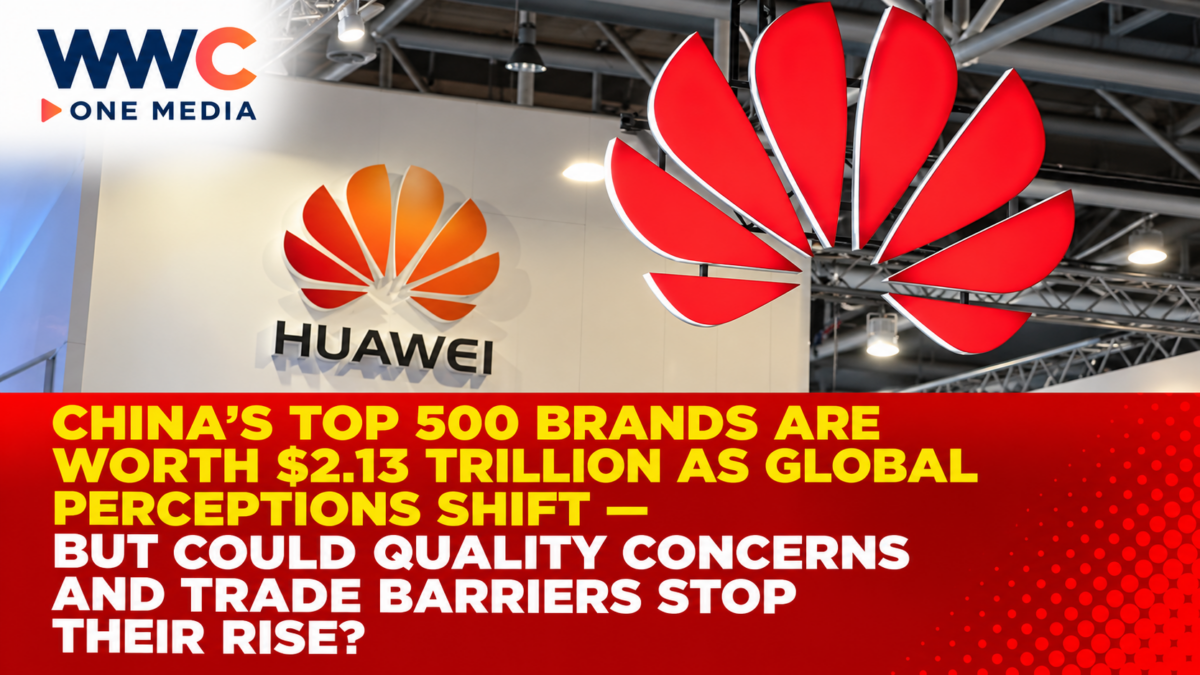
A separate Brand Finance study valued China’s top 500 brands at approximately $2.13 trillion, up 8%.
The difference between these figures reflects the research organizations’ different methodologies and the number of brands covered.
They should not be added together.
Brand value also differs from company revenue, share-market capitalization and profit.
Nevertheless, the estimates suggest that Chinese companies are creating substantial commercial value through reputation and consumer recognition.
Chinese products are gaining international appeal
Research firm Kantar has identified a shift in how Chinese brands compete internationally.
Its 2026 global-brand research examined consumer behavior across 11 markets and 15 product categories.
The report argues that Chinese companies are increasingly converting awareness into purchase consideration and actual product trials.
This is an important distinction.
Consumers may recognize a company’s name without trusting its products.
They may also consider buying a product without ultimately making a purchase.
A brand becomes more commercially valuable when it can convert recognition into sales, repeat business and customer loyalty.
Independent research by Totem examined 580 Chinese brands and conducted a digital audit of 447 across seven regions.
Its accompanying consumer survey covered 3,500 participants in Japan, South Korea, Indonesia, Malaysia, India, the United States and the United Kingdom.
The study found particularly strong willingness to consider Chinese brands in several emerging Asian markets.
However, these surveys do not represent every country or every product category.
The results demonstrate changing perceptions among surveyed consumers, not universal acceptance of Chinese brands.
BYD illustrates China’s fastest-growing international opportunity
The automotive industry offers one of the clearest examples of the changing reputation of Chinese manufacturing.
For decades, Japanese automakers established strong positions in international markets through fuel efficiency, reliability and extensive service networks.
Chinese carmakers are now challenging those advantages with electric vehicles, plug-in hybrids, battery technology and digital features.
BYD is a particularly important example.
The company has expanded across Southeast Asia, Europe, Latin America and other regions.
Its vehicles are increasingly competing with established brands on technology and price.
In the Philippines, BYD’s distributor reported 28,399 vehicle sales from January through August 2026, up approximately 99% from the corresponding period a year earlier.
WWC ONE MEDIA examined the trend in BYD Philippines Nearly Doubles Sales to 28,399 Units — But One Type of Vehicle Is Driving Almost 80% of the Boom.
Plug-in hybrid models accounted for a large majority of the company’s local sales.
The figures show meaningful demand for at least one Chinese automotive brand in the Philippine market.
But sales growth alone cannot establish that all Chinese vehicles now match Japanese brands in long-term reliability or owner satisfaction.
That conclusion requires evidence covering years of ownership, maintenance, resale values and service performance.
Chinese brands are becoming more visible in everyday Philippine life
The change is increasingly visible in Philippine shopping malls, roads and technology stores.
Chinese smartphones, electronics, appliances and electric vehicles are competing across a wide range of price points.
For consumers, the attraction often combines specifications and affordability.
A product may offer features that were previously available mainly in more expensive competing models.
However, the total value of a purchase depends on more than the initial price.
Warranty coverage, repair services, spare-parts availability and product longevity are particularly important for major purchases.
The same considerations apply to electric vehicles.
Charging access, battery performance, dealer support and resale values can determine whether customers remain satisfied after several years.
The challenge for Chinese brands is turning initial enthusiasm into long-term loyalty.
China’s car export boom reveals a more complicated story
Chinese automotive manufacturers have become increasingly dependent on international markets.
WWC ONE MEDIA recently examined this pressure in China Exports Over 7 Million Cars as Domestic Sales Plunge 22% — But Is Its Auto Industry Heading for a Global Trade War?.
That report discussed the contrast between accelerating vehicle shipments abroad and weakening demand inside China.
The distinction matters because rising exports can reflect more than strong foreign demand.
Manufacturers may also expand overseas because their domestic factories have more capacity than the home market can absorb profitably.
Companies can therefore gain international visibility while facing shrinking margins.
For a brand to succeed over the long term, it must turn market share into sustainable earnings.
Selling more vehicles at deeply discounted prices is different from persuading customers to pay a premium because they trust a brand.
Japan’s most successful automakers eventually achieved substantial international loyalty.
Chinese manufacturers now face their own test of whether sales growth can translate into durable brand strength.
Technology and design are helping Chinese companies move beyond price
Chinese companies are increasingly competing in categories where technology strongly influences consumer preferences.
Smartphones are one example.
Companies such as Huawei and Xiaomi have invested in product design, cameras, operating systems, software experiences and connected devices.
Electric vehicles are another.
Battery performance, charging technology, digital interfaces and driver-assistance features can be major purchasing considerations.
Home appliances offer a third example, with manufacturers using energy efficiency, smart-home functionality and distinctive product designs to compete internationally.
These advances challenge the assumption that Chinese companies succeed only by manufacturing cheaper versions of foreign products.
But technology leadership varies by company and product.
A strong phone camera does not prove superior vehicle reliability, just as efficient appliance manufacturing does not establish leadership in semiconductor design.
The evidence must be evaluated category by category.
Quality and after-sales service remain major tests
An important warning comes from J.D. Power’s September 2026 China Brand Reputation Index.
The study found strong consumer recommendations for several domestic automotive brands, including Geely, AITO, NIO and Xiaomi in their respective market segments.
However, it also reported a significant decline in service satisfaction among new-energy vehicle owners.
The service-related Net Promoter Score for new-energy vehicles fell by 14.9 points compared with 2025.
The finding suggests that rapid improvements in vehicles and digital features have not always been matched by equally rapid development of maintenance and customer-service infrastructure.
That matters for international expansion.
Consumers may be willing to try an unfamiliar brand because it offers impressive technology at an attractive price.
But poor service can undermine their willingness to recommend it.
For Chinese companies hoping to establish reputations comparable with long-standing Japanese brands, consistent after-sales performance may be one of the most important challenges.
Can Chinese brands command higher prices?
One of the strongest signs of a mature global brand is pricing power.
A manufacturer has pricing power when customers continue choosing its products even when cheaper alternatives are available.
Price competition helped many Chinese brands enter overseas markets.
But relying permanently on low prices can place pressure on profitability.
Research by Totem suggests some Chinese companies may be underpricing their products relative to consumers’ willingness to pay in surveyed markets.
That creates a potential opportunity.
A brand that can demonstrate quality, innovation and dependable service may eventually earn stronger margins.
However, raising prices before establishing trust can also drive customers toward competitors.
The transition from low-cost challenger to premium brand requires careful execution.
Japan’s most successful manufacturers spent years building reputations through repeated positive customer experiences.
Chinese companies may need to follow a similar process, even if technology allows them to move faster in certain categories.
The global luxury market offers another opportunity
China’s changing brand reputation is not limited to electronics or vehicles.
Domestic luxury brands are increasingly attracting customers interested in Chinese craftsmanship and cultural identity.
The Financial Times has examined the growing appeal of Chinese luxury jewelry and fashion businesses, including Laopu Gold.
The trend is sometimes associated with guochao, a movement reflecting renewed interest in domestic brands and traditional Chinese cultural influences.
This represents a different kind of competitive advantage.
Instead of imitating established Western luxury companies, successful Chinese brands can draw on their own design traditions and cultural narratives.
But luxury reputation depends on exclusivity, craftsmanship and consumer perception.
Rapid domestic growth does not guarantee equivalent acceptance in European or American luxury markets.
The opportunity is significant, but international expansion remains uncertain.
Overcapacity could weaken the brands China is trying to build
One major obstacle is the pressure created by intense manufacturing competition.
China has developed enormous production capacity in vehicles, batteries, solar products and other industries.
That capacity provides economies of scale, but it can also encourage damaging price competition when demand is insufficient.
WWC ONE MEDIA analyzed the issue in China Is Producing More Cars, Batteries and Goods Than Ever — But the Numbers Reveal Why the West’s ‘Overcapacity’ Case Isn’t So Simple.
The article examined the competing arguments about industrial subsidies, production efficiency and excess supply.
Western governments argue that state support can distort international competition.
China counters that its manufacturers have achieved genuine technological and cost advantages.
Both questions deserve examination.
A product can be legitimately innovative and competitively priced while its industry also faces excess capacity.
For global brand development, the danger is that aggressive discounting can undermine the very reputation and profitability companies are trying to create.
Trade barriers could slow China’s international expansion
Chinese brands are also confronting political and regulatory obstacles.
The European Union has imposed additional duties on certain Chinese-made battery-electric vehicles following an anti-subsidy investigation.
The United States maintains significant barriers affecting Chinese electric vehicles and some connected-vehicle technologies.
Such restrictions complicate international growth strategies.
Manufacturers may need to build overseas factories, create local partnerships or redesign their distribution networks.
In September, WWC ONE MEDIA examined one example in BYD Scraps Its Own Malaysia EV Plant — But the Mystery Local Partner Could Change Everything.
The report described BYD’s decision to pursue a local contract-assembly arrangement rather than proceed with its previously planned company-operated facility.
The change shows that international expansion is not simply a matter of exporting more products.
Manufacturers must adapt to local business conditions, regulatory requirements and commercial partnerships.
Success in these areas can strengthen a global brand.
Poor execution can damage consumer confidence and investor returns.
China is also moving from manufacturing products to supplying industrial technology
Another significant development is China’s expanding role in the machinery and components used by overseas factories.
In an October 21 Bloomberg Intelligence discussion, Morgan Stanley’s Chetan Ahya described a shift from a traditional “Made in China” model toward a broader “Made by China” industrial strategy.
Under that model, Chinese companies supply equipment, components and production technology to manufacturers in countries such as Vietnam, Mexico and India.
The strategy could deepen Chinese participation in global supply chains even when finished products are assembled outside China.
It also creates opportunities for relationships involving maintenance, software and replacement parts.
But that is not identical to consumer-brand prestige.
A company can dominate industrial components while remaining largely unknown to everyday shoppers.
China’s broader economic influence will therefore depend on both industrial capability and consumer-facing trust.
What would prove China has reached its ‘Made in Japan’ moment?
The comparison with Japan should ultimately be judged by long-term outcomes rather than a single year of exports or brand rankings.
Several indicators would be important.
Chinese brands would need to demonstrate reliable quality over many years.
They would need strong after-sales networks and sustainable profitability.
Their products would need to retain customers across multiple generations and economic cycles.
Some would need the pricing power associated with genuine premium brands.
And companies would need to succeed in markets where they face little or no protection from domestic preferences.
China has already made considerable progress in several areas.
The scale of BYD’s international expansion, Huawei’s brand recognition and the global presence of Chinese consumer technology are substantial achievements.
But those developments do not prove that all Chinese brands have reached the level of trust associated with Japan’s most established manufacturers.
The transformation remains underway.
The bigger question: Can China turn manufacturing dominance into lasting global loyalty?
China has become far more than a factory producing low-cost goods for foreign companies.
Its businesses increasingly design, manufacture and market products under globally recognized brand names.
Consumer research indicates that perceptions are improving.
Brand valuations are rising.
And Chinese vehicles, electronics and appliances are gaining customers in markets once dominated by established international competitors.
Yet major challenges remain.
Competition is forcing some manufacturers to cut prices.
Trade restrictions are complicating expansion.
And after-sales service has not always kept pace with product development.
These pressures highlight the difference between becoming a powerful exporter and becoming a trusted global brand.
The ‘Made in China’ label is clearly changing. But whether Chinese manufacturers can repeat Japan’s historic rise will depend on what happens after the first sale: can they build the quality, service, trust and pricing power that keep customers coming back for decades?