
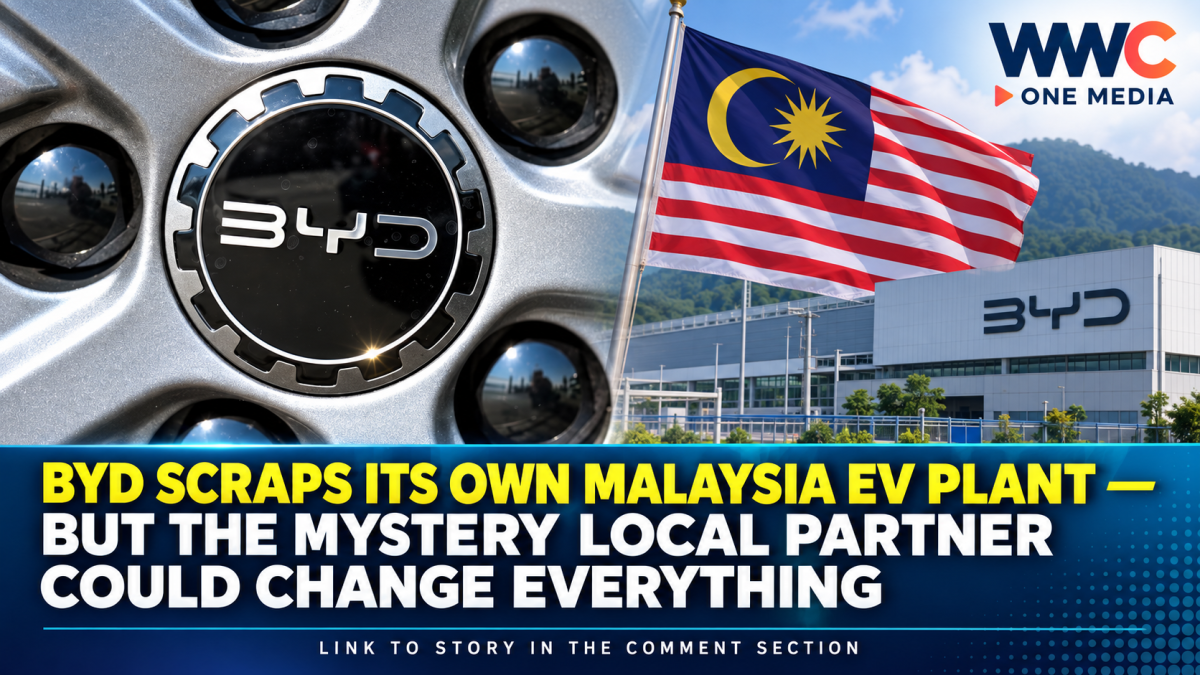
Chinese electric vehicle giant BYD has abandoned plans to build and operate its own assembly plant in Tanjung Malim, Malaysia, but the company insists it is not walking away from local production.
Instead, BYD is now moving toward a partnership with an established Malaysian contract assembler in a major shift that could reshape the company’s expansion strategy in Southeast Asia.
BYD Malaysia Managing Director Jacob Ma confirmed that the previously planned Tanjung Malim facility will no longer proceed. However, he stressed that the decision does not mean BYD has cancelled its plans to assemble vehicles locally.
The company is now in advanced discussions with an unnamed Malaysian partner capable of handling its complete knock-down, or CKD, assembly operations. BYD said the necessary documentation is being finalised, with an official announcement expected once an agreement is completed.
Tanjung Malim Is Out — But Malaysian Assembly Is Still On
BYD had announced plans in 2025 for its own CKD assembly facility in Tanjung Malim, Perak, with production originally expected to begin in the second half of 2026.
But uncertainty surrounding the project had grown in recent months.
Malaysia’s Ministry of Investment, Trade and Industry had previously indicated that no final decision on the project’s future had been officially communicated. Reports also pointed to broader questions surrounding manufacturing requirements and the government’s efforts to ensure foreign EV investments contribute to Malaysia’s domestic automotive industry and supply chain.
Now, BYD appears to have chosen a faster and potentially less capital-intensive route: using an existing Malaysian assembly operation rather than building an entirely new factory from scratch.
Who Is BYD’s Mystery Malaysian Partner?
BYD has not officially revealed the identity of its future assembly partner, but speculation has increasingly focused on Inokom’s assembly facility in Kulim, Kedah.
The possibility gained attention after BYD Asia-Pacific executive Liu Xueliang visited the Inokom plant in May. Inokom, linked to Sime Motors, already has experience in contract vehicle manufacturing and assembling electric vehicles.
Further speculation emerged after Sime Motors representatives reportedly visited BYD’s headquarters in Shenzhen for discussions involving strategic cooperation and future growth. However, it is important to note that neither BYD nor Sime Motors has officially confirmed an Inokom assembly agreement.
Why Is Local Assembly Becoming So Important?
The shift comes as Malaysia tightens its EV market policies.
Changes to the country’s rules for fully imported electric vehicles have increased pressure on automakers to consider local production. Industry observers say local CKD assembly could help carmakers establish a stronger long-term position while supporting Malaysian suppliers, manufacturing jobs and the wider automotive ecosystem.
BYD has also said it has been engaging Malaysian vendors as part of efforts to integrate more deeply into the country’s automotive industry.
Jacob Ma said the company’s plans may have changed, but its commitment to Malaysia remains.
Malaysia continues to be viewed by BYD as an important market and a strategic part of its future regional growth, particularly as Southeast Asia becomes an increasingly important battleground for Chinese EV manufacturers.
BYD’s Bigger Global Expansion Strategy
The Malaysia decision comes as BYD accelerates its international expansion.
Reuters recently reported that BYD is targeting major growth in overseas vehicle exports, underlining the company’s increasing focus on markets outside China. The automaker has also pursued overseas manufacturing and assembly strategies in several regions as it expands its global footprint.
For Malaysia, the big question is no longer whether BYD wants to assemble EVs locally.
That answer appears to be yes.
The real mystery now is who BYD has chosen as its Malaysian production partner — and when the first locally assembled BYD vehicles will finally roll off the line.
With negotiations reportedly already at an advanced stage, the announcement could reveal much more than just the name of a factory.
It could signal the next major phase of Malaysia’s ambition to become a Southeast Asian EV manufacturing hub.




Leave a Reply