
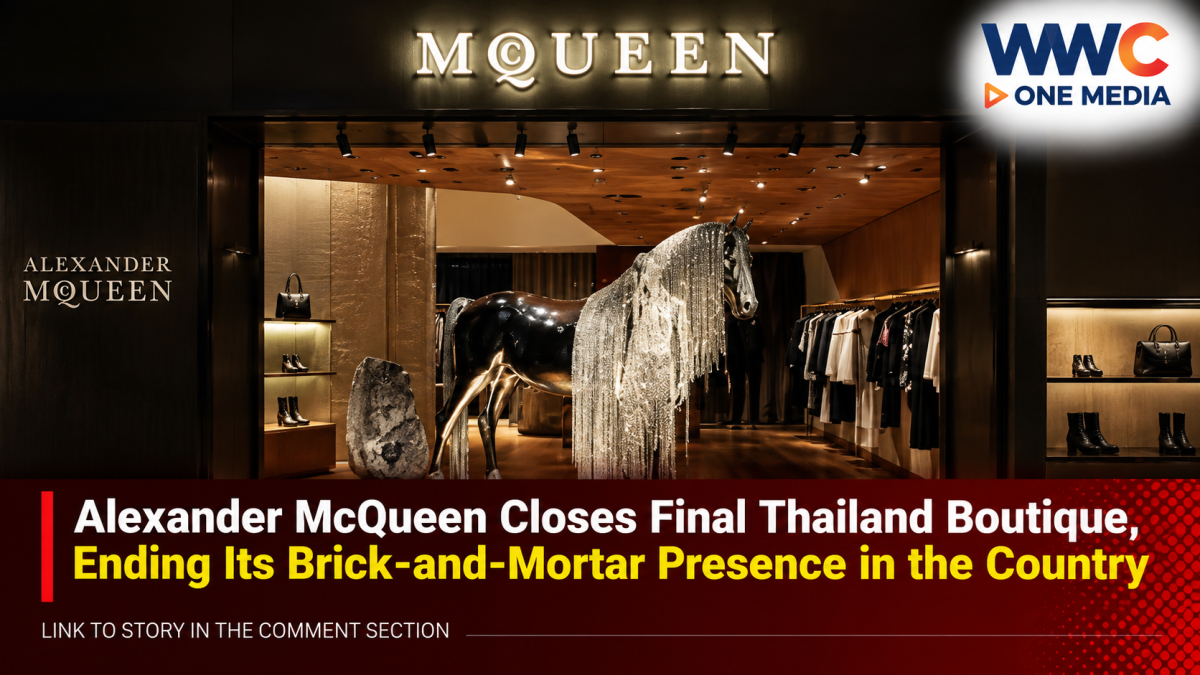
ALEXANDER MCQUEEN CLOSES ITS LAST THAILAND BOUTIQUE
British luxury fashion house Alexander McQueen has ended its brick-and-mortar retail presence in Thailand, following the closure of its final boutique at Bangkok’s ICONSIAM.
The closure marks the end of the brand’s physical store network in Thailand, according to a recent report by the Bangkok Post.
The development does not mean Alexander McQueen is leaving the global fashion business. The house continues to operate internationally and maintains its official online flagship and stores in other markets.
FROM BANGKOK BOUTIQUES TO A COMPLETE RETAIL EXIT
Alexander McQueen has been part of Bangkok’s luxury-shopping landscape for years, with its boutiques serving customers seeking the British house’s ready-to-wear collections, footwear, leather goods and accessories.
The closure of the ICONSIAM location means the brand no longer has a physical boutique in Thailand.
For luxury shoppers in Bangkok, the change represents the disappearance of another international fashion label from the country’s traditional brick-and-mortar luxury retail scene.
THE CLOSURE COMES AS LUXURY RETAIL IS BEING RETHOUGHT
Alexander McQueen’s Thailand exit comes against a broader backdrop of changes in the global luxury industry.
Luxury groups and fashion houses have been reassessing store networks, locations and operating models as they attempt to balance prestigious physical boutiques with increasingly important digital channels.
Reporting in 2026 has also pointed to a broader restructuring of Alexander McQueen’s store network, including plans to reduce its global footprint.
That makes the Thailand closure part of a wider retail strategy rather than evidence that the brand itself is disappearing.
WHY ICONSIAM MATTERS
The final boutique was located at ICONSIAM, one of Bangkok’s major luxury and tourism-oriented shopping destinations.
The mall has become an important address for international luxury brands and attracts both local shoppers and international visitors.
The departure of Alexander McQueen therefore highlights the competitive nature of Bangkok’s luxury retail market: even premium shopping destinations must continually adjust to changing brand strategies and consumer behavior.
WHAT HAPPENS TO THAI CUSTOMERS?
The closure of the physical boutique does not necessarily mean Thai customers lose access to the brand altogether.
Alexander McQueen continues to operate its official online flagship, allowing customers in supported markets to browse the fashion house’s collections digitally.
However, the disappearance of a physical store changes the luxury-shopping experience. Customers can no longer rely on a dedicated McQueen boutique in Thailand for the in-person presentation, fitting and service traditionally associated with luxury fashion retail.
A CHANGE IN THE LUXURY SHOPPING LANDSCAPE
The Thailand closure also reflects a larger question facing luxury fashion: how many physical stores does a global brand actually need in each market?
Flagship boutiques can strengthen brand identity and provide an exclusive customer experience, but they also come with substantial costs, from prime retail rents and staffing to inventory and store operations.
At the same time, online retail gives brands the ability to reach customers without maintaining the same physical footprint.
For a house such as Alexander McQueen, the challenge is finding the right balance between exclusivity, accessibility and profitability.
THE BRAND IS NOT DISAPPEARING
It is important not to confuse a country-level retail exit with the closure of the fashion house.
Alexander McQueen remains an active global luxury brand under Kering, with its own creative and commercial operations. The fashion house continues to sell clothing, accessories and other products through its international retail network and digital channels.
The Thailand development is therefore best understood as a strategic change in where and how the brand sells, rather than an end to Alexander McQueen.
WHAT THE EXIT COULD SIGNAL FOR THAILAND’S LUXURY MARKET
Thailand remains an important destination for international luxury shoppers, particularly in Bangkok, where major shopping complexes compete to attract global brands and affluent consumers.
But the closure shows that having a high-profile location does not guarantee that every international fashion house will maintain a permanent physical presence.
As luxury brands streamline operations and experiment with digital and selective retail strategies, Bangkok’s luxury market could see more changes in the years ahead.
For Alexander McQueen, meanwhile, the message is clear: the brand has closed its final physical store in Thailand, but its global fashion ambitions remain firmly intact.



Leave a Reply