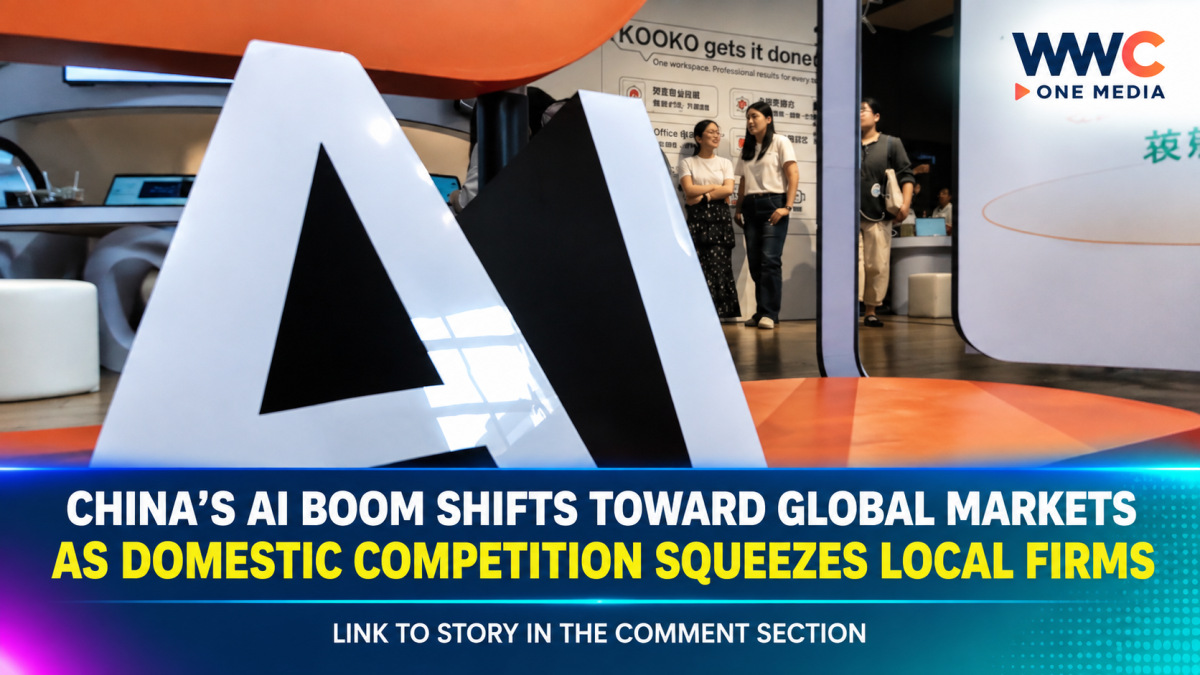
China’s push to become a global artificial intelligence powerhouse is increasingly benefiting companies that can sell AI-related products and infrastructure overseas, while firms focused mainly on the domestic market face intensifying competition and pressure on profits.
A Bloomberg index tracking 30 Chinese technology companies with the largest overseas revenue exposure has gained about 36% in 2026, compared with a 9% increase for companies more dependent on domestic sales. The gap reflects growing investor interest in businesses positioned to benefit from surging global demand for AI infrastructure.
China’s drive for technological self-sufficiency has also created fierce competition at home. Companies have rushed to introduce cheaper AI models, applications, chips and other products in an effort to capture market share, contributing to price competition and weaker profit margins.
Several domestically focused technology companies have consequently struggled. Moore Threads Technology, which generates nearly all of its revenue in China, has fallen about 25% this year, while AI company SenseTime has declined more than 40%. Kuaishou Technology, which derives less than 5% of its revenue overseas, has also suffered a sharp decline.
By contrast, companies with strong international exposure have benefited from demand for data centers, optical components and other infrastructure needed to support the rapid expansion of AI worldwide.
Optical component makers Zhongji Innolight and Eoptolink Technology, for example, generate more than 90% of their revenue overseas and have each gained roughly 50% in 2026, according to the latest market data.
The shift comes as global spending on artificial intelligence continues to expand. Nvidia CEO Jensen Huang has projected that the company could sell twice as many chips over the coming year, highlighting expectations for continued demand for computing capacity and AI infrastructure.
However, the outlook remains sensitive to geopolitics. Chinese companies that depend heavily on overseas markets could be exposed if tensions between Washington and Beijing intensify, particularly over technology restrictions, semiconductor access and AI-related trade.
At the same time, some analysts argue that China’s domestic AI ecosystem remains strategically important. Morgan Stanley analysts have described AI sovereignty and semiconductor localisation as longer-term opportunities for Chinese companies regardless of the outcome of US-China talks.
The contrasting fortunes highlight a broader shift in China’s AI industry. As the domestic market becomes increasingly crowded, the ability to compete internationally is emerging as an important factor separating companies benefiting from the global AI investment boom from those fighting for market share at home.
With US President Donald Trump and Chinese President Xi Jinping preparing for talks that could address trade and technology, the direction of US-China relations could further shape where the next phase of China’s AI growth takes place.