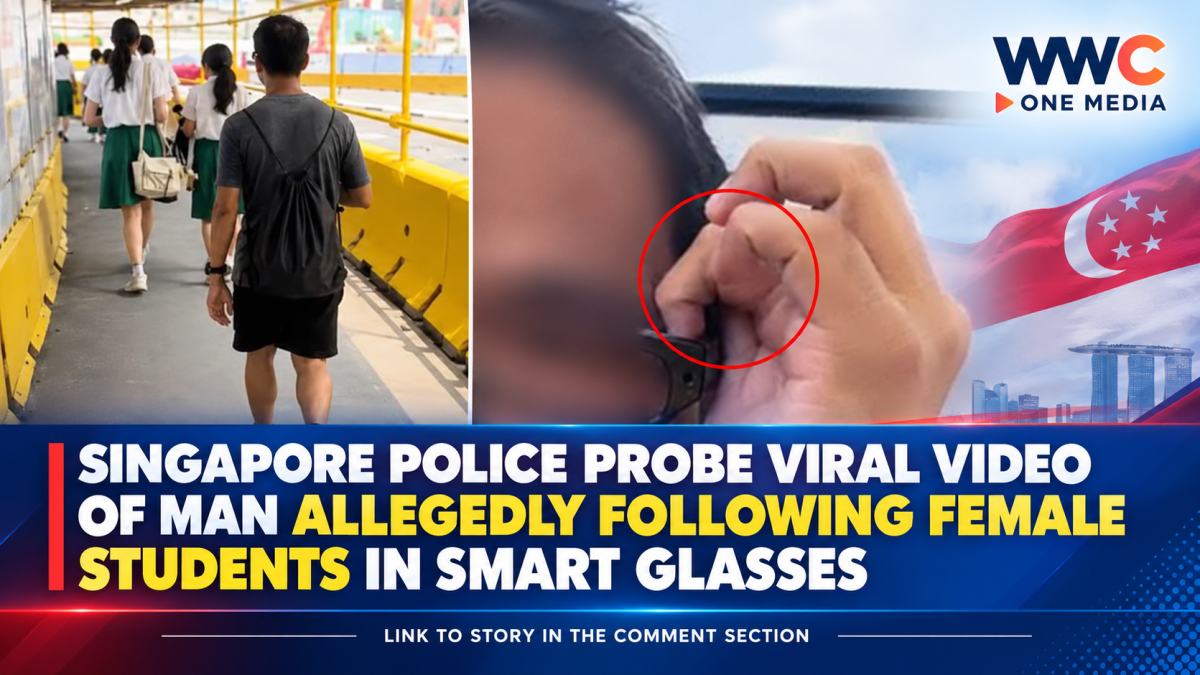
SINGAPORE — Singapore police are investigating after a video circulated online showing a man allegedly following female students while wearing glasses that social-media users claimed were capable of recording video.
Police confirmed on September 23 that a report had been lodged and that investigations were ongoing, according to The Straits Times and CNA.
The footage shows a man walking behind two female students in uniforms resembling those of Raffles Institution. The incident was said to have occurred along a pedestrian walkway toward Marymount MRT station, although the exact date and circumstances of the recording have not been established.
At one point, the man appears to press or touch the side of his black-rimmed glasses while holding a mobile phone close to his chest. After apparently noticing that he was being filmed, he turns around and walks away.
The video was first posted on Reddit on September 21 before being removed. It was subsequently reposted on social media, where claims circulated that the man was using artificial-intelligence or smart glasses capable of recording people.
What the video does — and does not — show
The footage has generated concern because modern smart glasses can incorporate cameras, microphones and other connected technology into an ordinary-looking pair of glasses.
However, the available footage does not independently establish that the glasses were recording at the time, nor has police announced that an offence has been committed.
That distinction is important as the investigation continues.
CNA reported that the social-media post alleged the glasses were capable of recording video, while The Straits Times likewise reported that the smart-glasses claim came from the account that reposted the footage. The exact model of the glasses has not been confirmed in the reports.
Smart-glasses privacy concerns are growing
The incident comes amid a broader international debate over privacy and wearable AI technology.
Reuters reported this week that smart glasses are facing increased scrutiny in several countries because cameras and microphones can make recording less obvious to people nearby. French authorities, for example, have stepped up scrutiny over privacy and harassment concerns involving the technology.
Singapore has already addressed questions surrounding the regulation of AI-enabled smart glasses.
In April, the Ministry of Digital Development and Information said smart glasses with AI capabilities are subject to existing data-protection safeguards. Organizations providing such products must comply with Singapore’s Personal Data Protection Act when collecting, using or disclosing personal data.
The ministry also said in May that the form factor of a device does not change the applicable rules: photographs, video and audio recordings are subject to the relevant legal and data-protection principles regardless of whether they are captured by a phone, camera or wearable device.
Singapore’s government further noted that non-consensual recording, sharing or misuse of intimate or private material can potentially constitute offences under existing laws.
Investigation remains ongoing
The viral video has prompted renewed discussion about privacy and personal safety in public spaces, particularly as wearable devices become smaller and less conspicuous.
But authorities have not publicly confirmed the identity of the man, the exact circumstances surrounding the recording, whether the glasses contained a functioning camera, or whether any students were actually recorded.
CNA said it contacted Raffles Institution to ask whether the school was aware of the incident and whether students or parents had raised concerns.
For now, the central fact remains that a police report has been lodged and an investigation is underway.
The case also highlights a rapidly developing technology challenge: as AI-powered wearables become more common, determining when someone is merely wearing smart glasses and when they are actually recording another person can become increasingly difficult — making transparency, privacy safeguards and existing laws more important.
WWC ONE MEDIA G,A