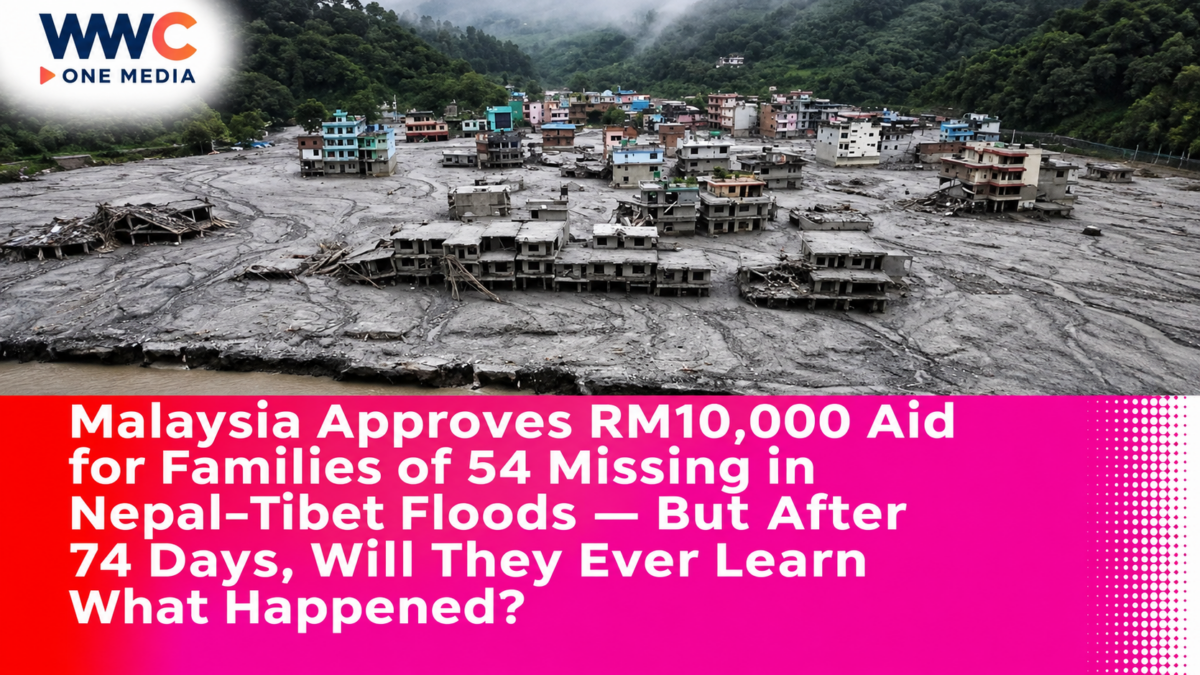
KUALA LUMPUR, MALAYSIA — More than two months after catastrophic floods swept through the Nepal–Tibet border region, 54 Malaysians remain missing, leaving their families trapped in an agonizing search for answers.
Now, Prime Minister Anwar Ibrahim’s government has announced financial assistance intended to help those families cope with the aftermath.
Malaysia will provide a one-off payment of RM10,000, or approximately US$2,460, to each affected family, following a decision reached during a Cabinet meeting on Friday, November 6.
The assistance will be distributed through Malaysia’s National Disaster Management Agency (NADMA).
But while the payments represent an important step, they cannot resolve the most painful question facing the families.
What happened to the 54 people who have not been heard from since the August 26 disaster?
According to Channel News Asia, the Malaysians disappeared after a massive collapse of glacial ice and rock sent torrents of water, mud and debris through communities along the Nepal–Tibet border.
The disaster destroyed homes, roads and bridges, disrupted communications and trapped tourists, pilgrims and residents in remote mountain areas.
Despite international rescue efforts, thousands of people remain unaccounted for.
And as Malaysia prepares to distribute assistance, relatives are confronting a difficult reality: financial support may arrive long before they receive confirmation of their loved ones’ fate.
Anwar Ibrahim Approves RM10,000 Assistance for 54 Families
Malaysia’s Human Resources Minister R. Ramanan announced the assistance on November 6 after visiting the Deepavali Carnival at Bukit Jalil National Stadium in Kuala Lumpur.
Ramanan said the government had discussed the situation extensively before Anwar approved the one-off payments.
Under the plan, each of the 54 affected families will receive RM10,000.
That represents a combined intended allocation of RM540,000.
The assistance will be administered through NADMA, which will determine the appropriate recipients using its established priority arrangements.
According to Bernama and The Star, spouses will receive first priority, followed by parents and then children.
Ramanan also instructed the Malaysian Indian Community Transformation Unit, known as MITRA, to coordinate with the Finance Ministry and contact the affected families.
Government officials are expected to collect the relevant information and complete the necessary administrative steps.
The announcement confirms that assistance has been approved.
However, the reports reviewed do not establish that every payment has already reached its recipient.
Why Are 54 Malaysians Still Missing?
The devastating flood struck on August 26, 2026.
A collapse involving glacial ice and rock in the upper Lhende Khola catchment in Tibet triggered a destructive surge of water and debris.
The resulting floodwaters swept through Himalayan valleys and affected communities near the Nepal–China border.
Buildings were destroyed.
Vehicles were carried away.
Roads and bridges were damaged or lost.
Communication networks failed, making it difficult for authorities to establish the whereabouts of residents and visitors.
Among those affected were tourists and pilgrims travelling toward Mount Kailash, a sacred destination for Hindus and Buddhists.
Malaysia initially classified 55 people as uncontactable.
One individual was subsequently located safely and returned home in early October.
That reduced the official number still missing to 54.
The distinction matters.
Authorities have not confirmed that all 54 people died.
Until their whereabouts or identities are established, they must continue to be described as missing.
Malaysia Refuses to Abandon the Search
Although Nepal has ended its active search-and-rescue phase and shifted toward recovery operations, Malaysian authorities say their efforts to obtain answers are continuing.
On October 22, Foreign Minister Mohamad Hasan told Malaysia’s Parliament that the Malaysian Embassy in Kathmandu remained in contact with local authorities and trekking checkpoints.
Officials were reviewing travel registration records and last-known telephone information to reconstruct the missing travellers’ movements.
Malaysia also deployed its Special Malaysia Disaster Assistance and Rescue Team to Nepal from September 5 to 11.
The team brought nine high-powered drones.
But the difficult Himalayan terrain created major obstacles.
Steep slopes, destroyed roads and inaccessible valleys prevented search teams from reaching some locations.
The deployment demonstrated Malaysia’s commitment to assisting the search, but it did not resolve the fate of the missing individuals.
For families, every unanswered lead prolongs the uncertainty.
More Than 1,400 Killed as Thousands Remain Unaccounted For
The scale of the Nepal–Tibet disaster has continued to emerge over the weeks since August 26.
CNA and Bernama reported that at least 1,451 people had died and approximately 5,700 remained missing across the affected disaster area.
A November 8 report by The Guardian cited 1,459 confirmed deaths and 5,285 people still unaccounted for.
These figures reflect different reporting updates and should not be combined or treated as a single reconciled count.
What is clear is that the catastrophe caused extraordinary human suffering.
Families from numerous countries have been affected.
The destruction has damaged tourism, trade routes, housing and essential infrastructure.
Communities that depended on roads crossing the Nepal–Tibet frontier have faced enormous difficulties obtaining supplies and restoring economic activity.
As previously reported by WWC ONE MEDIA in its analysis of Nepal’s multibillion-dollar reconstruction challenge, preliminary assessments placed damage to infrastructure, property and housing at approximately 387.5 billion Nepalese rupees.
Those figures were preliminary and do not represent a final audited rebuilding bill.
The disaster has therefore become both a humanitarian tragedy and a long-term economic challenge.
The Search Has Become a Difficult Forensic Investigation
As the likelihood of finding survivors diminishes with time, authorities face the painful task of identifying recovered victims.
That work can be exceptionally difficult after powerful floods.
Bodies and remains may be swept far downstream.
Some may be recovered without documents or personal possessions.
Others may be impossible to identify visually.
DNA analysis, fingerprints, dental records and other forensic methods can help establish identities.
But the process requires time, laboratory capacity and cooperation from relatives.
As WWC ONE MEDIA reported in its coverage of Nepal’s growing flood-related DNA identification crisis, the scale of recovered remains has challenged the country’s identification systems.
The Guardian reported on November 8 that more than 2,000 people had provided DNA samples to assist investigations.
By early October, only 112 bodies had reportedly been identified and returned to families.
Those figures highlight why relatives may wait months for answers even after recovery teams have located remains.
For the 54 Malaysian families, any eventual identification would depend on reliable forensic evidence and official confirmation.
International Assistance Has Helped Nepal’s Recovery
Malaysia is not the only country supporting Nepal after the disaster.
Singapore has provided humanitarian assistance, forensic specialists and equipment intended to strengthen recovery operations.
The shipment included medical supplies, personal protective equipment, DNA-testing materials and specialized search equipment.
Singaporean forensic personnel have also assisted Nepalese authorities with disaster-victim identification.
These contributions are important because recovery operations require more than food and temporary shelter.
Governments must restore communications, identify victims, support displaced families and rebuild damaged infrastructure.
International coordination becomes particularly important when victims and missing persons come from several countries.
Himalayan Glacier Hazards Raise New Questions About Disaster Preparedness
The August flood has also renewed attention to the hazards associated with unstable glaciers, steep mountain terrain and high-altitude lakes.
A collapse involving glacier ice and rock can send enormous amounts of debris into a river system.
In certain conditions, the resulting surge can travel rapidly downstream, giving communities little time to escape.
Climate change is altering Himalayan glaciers and surrounding mountain environments.
However, attributing a particular collapse entirely to climate change requires detailed scientific investigation.
The August disaster involved an ice-and-rock collapse, and researchers have examined the possible influence of changing climate conditions.
The catastrophe has increased calls for improved monitoring, early-warning systems and safer infrastructure.
As WWC ONE MEDIA previously reported on Nepal’s plan to lower the water levels of four potentially dangerous glacial lakes, authorities are considering engineering and monitoring measures to reduce future risks.
That glacial-lake initiative addresses broader Himalayan hazards; it should not be confused with a finding that a particular lake caused the August 26 disaster.
Protecting mountain communities will require stronger scientific monitoring, emergency communications and disaster-response capabilities.
Financial Assistance Cannot End the Families’ Uncertainty
Malaysia’s RM10,000 assistance plan is a significant acknowledgement of the hardships facing affected households.
Families may have encountered expenses associated with travel, documentation and prolonged uncertainty.
Some may also face financial difficulties if a missing relative contributed to household income.
But the assistance does not resolve questions about legal status, inheritance, insurance or long-term family support.
Those issues may require separate administrative or legal processes.
For relatives, the immediate priority often remains obtaining credible information.
The Guardian’s November 8 reporting described families from several countries who continue seeking updates and hoping for confirmation of their loved ones’ fate.
Some have organized advocacy efforts to encourage authorities to maintain communication and continue recovery work.
Their experiences show that the consequences of a disaster do not end when television coverage fades or emergency rescue teams withdraw.
For many families, the hardest period begins after the initial emergency.
What Happens Next for the 54 Malaysian Families?
The first immediate step is distributing the approved assistance.
NADMA and the relevant Malaysian agencies must identify eligible next of kin and complete the required procedures.
The second priority is continued diplomatic coordination.
Malaysia’s embassy in Kathmandu can pursue available information from Nepalese authorities, travel records and relevant recovery operations.
The third involves victim identification.
Where remains are recovered, forensic analysis may help determine whether any of the missing Malaysians are among those found.
The fourth is sustained communication with relatives.
Accurate updates are essential, even when authorities have no new findings to report.
But no public timetable guarantees when the missing-person cases will be resolved.
Some families may receive confirmation as recovery work progresses.
Others may face a much longer wait.
It would be irresponsible to predict the fate of the 54 people without verified evidence.
The Bottom Line: Malaysia Offers Financial Help, but the Search for Answers Continues
Malaysia has approved RM10,000 in one-off assistance for each of the 54 families affected by the Nepal–Tibet flood disaster.
The decision was made by Prime Minister Anwar Ibrahim on November 6 and will be implemented through NADMA.
The payments are intended to ease financial pressure on families whose loved ones remain missing after the August 26 catastrophe.
Malaysia has also maintained efforts to trace its missing nationals, even as Nepal’s response has shifted from active rescue operations toward recovery.
The wider disaster has left more than 1,400 people dead and thousands unaccounted for, according to the latest reports.
International teams continue supporting recovery, forensic identification and reconstruction.
But financial assistance and disaster recovery are only part of the story.
For the families of the 54 missing Malaysians, the most important outcome remains confirmation of what happened.
And as Malaysia prepares to deliver financial assistance more than two months after one of the Himalayas’ deadliest recent disasters, one heartbreaking question remains: Will the families of the 54 missing Malaysians finally receive the answers they have waited so long to hear—or could their search for closure continue for months or even years?