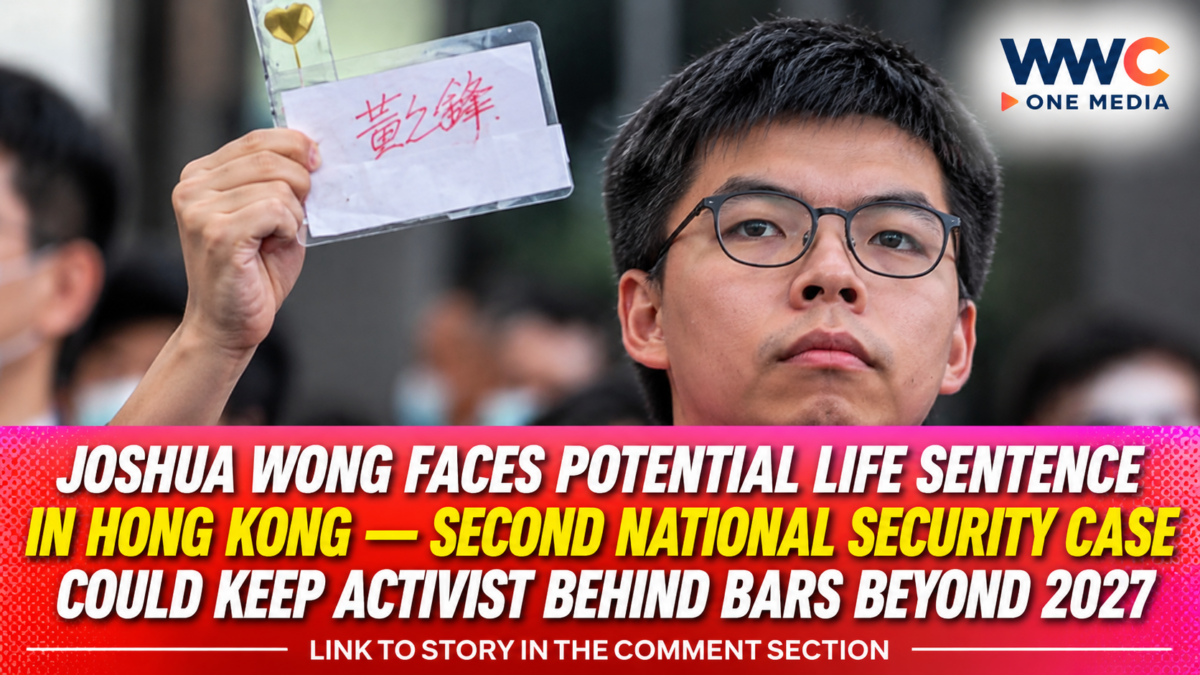
HONG KONG — November 5, 2026 — Hong Kong pro-democracy activist Joshua Wong is facing another major prison sentence in a national security case that could dramatically extend his time behind bars, potentially keeping him imprisoned well beyond his previously expected release in January 2027.
The 30-year-old former student leader pleaded guilty in September to conspiracy to collude with foreign forces under Hong Kong’s National Security Law. The offence carries a possible sentence ranging from three years to life imprisonment, depending on how seriously the court classifies the conduct.
Wong is already serving four years and eight months in prison following his conviction in a separate case involving Hong Kong’s unofficial 2020 pro-democracy primary election.
The latest prosecution concerns allegations that Wong worked with exiled activist Nathan Law and others to encourage foreign governments, organisations and individuals to impose sanctions, blockades or other hostile measures against Hong Kong and China.
Wong admitted the charge on September 2, 2026.
His sentencing was scheduled for November 5 before High Court Judge William Tam. However, the AsiaOne report published early Thursday morning did not include the final court ruling.
The case has attracted international attention because of Wong’s prominent role in Hong Kong’s democracy movement and the continuing debate over the reach of Beijing’s national security legislation.
Why Joshua Wong Is Facing Another National Security Sentence
The latest case centres on an alleged international lobbying campaign between July 1 and November 23, 2020.
Prosecutors accused Wong of conspiring with Nathan Law and other individuals to request that foreign countries, institutions, organisations and individuals impose sanctions, blockades or other hostile measures against Hong Kong and China.
The allegations involve political lobbying, international advocacy, media appearances and online campaigning.
According to prosecutors, Wong remained in Hong Kong while Law and other activists continued their work overseas. Wong allegedly supported the campaign through foreign media outlets and social media platforms.
The prosecution argued that these activities formed part of a wider effort to pressure Beijing and the Hong Kong government.
Wong pleaded guilty to the conspiracy charge before the High Court in September.
The specific period covered by the charge is important: it began on July 1, 2020, one day after China’s National Security Law took effect in Hong Kong.
The law criminalises collusion with foreign forces, including requesting foreign entities to impose sanctions or take other hostile actions against Hong Kong or China.
Could Joshua Wong Receive Life Imprisonment?
One of the most consequential aspects of the case is the potential punishment.
Under Article 29 of Hong Kong’s National Security Law, the penalties depend on the seriousness of the offence.
- Less serious cases: Imprisonment of three to 10 years.
- Grave cases: Imprisonment of at least 10 years, potentially extending to life imprisonment.
This means a life sentence is legally possible, but it is not an automatic consequence of Wong’s guilty plea.
The court must determine the appropriate seriousness classification before deciding the sentence.
A guilty plea can also reduce the eventual punishment, although the final decision rests with the judge.
Reuters and the Associated Press have both highlighted the possibility of life imprisonment, while Wong’s defence has argued for a substantially lower sentence.
The distinction between the two sentencing categories could determine whether Wong receives several additional years in prison or faces a much longer period of incarceration.
Wong’s Lawyers Ask the Court to Consider His Years Behind Bars
Wong’s defence team has asked the court to take into account the time he has already spent in prison and the fact that he admitted the charge.
His lawyer, Derek Chan, argued that Wong had already spent nearly six years in custody and had undergone a lengthy period of reflection.
According to Associated Press reporting, Chan told the court that Wong had continued reading and studying while imprisoned and hoped to eventually leave prison to care for his aging parents.
The defence also sought a reduction for Wong’s guilty plea.
South China Morning Post reported that the defence proposed an eventual sentence of approximately four and a half years, taking into account the appropriate sentencing category and other mitigating factors.
However, the defence’s proposed punishment is not binding on the court.
The judge must independently assess the circumstances and apply the relevant sentencing provisions.
His Previous Release Date Was January 2027
Before the latest prosecution, Wong was expected to complete his existing prison term in January 2027.
That sentence was imposed in November 2024 after he pleaded guilty to conspiracy to commit subversion in connection with the unofficial 2020 pro-democracy primary election.
The case involved 47 opposition figures who participated in the primary, which was organised to select candidates for Hong Kong’s Legislative Council election.
Prosecutors argued that the activists intended to secure a legislative majority and use their position to block government budgets, potentially forcing Hong Kong’s leader to resign.
Authorities considered the alleged strategy a conspiracy to subvert state power.
Wong received four years and eight months in prison.
The second national security case has now placed his expected release date in serious doubt.
Even if the court imposes a sentence substantially below the maximum available under the law, Wong could remain incarcerated for years beyond January 2027.
WWC One Media previously examined this development in Joshua Wong Had Been Due to Leave Prison in 2027 — Then He Pleaded Guilty in a Second National Security Case.
The earlier report explained why the new conviction created uncertainty over the activist’s expected release and why the difference between the two sentencing categories matters.
What Did Wong and Nathan Law Allegedly Do?
The prosecution’s case focuses on efforts to obtain international support for political pressure against Hong Kong and Chinese authorities.
Prosecutors said Wong and Law had agreed around 2016 to pursue international lobbying in support of democratic self-determination.
Their earlier activities included seeking foreign political support and advocating measures against Beijing and the Hong Kong government.
After the National Security Law came into force, prosecutors alleged that the campaign continued.
One example involved an online petition promoted by Nathan Law urging digital-forensics companies to stop cooperating with Hong Kong police.
According to prosecution statements reported by AP and SCMP, Wong supported the effort by sharing and promoting the campaign through social media and foreign media platforms.
Prosecutors also referred to Wong’s international contacts and advocacy involving American political figures.
The case therefore involves more than public criticism of government policy. The prosecution argued that the alleged coordinated effort to secure foreign sanctions and other hostile measures amounted to criminal collusion under the national security legislation.
Wong’s guilty plea means he admitted the charge and the prosecution’s factual basis presented to the court.
From Teenage Protest Leader to Internationally Recognised Activist
Wong became internationally known while still a teenager.
In 2012, he emerged as a prominent figure in protests against a proposed national education programme in Hong Kong. Critics feared the programme would promote political indoctrination in schools.
Two years later, he became one of the leading figures of the 2014 Umbrella Movement.
The demonstrations called for greater democratic participation in choosing Hong Kong’s leader and became one of the city’s most significant protest movements.
In 2016, Wong helped establish Demosisto, a political organisation advocating democratic reform and greater political self-determination for Hong Kong.
Nathan Law was also among the group’s prominent founding figures.
Wong later became involved in the large anti-government demonstrations that began in 2019.
Those protests initially centred on a proposed extradition bill but expanded into a wider movement involving demands for political reform, accountability and greater protection of civil liberties.
The demonstrations also involved violent confrontations between some protesters and police.
Beijing and Hong Kong authorities subsequently introduced the National Security Law in June 2020.
Demosisto disbanded shortly before the legislation came into force.
Beijing Says the National Security Law Protects Stability
The prosecution has become part of a wider international debate over Hong Kong’s political environment.
Beijing and Hong Kong authorities maintain that the National Security Law was necessary to restore stability after the widespread unrest in 2019.
They argue that the legislation targets activities that threaten national security and does not prevent residents from exercising legitimate freedoms.
From the government’s perspective, efforts to persuade foreign governments to impose sanctions or blockades against Hong Kong and China cross a national security boundary.
Authorities have also maintained that law enforcement decisions are based on evidence and that the judiciary exercises its powers independently.
Critics Say the Case Could Further Discourage Political Opposition
Human-rights organisations and several Western governments have expressed concern that the National Security Law has significantly restricted political opposition, public demonstrations and civil society activity.
Critics argue that prosecutions involving prominent activists have created a climate in which political advocacy can carry serious legal consequences.
The Associated Press reported that some observers view Wong’s second national security prosecution as an example of how repeated charges can keep prominent political figures behind bars.
Eric Lai, a research fellow at Georgetown Center for Asian Law, told AP that the repeated use of national security charges could prevent specific political prisoners from being released.
This is a criticism of the law’s implementation, not a judicial finding.
The authorities reject the broader claim that the legislation eliminates legitimate freedoms and insist that national security enforcement is necessary to protect the city.
The disagreement reflects two sharply different interpretations of the same political activity.
Wong’s supporters view international lobbying as part of a campaign for democratic reform, while prosecutors argued that the conduct amounted to collusion with foreign forces.
Hong Kong’s Other High-Profile National Security Cases
Wong’s prosecution is not an isolated case involving Hong Kong’s former pro-democracy movement.
Former media tycoon Jimmy Lai, founder of the now-closed Apple Daily newspaper, was convicted under the National Security Law and sentenced to 20 years in prison in February 2026.
His case has drawn international attention because of concerns about press freedom and the treatment of political dissent.
Read WWC One Media’s report: Jimmy Lai Is Serving 20 Years and Won’t Appeal — Now His Son Is Betting on Xi Jinping’s Washington Visit.
Another major case involved former leaders of the Hong Kong Alliance, which organised the city’s annual Tiananmen Square remembrance vigils.
Lee Cheuk-yan and Chow Hang-tung received lengthy prison sentences in September 2026 after being convicted of inciting subversion.
Read more: Hong Kong Jails Two Tiananmen Vigil Leaders for Seven Years in Landmark National Security Case.
These cases demonstrate how national security prosecutions have affected different parts of Hong Kong’s former opposition movement, including political activists, media figures and civil society organisers.
Nathan Law Remains in Exile
The latest case also places renewed attention on Nathan Law, Wong’s former political ally.
Law left Hong Kong after the National Security Law came into effect and is now based in Britain.
Prosecutors alleged that Law and Wong continued their political campaign despite being in different countries.
While Law pursued overseas advocacy, Wong allegedly supported the effort from Hong Kong through online activity and foreign media.
Hong Kong authorities have also pursued other overseas activists under national security legislation.
The prosecution of Wong highlights the potential legal consequences for people accused of coordinating international pressure campaigns against Hong Kong and Chinese authorities.
What Happens Next?
The central issue is the length of Wong’s additional prison term.
The High Court must consider the seriousness of the offence, the circumstances surrounding the alleged conspiracy and the mitigating factors raised by the defence.
His guilty plea is relevant to sentencing, but it does not guarantee a particular reduction.
A sentence in the lower category could still keep Wong behind bars beyond his previously expected release date.
A finding that the offence was grave would expose him to a much harsher penalty, including the possibility of life imprisonment.
As of the latest reports verified for this article, the final sentencing decision has not been confirmed in the sources available.
The November 5 hearing is therefore a major development, but the precise punishment should not be reported as fact until a reliable court report confirms it.
The Bottom Line: Joshua Wong’s Future Behind Bars Remains Uncertain
Joshua Wong’s second national security conviction has placed his future under renewed uncertainty.
The 30-year-old activist is already serving four years and eight months for conspiracy to commit subversion in the 2020 unofficial primary election case.
His guilty plea to a separate conspiracy to collude with foreign forces charge could result in another substantial prison term.
The prosecution centres on alleged international efforts to encourage sanctions, blockades and other hostile measures against Hong Kong and China.
The defence has asked the court to consider Wong’s nearly six years in custody and his guilty plea, while the law allows a much harsher penalty if the offence is classified as grave.
The outcome will have consequences not only for Wong and his family but also for the wider debate over Hong Kong’s National Security Law and the future of political opposition in the territory.
For the activist who became one of the most recognisable faces of Hong Kong’s democracy movement, the biggest question remains: Will he ever be able to walk free in the near future, or could this second case keep him behind bars for many more years?