
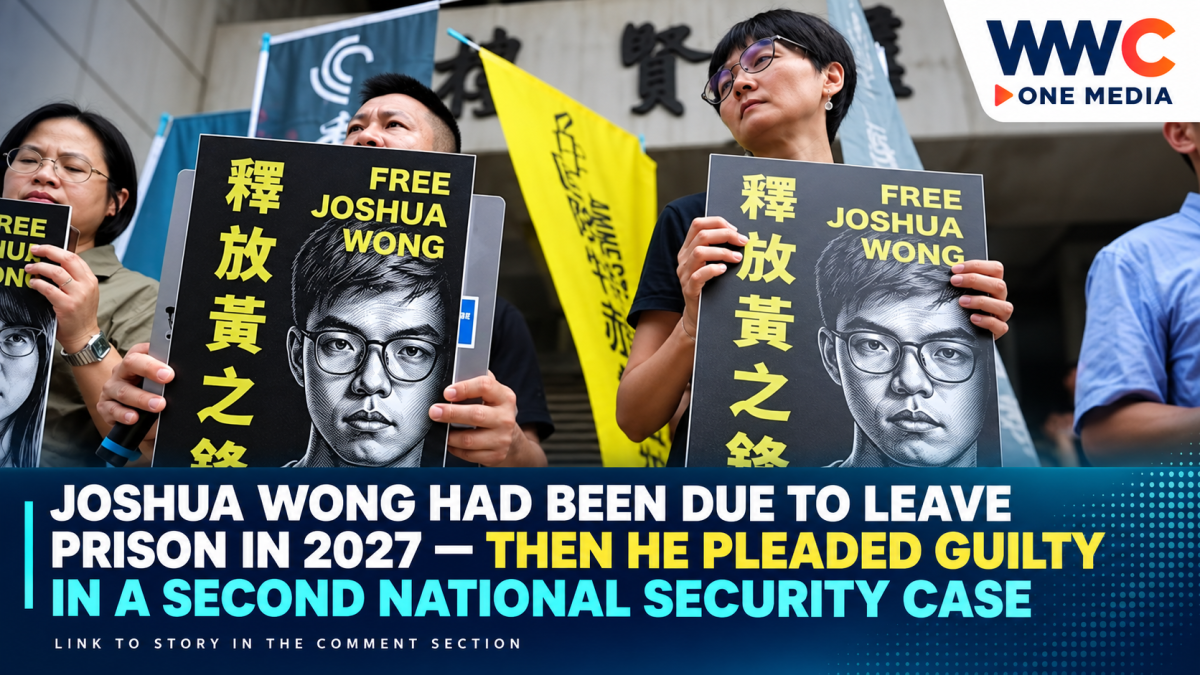
HONG KONG — For Joshua Wong, January 2027 had represented something increasingly rare after years behind bars: a possible release date.
That prospect is now in serious doubt.
The 29-year-old Hong Kong pro-democracy activist pleaded guilty on Sept. 2 to conspiracy to collude with foreign forces to endanger national security, opening the way for another prison sentence on top of the four years and eight months he is already serving in a separate national-security case.
The new charge is among the most serious offenses contained in Hong Kong’s Beijing-imposed National Security Law.
But one critical question remains unanswered:
How many additional years will the court give him?
Justice William Tam told the High Court that he would determine Wong’s sentence as soon as possible, but no sentencing date was announced.
And under the law, the difference between sentencing categories could be enormous.
The punishment can range from three years to life
Wong pleaded guilty under provisions covering collusion with a foreign country or external elements.
Article 29 of Hong Kong’s National Security Law provides for three to 10 years’ imprisonment in ordinary cases.
If the court determines an offense was “of a grave nature,” however, the punishment becomes at least 10 years and can extend to life imprisonment.
That does not mean Wong will receive a life sentence.
His defense is specifically arguing that his conduct should fall within the lower sentencing category rather than be treated as a grave offense. Reuters reported that lawyer Derek Chan urged the judge to consider a sentence toward the upper portion of the three-to-10-year band before applying appropriate reductions.
South China Morning Post reported that Wong’s lawyers proposed an eventual sentence of about 4½ years, citing the seriousness level of the offense, his guilty plea and the delay in prosecuting the case.
The court has not accepted that proposal.
What exactly did Wong admit?
The criminal charge focuses on conduct between July 1 and Nov. 23, 2020.
Prosecutors said Wong conspired with exiled activist Nathan Law and others to encourage foreign countries, institutions, organizations and individuals to impose sanctions, blockades or other hostile actions against Hong Kong or China.
That time period matters because Beijing’s National Security Law took effect on June 30, 2020.
Prosecutors also presented earlier political activity dating back several years as background to what they described as a broader international lobbying campaign.
According to AP, prosecutors said Wong and Law had agreed around 2016 to pursue international lobbying in support of democratic self-determination. Before the security law came into force, they sought overseas political support and advocated measures against Hong Kong and Chinese authorities.
The charged conspiracy, however, specifically covers activity after the security law had taken effect.
That distinction should be maintained in any accurate version of the story.
Prosecutors pointed to sanctions campaigns and corporate pressure
One of the government’s central allegations involved efforts to encourage international sanctions.
Prosecutors cited Wong’s previous support for the Hong Kong Human Rights and Democracy Act in the United States and his international advocacy involving American political figures.
AP reported that prosecutors referenced his appearances and contacts with prominent U.S. politicians as part of the broader history of the campaign.
After the National Security Law took effect, prosecutors said Nathan Law continued overseas lobbying while Wong remained in Hong Kong and supported those efforts through social media and foreign media.
One example involved Wong sharing an online petition promoted by Law that urged digital-forensics companies to stop cooperating with Hong Kong police.
Prosecutors said one company subsequently stopped selling certain digital-intelligence products to customers in Hong Kong and mainland China. Wong confirmed that he accepted the prosecution’s statement of facts presented to the court.
South China Morning Post separately reported allegations that Wong urged foreign companies to reconsider investment or business relationships connected to mainland China and Hong Kong authorities.
He was already supposed to remain imprisoned until January
Even before Wednesday’s guilty plea, Wong was serving a four-year, eight-month sentence.
That punishment arose from the landmark case involving dozens of opposition figures who participated in an unofficial primary election in 2020.
Wong pleaded guilty in that case to conspiracy to commit subversion and was sentenced in November 2024. Before authorities brought the latest foreign-collusion case against him, his existing prison term was expected to finish in January 2027.
He has effectively been continuously incarcerated since November 2020, meaning he has spent nearly six years behind bars.
The latest conviction therefore changes the equation dramatically.
Instead of counting down the final months of his existing sentence, Wong is now waiting to learn how far beyond 2027 his imprisonment could extend.
His lawyer is asking the court to leave him a future
Wong’s defense focused heavily on the amount of time he has already spent incarcerated.
Lawyer Derek Chan told the court that Wong had had years to reflect on his choices and had matured while in prison.
His defense said Wong has read extensively while incarcerated and hopes eventually to leave prison and care for his aging parents.
AP reported that the defense requested a substantial sentencing reduction because Wong pleaded guilty and because of the time taken to bring the latest case against him.
A guilty plea can result in a sentencing discount, but the final calculation rests with the court.
The much more important preliminary decision will be whether Justice Tam treats Wong’s conduct as falling within the normal three-to-10-year range or determines that it crossed into the law’s more serious category.
The teenager who became a global face of Hong Kong’s protests
Wong’s political history stretches back far beyond the 2019 unrest that reshaped Hong Kong.
He emerged nationally in 2012, while still a school student, during protests against the proposed introduction of national education.
He later became one of the most internationally recognizable faces associated with the 2014 Umbrella Movement, which demanded greater democratic participation in the selection of Hong Kong’s leader.
In 2016, Wong helped establish Demosisto alongside other young activists, including Nathan Law.
The group advocated democratic reforms and eventually supported the idea of allowing Hong Kong residents to determine the city’s political future.
Demosisto disbanded shortly before the National Security Law came into effect in 2020.
Wong also sought overseas political support during and around the massive anti-government demonstrations that rocked Hong Kong in 2019.
Those protests began over a proposed extradition law but expanded into a much broader confrontation over political freedoms, policing and Beijing’s influence over the territory.
Some demonstrations turned violent, with clashes between protesters and police.
Beijing says the National Security Law restored stability
The political meaning of Wong’s prosecution remains sharply contested.
Beijing and Hong Kong authorities argue that the National Security Law was necessary after the upheaval of 2019 and say it restored stability while targeting conduct that threatens national security rather than normal political speech.
Regarding Wong’s case, a Hong Kong government spokesperson has argued that legitimate freedom of expression should be distinguished from efforts to persuade foreign governments to impose sanctions against one’s own country.
The statutory language itself specifically criminalizes requesting or conspiring with foreign actors to impose sanctions or blockades, among other acts, against the Hong Kong Special Administrative Region or China.
From the government’s perspective, Wong’s admitted conduct therefore crossed the line from political advocacy into activity expressly prohibited by national-security legislation.
Critics see something very different
Human-rights organizations and many Western governments have long argued that the National Security Law has fundamentally changed Hong Kong’s political environment by criminalizing forms of opposition and international advocacy that were previously permitted.
Reuters notes that Wong’s case is being closely watched by international rights groups and Western governments concerned about implementation of the legislation.
Hong Kong Watch, a UK-based advocacy organization highly critical of Beijing and the Hong Kong government, described Wong’s second national-security prosecution as evidence that the law is being used to prolong the imprisonment of prominent democracy activists.
That is an advocacy group’s interpretation, not a court finding.
Hong Kong and Beijing authorities reject the broader claim that the National Security Law eliminates legitimate freedoms, maintaining that rights remain protected provided they are exercised within the law.
The disagreement goes to the heart of how the same conduct is viewed on opposite sides of Hong Kong’s political divide:
international political advocacy to Wong’s supporters; foreign collusion threatening national security to prosecutors.
Nathan Law remains outside Hong Kong
The latest case also reconnects Wong with another major figure from Hong Kong’s former opposition movement.
Nathan Law, now living in Britain, left Hong Kong following implementation of the National Security Law.
Hong Kong authorities have accused Law and other overseas activists of national-security offenses and offered HK$1 million rewards for information leading to the arrests of several wanted activists abroad.
Wong, by contrast, remained in Hong Kong and has spent much of the period since 2020 behind bars.
The prosecution’s case alleges that even after Law left the city, the two men’s political campaign remained connected, with overseas activity reinforced through Wong’s media and social-media support inside Hong Kong.
The most important ruling hasn’t happened yet
The guilty plea means the courtroom fight is no longer primarily about whether Wong committed the charged offense.
It is now about punishment.
And that makes the next decision enormously consequential.
If the court places the conduct in the ordinary sentencing band and gives Wong substantial credit for pleading guilty, the outcome could be measured in several additional years.
If the court determines the offense was of a grave nature, the statutory framework becomes dramatically harsher.
For now, Justice Tam has said only that he intends to decide the sentence as soon as possible.
There is no confirmed sentencing date.
That is the central unresolved fact.
Joshua Wong entered prison in his mid-20s. He turns 30 this year. Until this second case emerged, the sentence he was already serving had put freedom potentially within sight in early 2027.
Now the question is no longer whether he will finish that sentence. It is how many more years may be waiting for him when he does.
WWC ONE MEDIA M.J.E




Leave a Reply