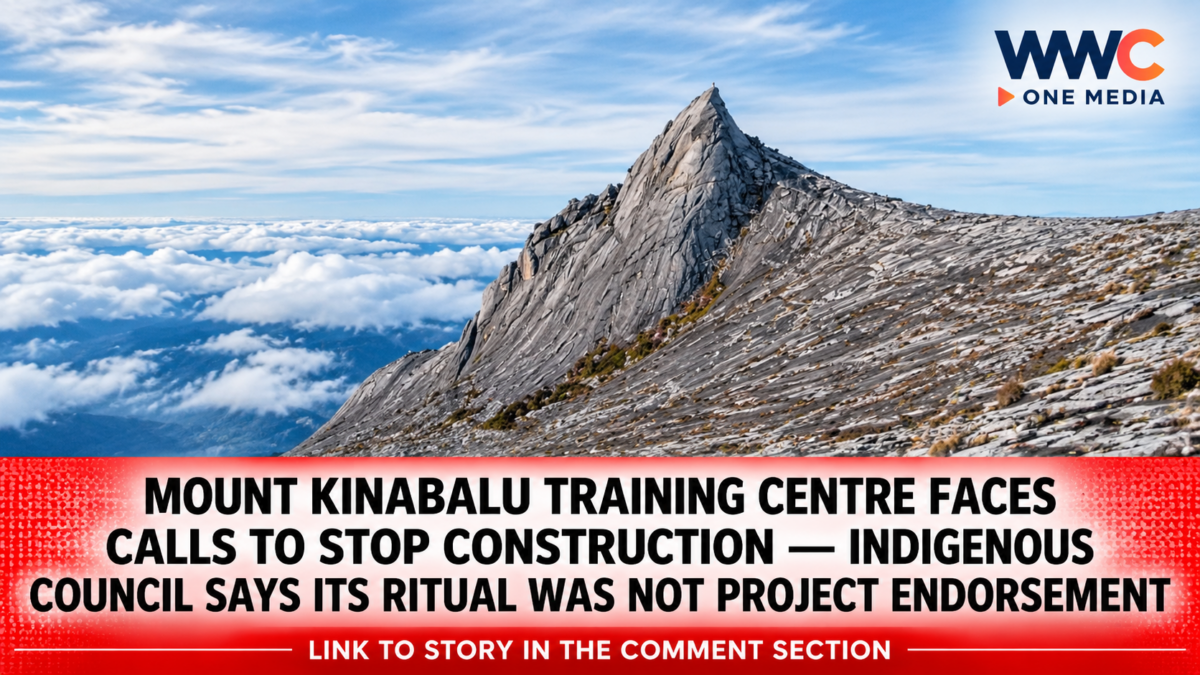
KOTA KINABALU, Sabah — A proposed high-altitude training centre on Mount Kinabalu is facing mounting scrutiny after indigenous representatives and tourism stakeholders questioned its environmental impact, construction approvals and consultation process. The controversy has taken a new turn after the Mount Kinabalu Native Customary Advisory Council clarified that a traditional ceremony it conducted at the site was not an endorsement of the development.
The dispute centres on construction activities near Sayat-Sayat, an area close to the mountain’s summit. Photographs showing structures and apparent drilling work circulated on social media around October 30, prompting questions about what was being built, who authorised the work and whether the mountain’s sensitive environment and cultural significance were being adequately protected.
Sabah authorities say the High Altitude Training Centre (HATC) is an approved development intended to improve facilities for climbers preparing for major mountaineering expeditions. The state government has also said that lightweight, prefabricated construction methods are being used to minimise disturbance.
But indigenous representatives have questioned whether communities with customary connections to Aki Nabalu were properly informed and consulted. Concerns have also been raised about drilling, water catchments, sewage disposal and the potential consequences of increasing activity in a fragile high-altitude environment.
The latest clarification from the customary council has intensified the debate: while the government previously cited the council’s involvement as part of the project’s cultural safeguards, its chairman says the council’s role was limited to a traditional safety ritual and that it had not received detailed information about the development.
The disagreement has placed the project’s consultation process under renewed scrutiny.
What Is Happening on Mount Kinabalu?
The controversy emerged after photographs of structures and construction materials near the Sayat-Sayat station began circulating online in late October.
The images prompted residents, tourism stakeholders and members of the public to ask whether the structures were authorised and what purpose they would serve.
Kundasang Tourism and Culture Association chairman Datuk Japiril Suhaimin called for an investigation into the project’s location, scope and approvals. He also raised concerns about possible effects on water sources, soil stability and biodiversity.
Sabah Parks director Datuk Dr Maklarin Lakim separately explained that the huts near Sayat-Sayat were Sabah Parks property and were intended as additional facilities for high-altitude training.
That explanation helped clarify the stated purpose of the structures, but it did not resolve every question surrounding the wider development, including the project’s construction arrangements and environmental safeguards.
Bundu Tuhan Village Heritage and Culture head Adrian Soros also questioned whether communities with customary ties to Mount Kinabalu had been adequately consulted. He said many villagers were unaware of the construction and argued that customary practices should not be sidelined by development.
The concerns extend beyond the appearance of the buildings. Critics want authorities to explain how the project will manage human waste, protect local water sources and prevent construction from damaging the mountain’s fragile surroundings.
A Major Dispute: Did the Indigenous Council Actually Endorse the Project?
One of the most significant developments came on November 4, when Daily Express Malaysia reported that the Mount Kinabalu Native Customary Advisory Council had clarified its involvement in the construction activities around Sayat-Sayat and Gurkha Hut.
Council chairman Johnny Ghani said the council’s participation was limited to carrying out a customary safety ritual known as a Monogit ceremony. He stressed that the ceremony should not be interpreted as the council’s endorsement of the training-centre project.
According to his explanation, the contractor, Travers and Tour Sdn Bhd, requested the ceremony through Kinabalu Park management before construction began. It was conducted on March 27, 2026.
Ghani also said the council had not received a specific briefing or detailed information about the project. Its understanding, he said, was that the construction involved replacing the ageing Multi Peaks climbers’ rest facility, which was no longer considered safe.
This clarification is important because the Sabah government had previously referred to the Mount Kinabalu Native Customary Advisory Council’s endorsement when explaining the project’s approval and its recognition of indigenous cultural concerns.
The council’s latest statement raises a distinction between conducting a customary ritual for safety and formally supporting a development.
It also leaves an important question unanswered: what consultation took place with the council and affected communities about the actual scope, design and environmental implications of the project?
The council’s clarification does not, by itself, establish whether the project has or has not received all required government approvals. It does, however, challenge the suggestion that the customary ceremony should be treated as proof of indigenous endorsement.
Sabah Government Says the Project Was Planned Years Ago
Tourism, Culture and Environment Minister Datuk Jafry Ariffin has defended the development, saying the HATC was not a recently conceived project.
According to the minister, the proposal was originally included in the Kinabalu Park Development Plan in 2015. Its implementation was deferred following the earthquake that struck Mount Kinabalu that year.
The initiative was subsequently revived and officially launched in 2025 as part of Sabah’s efforts to diversify tourism offerings and strengthen the state’s position as an international mountaineering destination.
Jafry said the development had received approval from the Sabah Parks Board of Trustees. He also previously cited the Mount Kinabalu Native Customary Advisory Council’s involvement in the process.
The minister described the centre as a specialised facility intended to support mountaineers preparing for expeditions to high-altitude destinations such as Mount Everest, Mount Kilimanjaro and Aconcagua.
The government has presented the project as an investment in Sabah’s mountaineering infrastructure, rather than simply another accommodation development.
However, the customary council’s November 4 clarification means the nature of its involvement now needs to be described more precisely. The minister’s account of the approval process and the council chairman’s account of the ceremony and briefing are separate statements that should not be treated as interchangeable.
What the High Altitude Training Centre Is Supposed to Provide
The proposed centre is designed to offer basic accommodation and specialised facilities for mountaineers undertaking high-altitude preparation.
According to the state government’s explanation, the facility is intended to support several activities:
- Altitude acclimatisation: Helping climbers prepare for the physical demands of operating at higher elevations.
- Technical training: Supporting specialised mountaineering instruction and preparation.
- Equipment familiarisation: Allowing climbers to practise using technical climbing equipment.
- Basic accommodation: Providing facilities for training activities in the mountain environment.
The project could help expand Sabah’s profile among international mountaineering organisations and adventure travellers.
It may also create opportunities for tourism operators and businesses connected to climbing activities.
However, the potential economic benefits do not remove the need for careful environmental assessment, transparent approvals and meaningful engagement with communities that regard the mountain as a sacred place.
Why Drilling and Construction Are Raising Environmental Questions
Environmental concerns have become central to the debate because Mount Kinabalu is a high-altitude landscape with sensitive natural features.
Tourism stakeholders and local representatives have questioned whether construction could affect water sources, soil stability and biodiversity.
One concern involves Gayongaran, which Adrian Soros described as an important water source for surrounding areas. He questioned whether drilling and other physical alterations could conflict with customary beliefs and place water resources at risk.
Other local voices have raised questions about sanitation infrastructure, particularly how wastewater and human waste would be handled on steep, rocky terrain.
These concerns are not proof that pollution has occurred or that the project has violated environmental requirements. They are issues that require technical assessment and clear answers from the authorities and project operators.
At high elevations, waste management can be especially challenging because facilities are remote and access for maintenance may be difficult. A system that is poorly designed or inadequately maintained could create risks for nearby water sources and the surrounding environment.
A credible environmental review would therefore need to explain how wastewater will be collected, treated and disposed of, how water catchments will be protected, and how the site will be monitored during and after construction.
Government Says Modular Construction Will Minimise Disturbance
In response to public criticism, Jafry said the HATC would use lightweight, prefabricated and modular building materials.
The structures are designed to withstand strong winds and difficult weather conditions at higher elevations. The construction approach is also intended to avoid heavy machinery and reduce disturbance to the mountain’s natural surroundings.
The minister said environmental protection remained a priority and that tourism development should not compromise Mount Kinabalu’s ecological integrity.
He also stressed that approval does not give the project unrestricted permission to proceed.
Construction must comply with approved specifications, technical requirements, environmental safeguards and relevant laws and regulations.
The ministry said it would consider a comprehensive investigation with Sabah Parks and other relevant authorities to determine whether all stipulated conditions had been followed. Jafry also indicated that enforcement action could be taken if non-compliance were established.
This is an important distinction: the government’s statement that the project is approved does not automatically establish that every activity at the site has complied with every approval condition.
The results of any inspection or investigation will be important in determining whether the work has followed the approved plans.
Indigenous Representatives Want Construction Stopped
The Dayak International Organisation (DIO) has called for construction, drilling and installation activities at Sayat-Sayat to be halted.
Its United Nations representative, Datuk Petinggi Andrew Ambrose Atama Katama, said the project raised serious questions about indigenous rights and the protection of sacred places.
DIO argues that Aki Nabalu should be understood as a sacred landscape and ancestral place, rather than simply as a site for commercial tourism development.
The organisation has questioned whether the consultation process adequately represented the concerns of affected communities, particularly members of the Kadazandusun and Momogun peoples.
It has also argued that an administrative advisory council’s involvement should not be treated as a substitute for meaningful participation and consent from communities with customary connections to the mountain.
DIO claims that drilling and physical alterations could violate indigenous customary laws and principles reflected in the United Nations Declaration on the Rights of Indigenous Peoples (UNDRIP).
These are allegations and positions advanced by the organisation. They should not be presented as a court ruling or an established finding that Malaysian law or international obligations have been violated.
Nevertheless, the organisation’s demand for a halt has added an indigenous-rights dimension to what initially appeared to be a dispute over construction and environmental approvals.
Independent Environmental Audit Among the Demands
DIO has also called for an independent environmental audit, including an assessment of possible effects on water catchments and wastewater management.
The organisation wants authorities to examine whether the development could affect the mountain’s natural resources and whether adequate safeguards are in place for the construction and eventual operation of the facility.
It has indicated that it may bring the issue to international forums, including the United Nations Permanent Forum on Indigenous Issues and the UNESCO Global Geoparks Network.
An international appeal would not automatically establish wrongdoing or determine the project’s legal status. However, it could bring additional attention to the questions surrounding indigenous participation and conservation.
For local communities, the key issue is whether independent findings will be made public and whether authorities will act on any problems identified.
Why Mount Kinabalu Is More Than a Tourism Destination
Mount Kinabalu, also known as Aki Nabalu, rises approximately 4,095 metres above sea level and is Sabah’s highest mountain.
It holds deep cultural and spiritual significance for indigenous communities, particularly the Kadazandusun people.
Traditional beliefs connect the mountain with ancestral stories, spiritual practices and respect for the natural world. Ceremonies and customary practices reflect the relationship between local communities and the landscape.
This cultural connection helps explain why the debate is not limited to the size or design of the proposed buildings.
For indigenous representatives, it also concerns who gets to participate in decisions about a sacred place, how customary knowledge is recognised and whether development can proceed without undermining longstanding traditions.
The dispute therefore raises questions about the relationship between government planning, tourism investment and indigenous customary governance.
UNESCO World Heritage Status Raises the Conservation Stakes
Kinabalu Park was inscribed on the UNESCO World Heritage List in 2000 because of its exceptional natural significance and biodiversity.
The park contains a wide range of habitats and plant life, making conservation a major consideration for development in its protected landscape.
Mount Kinabalu’s high-altitude environment is also part of a wider network of biologically important mountain ecosystems in Borneo.
WWC One Media previously reported on the discovery of a gecko species previously unknown to science in Sabah’s Crocker Range. The finding highlights the biodiversity that can remain undocumented even in mountain environments that have been studied for years. Read more: Scientists Discover Gecko Species Unknown to Science in Sabah’s Crocker Range.
The discovery is not evidence that the HATC site contains that species or that the project threatens it. It does, however, reinforce why environmental assessments in Sabah’s highland areas should be based on reliable ecological information.
The Wider Borneo Conservation Question
The Mount Kinabalu controversy also reflects a broader challenge across Borneo: how to balance economic development, tourism and infrastructure with the protection of natural environments and the rights of communities who depend on them.
WWC One Media has also covered environmental concerns surrounding forest fires and haze in Indonesia’s Borneo region, where indigenous and civil-society groups have called for stronger government accountability. Read more: Indonesian Groups Criticise Government No-Show at Forest Fire Hearing as Haze Crisis Deepens.
The circumstances are different, but both stories highlight the importance of transparent environmental oversight and meaningful community participation.
The issue is not whether every development project should automatically be rejected. It is whether projects in ecologically sensitive and culturally significant places are assessed carefully, explained openly and monitored effectively.
Indigenous Participation Must Be More Than a Formality
The disagreement over the customary council’s role has brought a broader question into focus: what does meaningful consultation actually require?
A ceremony conducted before construction may serve an important cultural or safety purpose. But it should not automatically be interpreted as agreement with the project’s design, scope or environmental implications.
The council chairman’s clarification makes that distinction especially relevant in this case.
For comparison, WWC One Media has reported on indigenous leaders around Mount Apo who presented a five-year agenda covering ancestral land protection, traditional governance, biodiversity conservation and sustainable livelihoods. Read more: Mount Apo Indigenous Leaders Unveil 5-Year Agenda to Protect Ancestral Lands and Preserve Tribal Heritage.
The Mount Apo initiative is a separate development in the Philippines, but it illustrates how indigenous communities can seek a direct role in decisions affecting ancestral landscapes and local resources.
In the Mount Kinabalu case, the immediate question is whether the communities concerned received sufficient information and had a meaningful opportunity to express their views before decisions were made.
Water Protection Is Another Central Concern
Water is among the most important issues raised by local representatives.
Mountain catchments support ecosystems and communities beyond the immediate construction site. Any development that could affect water quality or drainage therefore deserves careful scrutiny.
WWC One Media has previously examined the importance of reliable water access for indigenous communities in the Philippines. Read more: Clean Water Finally Reaches Indigenous Communities in Zamboanga Peninsula — But the Fight for Reliable Access May Not Be Over.
The circumstances are not directly comparable, but the underlying issue is clear: water infrastructure, water quality and long-term protection matter to communities whose daily lives depend on dependable sources.
For Mount Kinabalu, authorities will need to explain how the HATC will handle wastewater and protect surrounding catchments, rather than relying solely on general assurances that construction will be environmentally sensitive.
What Needs to Be Clarified Before the Dispute Can Be Settled?
Several questions remain central to the controversy:
- What exactly has been approved? Authorities should clarify the project’s full scope, location, construction plans and applicable approval conditions.
- What was the customary council asked to do? The council says its March 27 ceremony was a safety ritual, not an endorsement, and that it received only limited project information.
- Were affected communities adequately consulted? The government and project representatives should explain how communities with customary ties to the mountain were informed and involved.
- How will water and waste be managed? Technical details should be provided on sanitation, wastewater treatment, drainage and protection of water catchments.
- Will an independent assessment be conducted? An impartial review could help establish whether the construction and planned operations meet environmental requirements.
- Will the findings be made public? Transparency would allow residents, tourism stakeholders and indigenous representatives to evaluate the project’s compliance.
Until these questions are addressed, the dispute is likely to remain focused not only on the proposed facility, but also on public confidence in the process behind it.
The Bottom Line
The High Altitude Training Centre on Mount Kinabalu was presented by Sabah authorities as an approved project designed to strengthen the state’s mountaineering tourism facilities. Officials say the use of lightweight, modular structures is intended to reduce environmental disturbance and that construction must comply with regulatory safeguards.
But the controversy has become more complicated following the Mount Kinabalu Native Customary Advisory Council’s clarification that its March 2026 Monogit ceremony was a customary safety ritual, not an endorsement of the development. Its chairman also said the council had not received a detailed briefing about the project.
Meanwhile, indigenous representatives and tourism stakeholders are demanding greater transparency, stronger environmental scrutiny and meaningful consultation. Their concerns about water sources, waste management, drilling and the mountain’s sacred significance remain issues for authorities to address through evidence and clear explanations.
The government has indicated that it may conduct a comprehensive investigation and take enforcement action if violations are established. The findings of any review could help determine whether the project has complied with its approval conditions and whether additional safeguards are necessary.
For Sabah, the challenge is not simply to build a facility for international climbers. It is to demonstrate that tourism development can proceed without overlooking the ecological importance of Mount Kinabalu or the customary relationship indigenous communities have with Aki Nabalu.
Will Sabah’s authorities pause the project and commission an independent review, or will construction continue while questions over indigenous consultation and environmental protection remain unresolved?