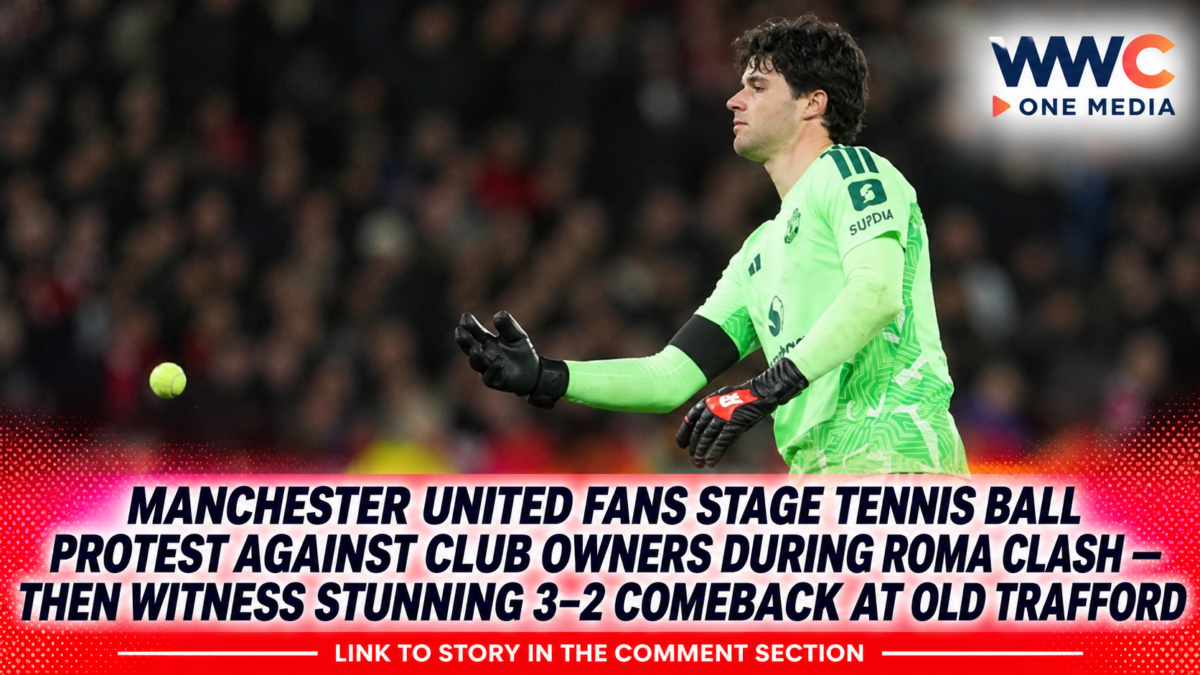
MANCHESTER, England — Manchester United supporters brought their anger over the club’s ownership into the spotlight during Tuesday’s UEFA Champions League meeting with AS Roma, throwing tennis balls onto the Old Trafford pitch in a planned demonstration against the Glazer family and minority owner Sir Jim Ratcliffe.
The protest briefly interrupted the match and came at a particularly difficult moment for the home side, which had already fallen two goals behind inside the opening 18 minutes. But what initially looked like another damaging night for United turned into an extraordinary comeback, with Matheus Cunha scoring twice late in the second half to secure a 3–2 victory.
The demonstration reflected years of frustration among sections of the club’s fan base over ownership, sporting decisions, rising ticket prices and the team’s disappointing performances.
Supporters used green and gold colours associated with the club’s history, while the tennis balls were thrown onto the pitch at a time chosen to reference the Glazers’ 2005 takeover.
By the final whistle, the atmosphere inside Old Trafford had changed dramatically. United had rescued the match, but the victory did not erase the dissatisfaction directed at the people running the club.
TENNIS BALLS INTERRUPT CHAMPIONS LEAGUE MATCH
The protest unfolded during Manchester United’s Champions League match against Roma on November 3.
A group of supporters had planned the demonstration in advance, with the Stretford End becoming the focal point of the action.
Fans threw tennis balls onto the playing surface, prompting a brief interruption as players helped remove the objects before the match resumed.
The timing carried a specific message. The demonstration was organised around the 21st minute, marking 21 years since the Glazer family completed its leveraged buyout of Manchester United in 2005.
The green and gold colours also carried historical significance. They are associated with Newton Heath, the club’s original identity before it became Manchester United, and have long been used by supporters protesting against the Glazers.
The demonstration was intended to make dissatisfaction visible during a major European fixture rather than allow it to remain confined to protests outside the stadium or messages on social media.
Although the interruption was relatively short, the images of tennis balls scattered across the pitch drew attention to the continuing divide between the club’s ownership and sections of its supporters.
WHY UNITED SUPPORTERS ARE ANGRY AT THE GLAZERS
The Glazer family has faced opposition from Manchester United supporters for years, particularly since its acquisition of the club in 2005.
The takeover was financed through borrowing, leaving the club carrying substantial debt. Many supporters have argued that the arrangement placed financial pressure on an institution they believe should have been managed primarily for sporting success.
The Glazers’ ownership has repeatedly been challenged through demonstrations, chants, organised campaigns and calls for the family to sell its controlling stake.
For critics, the issue goes beyond individual match results. It concerns the club’s direction, financial priorities, leadership decisions and relationship with the people who support it.
Manchester United remains one of football’s most commercially valuable clubs, but its financial strength has not consistently translated into the level of success expected by its supporters.
The contrast between its global profile and its recent sporting difficulties has helped keep ownership questions at the centre of the debate.
The tennis ball demonstration was another expression of that long-running dissatisfaction.
JIM RATCLIFFE AND INEOS ALSO FACE SUPPORTER CRITICISM
The protest was not directed exclusively at the Glazers.
British billionaire Jim Ratcliffe, whose INEOS group acquired an initial 25% stake in Manchester United in 2024, has also faced criticism from sections of the fan base.
Ratcliffe took responsibility for the club’s football operations as part of the investment arrangement, raising expectations that changes in management and sporting strategy would help restore United’s competitiveness.
However, the club’s difficult run of results and decisions involving its football leadership have kept pressure on the minority owner.
Supporters have also expressed concerns about ticket prices and the wider direction of the club.
For some fans, the criticism reflects disappointment that the changes introduced under the new football structure have not yet delivered the improvement they expected.
The distinction between the Glazers’ controlling ownership and Ratcliffe’s minority stake remains important. They occupy different positions within the club’s ownership structure, even though both have become targets of supporter frustration.
The demonstration therefore highlighted a broader demand for accountability from the people responsible for United’s financial and sporting direction.
ROMA TAKE CONTROL AS UNITED FALL TWO GOALS BEHIND
The match itself began disastrously for Manchester United.
Roma took the lead in the 11th minute when Matias Soulé found the net, exposing the home side’s defensive problems.
Seven minutes later, Donyell Malen converted a penalty to make it 2–0. The spot-kick followed a handball by United defender Ayden Heaven.
The early goals intensified the frustration inside Old Trafford. United were already under pressure following a difficult run of results, and the rapid two-goal deficit made the situation even more uncomfortable.
Roma looked capable of adding to its advantage before the interval, creating further opportunities against a United defence that struggled to contain the visitors.
The home side went into half-time facing the possibility of another damaging result, while manager Michael Carrick was under growing scrutiny.
The combination of poor defending, a two-goal deficit and visible anger from the stands created an atmosphere that reflected the club’s wider difficulties.
BRUNO FERNANDES SPARKS THE SECOND-HALF RECOVERY
Manchester United returned after the break with greater urgency, and the comeback began with a penalty awarded following contact involving Cunha and Roma defender Gianluca Mancini.
Captain Bruno Fernandes stepped forward to take the spot-kick.
His initial effort was saved by Roma goalkeeper Devis Vásquez, but the referee ordered a retake after an infringement in the penalty area. Fernandes made no mistake with his second attempt, reducing the deficit and giving United a route back into the contest.
The goal changed the atmosphere inside the stadium.
United began attacking with more confidence, while Roma faced increasing pressure as the home side searched for an equaliser.
There were further opportunities for the hosts, including a close-range effort from Bryan Mbeumo that struck both posts without crossing the goal line.
The missed chance could have ended United’s hopes of recovering, but the team continued to push forward.
CUNHA SCORES TWICE TO COMPLETE A REMARKABLE TURNAROUND
The decisive moments arrived late in the match.
Cunha equalised in the 83rd minute, bringing Manchester United level after a determined second-half effort.
Just three minutes later, the Brazilian forward struck again to put United ahead 3–2.
His second goal completed the turnaround and sent Old Trafford into celebration.
The comeback was especially significant because United had appeared close to another damaging defeat after conceding twice so early.
Instead, the team recovered from the deficit and produced a result that could provide a much-needed lift for players, supporters and the coaching staff.
However, the match ended on another dramatic note for Cunha. He was sent off in stoppage time after receiving a second yellow card, meaning United had to finish the contest without the player who had delivered the winning goals.
Despite the late dismissal, the final whistle confirmed a memorable victory.
The celebrations were a striking contrast to the anger that had been heard earlier in the evening.
A WIN DOES NOT AUTOMATICALLY END THE OWNERSHIP DEBATE
Manchester United’s comeback provided temporary relief, but the result does not settle the questions surrounding the club’s ownership and management.
Supporters have repeatedly made clear that their dissatisfaction is rooted in more than a poor run of matches.
The Glazers’ long-standing position as controlling owners remains a major source of disagreement, while Ratcliffe and INEOS are being judged on the changes introduced under their football leadership.
A dramatic European victory can improve the mood around a team, but it cannot by itself resolve concerns about governance, investment priorities, ticket prices or the club’s long-term strategy.
The demonstration also showed that supporters remain willing to use high-profile matches to communicate their demands.
For the club’s leadership, the challenge is not simply to secure better results. It is also to rebuild trust with a fan base that has spent years questioning whether its interests are being prioritised.
WHAT THE RESULT MEANS FOR MICHAEL CARRICK
The victory was an important moment for Carrick, whose position had come under pressure amid United’s poor form.
The team entered the Roma fixture after a nine-game winless run, making the match a significant test for the manager and his players.
Going two goals down so early threatened to deepen the crisis.
The second-half response, however, demonstrated a level of attacking determination that had been missing during the difficult spell.
Fernandes’ penalty gave the team momentum, while Cunha’s late goals turned a potentially damaging defeat into a major European win.
The result may strengthen Carrick’s position in the short term, but one comeback does not resolve the broader questions about consistency and defensive organisation.
United will need to show that the performance was more than a one-night reaction if the manager is to ease the pressure surrounding his role.
The next fixtures will be important in determining whether the victory marks a genuine turning point.
THE BOTTOM LINE
Manchester United’s Champions League clash with AS Roma became a night of two very different messages at Old Trafford.
Before the comeback, supporters used tennis balls and green-and-gold symbolism to renew their protest against the Glazer family and raise concerns about the club’s direction under its ownership and football leadership.
On the pitch, United initially appeared headed for another difficult result after conceding twice inside the opening 18 minutes.
But Bruno Fernandes’ retaken penalty and Matheus Cunha’s late double transformed the match into a 3–2 victory. Cunha’s stoppage-time dismissal added one final twist to an already dramatic evening.
The result gave Carrick and the players a much-needed boost, but the supporters’ demonstration made clear that the club’s deeper problems remain unresolved.
For Manchester United, winning matches is essential. Rebuilding confidence in the people running the club may prove just as difficult.
Will this dramatic comeback give Manchester United the momentum it needs to rebuild its season, or will the protests against the club’s owners continue regardless of what happens on the pitch?