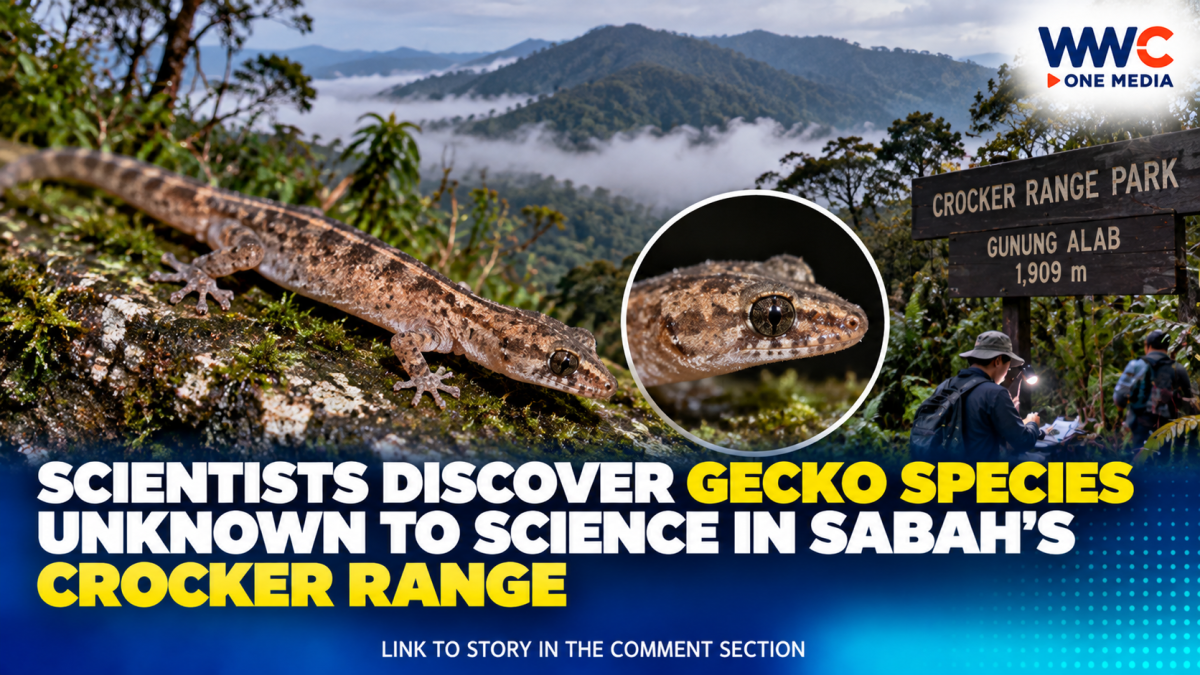
A tiny nocturnal gecko hiding around buildings in the misty highlands of Sabah has just been confirmed as a species previously unknown to science, adding another remarkable chapter to Borneo’s extraordinary biodiversity.
Researchers from Universiti Malaysia Sabah (UMS) have formally identified the lizard as Lepidodactylus crockerensis, commonly known as the Crocker Range Mourning Gecko.
The discovery was made in the Gunung Alab area of the Crocker Range, where the geckos were observed hunting insects around artificial lights on building walls and eaves. Researchers encountered them under cool, misty conditions, with temperatures between 14°C and 16°C.
A Gecko That Looked Familiar—Until Scientists Took a Closer Look
At first glance, Lepidodactylus crockerensis resembles the Ranau Mourning Gecko (Lepidodactylus ranauensis), a Bornean species associated with the Mount Kinabalu area.
But genetic testing revealed a crucial difference.
The Gunung Alab population represents a distinct evolutionary lineage, while detailed examination also found statistically significant differences in physical characteristics and scale patterns. The two populations are separated by roughly 36 kilometres of unsuitable lowland terrain, helping explain their evolutionary separation.
The species is now officially recognized as the third member of the Lepidodactylus genus recorded in Borneo.
Discovery Began With a 2025 Field Specimen
The research story dates back to August 23, 2025, when herpetologist Evan S.H. Quah collected the holotype—the reference specimen used to formally describe a new species—at the old Rhododendron Hut in Crocker Range Park.
The site sits approximately 1,909 metres above sea level.
Quah led the research team alongside Aderina Dukit of Monash University, Fred Y.Y. Tuh of Sabah Parks and L. Lee Grismer of La Sierra University. Their findings were published on September 22, 2026, in the journal Zootaxa.
Why This Discovery Matters
Scientists say the finding highlights how isolated mountain environments can produce unique evolutionary lineages.
Researchers also caution that the gecko’s known distribution is currently limited to the vicinity of the Gunung Alab substation. It may occur in other high-elevation areas, but additional surveys are needed to determine its full range, population size and ecological requirements.
For Sabah, the discovery is another reminder that even areas that have been studied for years can still contain species that have never been formally documented by science.
The Crocker Range is therefore not simply another mountain landscape—it is proving to be an important setting for understanding Borneo’s biodiversity, evolution and endemic wildlife.
And the biggest question may now be what else remains hidden in Sabah’s high-elevation forests.
WWC ONE MEDIA G,A