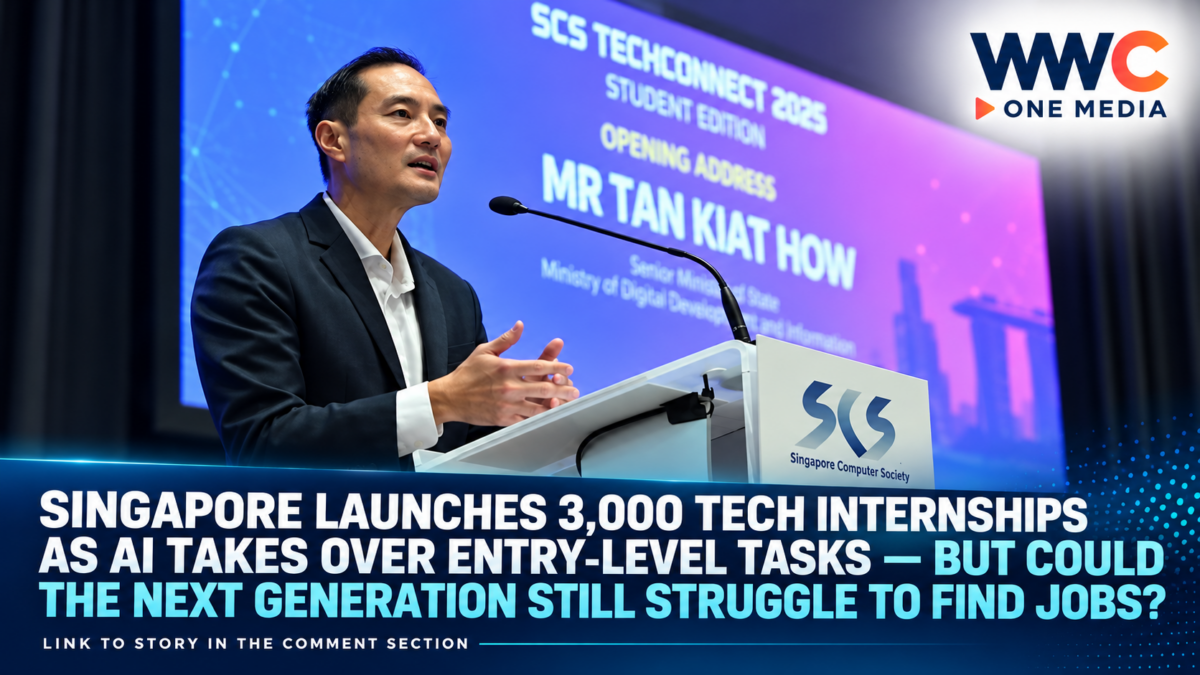
SINGAPORE, October 20, 2026 — Singapore is launching a major push to protect the next generation of technology workers from the growing disruption of artificial intelligence, offering approximately 3,000 year-long internships over the next three years as AI threatens to transform the entry-level jobs that traditionally help fresh graduates start their careers.
The initiative comes amid growing concerns that AI-powered tools are taking over basic programming, software testing, debugging and other junior-level responsibilities, potentially making it more difficult for young professionals to acquire the experience employers increasingly demand.
Announced on October 19 by Senior Minister of State for Digital Development and Information Tan Kiat How at the Singapore Computer Society’s TechConnect 2026 event, the expanded programme aims to create stronger connections between classroom education and real-world employment.
Under the Infocomm Media Development Authority’s (IMDA) Bridge2Tech initiative within TIP Alliance+, eligible Information and Digital Technologies students from the Institute of Technical Education (ITE), polytechnics and autonomous universities will gain access to structured workplace experience lasting 10 to 12 months.
The move represents more than an expansion of internship opportunities. It is part of Singapore’s response to a fundamental question confronting economies worldwide: How can young workers gain experience when AI increasingly performs the tasks that once helped them learn?
AI Is Changing the First Step Into Technology Careers
For decades, young software engineers built their careers through relatively straightforward assignments such as writing basic code, testing applications, maintaining systems and fixing technical problems.
But generative AI is increasingly capable of assisting with these responsibilities, allowing experienced employees to complete some tasks faster and potentially reducing the need for traditional junior-level work.
Tan acknowledged that these developments have created legitimate anxiety among students and recent graduates about their future employment prospects.
Singapore’s challenge is not simply to teach students how to use AI. It is to ensure they still have meaningful opportunities to develop professional judgment, technical expertise and workplace confidence.
Employers continue to need experienced engineers, cybersecurity specialists and technology professionals. However, if the opportunities that traditionally produced those experienced workers disappear, businesses could eventually face a shortage of talent capable of handling more complex responsibilities.
3,000 Internships Designed to Deliver Real Experience
Unlike short-term internships that may provide only limited workplace exposure, the expanded programme will offer placements lasting approximately one academic year.
These internships will be integrated into students’ educational programmes and jointly developed by institutions and participating employers.
Students will be expected to work on substantial projects, collaborate with experienced professionals and gain exposure to actual business challenges.
The initiative builds on longer internships already available to eligible ITE and polytechnic students since 2022, while expanding participation to students from Singapore’s autonomous universities.
According to additional reporting by The Straits Times, internships will span industries including technology, finance and healthcare.
Companies involved in earlier programmes have included OCBC Bank, Accenture and PSA.
To encourage business participation, IMDA will provide financial support, with eligible employers able to receive up to S$1,000 per month per intern.
The longer placements are also intended to shift the focus away from simply accumulating internships on a résumé toward developing deeper, demonstrable skills.
Singapore Offers Up to 90% Funding for AI, Cloud and Cybersecurity Training
Beyond workplace placements, eligible students will receive additional assistance to pursue industry-recognised certifications in rapidly evolving technology fields.
IMDA funding can cover up to 90% of approved course and certification costs, subject to applicable funding caps.
Priority areas include artificial intelligence, cloud computing and cybersecurity, reflecting the importance of these capabilities across Singapore’s digital economy.
A new Government Tech Domain Pathway is also scheduled to open for applications in November 2026.
The programme will help students understand government technology requirements, public-sector operations and the practical challenges involved in developing digital solutions for government agencies.
Singapore is also working with partners to introduce a HealthTech pathway in 2027, potentially opening more specialised opportunities for students interested in the intersection of technology and healthcare.
More Than 200 Employers Back Skills-Based Hiring
Another major component of the initiative involves changing how companies evaluate fresh graduates.
More than 200 employers have pledged to support skills-based hiring under TIP Alliance+, placing greater emphasis on practical capabilities and relevant experience rather than academic qualifications alone.
The shift comes as companies increasingly expect new employees to demonstrate that they can apply technical knowledge to real business situations.
According to The Straits Times, companies supporting skills-based hiring include DBS, Google, HSBC and Singtel.
For young jobseekers, the message is becoming clearer: holding a diploma or university degree remains valuable, but employers are increasingly looking for evidence of what applicants can actually accomplish.
However, employer commitments will need to translate into recruitment practices, meaningful entry-level opportunities and recognition of skills developed through internships.
Singapore Is Already Preparing Students for an AI-Driven Economy
The internship expansion is part of a broader transformation of Singapore’s education and workforce development system.
In May 2026, Education Minister Desmond Lee announced that students entering universities, polytechnics and ITE from the 2027 academic year would receive foundational AI education tailored to their fields of study.
Existing students would also see AI-related enhancements to their curricula.
The strategy reflects an understanding that AI literacy can no longer be treated as a specialised capability reserved for computer science graduates.
As automation spreads across finance, logistics, healthcare, manufacturing and professional services, workers from a wide range of disciplines will need to understand how to use AI responsibly and effectively.
Meanwhile, Singapore’s technology employment landscape presents a growing contradiction: demand for advanced AI expertise remains strong even as some traditional junior-level responsibilities become more automated.
The Straits Times reported in June 2026 that compensation for certain AI positions had risen significantly amid competition for specialised talent.
This creates a potentially difficult transition for new graduates. Opportunities remain in the digital economy, but the experience and skills needed to secure those opportunities are changing quickly.
The Bigger Question: Can Internships Keep Up With AI?
Singapore’s 3,000-internship initiative may provide a model for other economies confronting the same challenge.
For the Philippines and other Southeast Asian countries, the development is particularly relevant as companies accelerate automation and increasingly require technology workers to combine technical proficiency with practical experience.
Longer internships could help students build skills that are harder to develop through coursework alone, including collaboration, problem-solving, project management and professional decision-making.
But the effectiveness of Singapore’s programme will ultimately depend on whether internships translate into stronger employment outcomes, rather than simply delaying graduates’ entry into an increasingly competitive job market.
It will also depend on whether companies genuinely invest in mentoring young talent instead of using technology primarily to reduce junior staffing needs.
The Bottom Line
Singapore is betting that giving students meaningful workplace experience before graduation can help protect their future in an economy increasingly shaped by artificial intelligence.
With 3,000 year-long internships, expanded technical training and stronger employer participation, the country is trying to rebuild the pathway from education to employment before AI permanently changes how that pathway works.
But the biggest question remains: Will giving young workers more experience be enough when artificial intelligence is changing the very jobs they are preparing to enter?