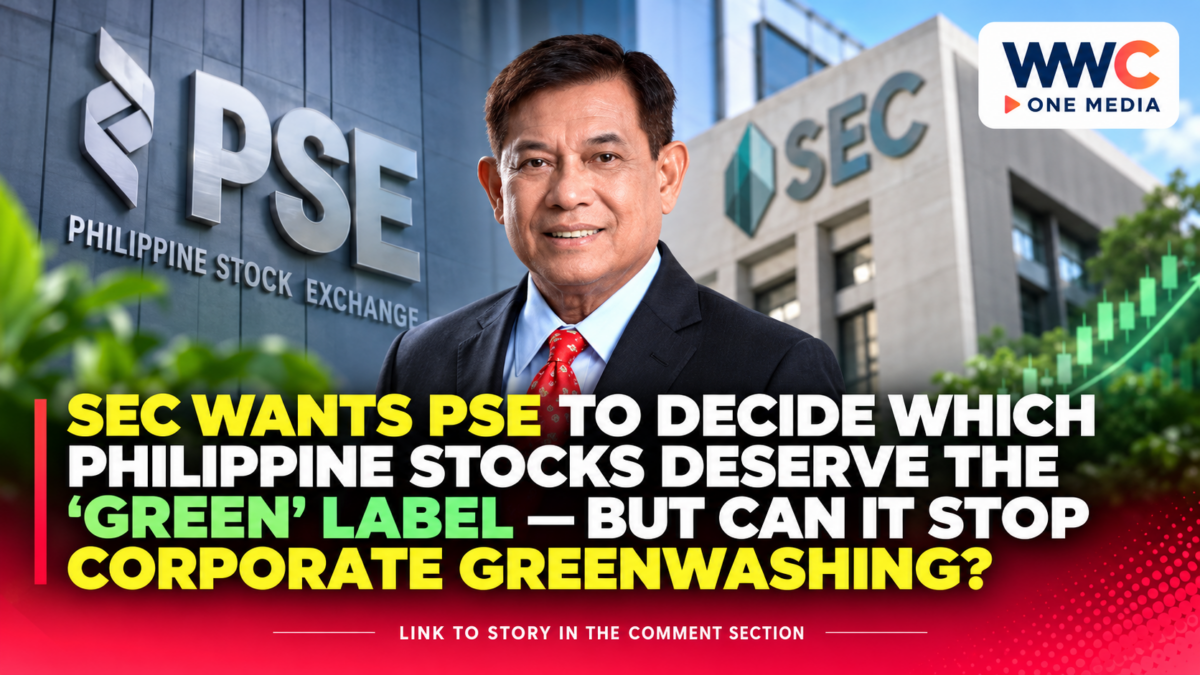
MANILA, Philippines — Philippine companies hoping to attract environmentally conscious investors could soon face a more closely scrutinized path to earning the coveted “green” designation, as the Securities and Exchange Commission (SEC) proposes transferring authority over green equity certification to the Philippine Stock Exchange (PSE).
The proposed regulatory shakeup would put the country’s main stock exchange in charge of assessing applications and determining which listed companies qualify for the Philippine Green Equity Label.
The initiative seeks to make sustainable investing more transparent while reducing overlapping regulatory procedures that can complicate the certification process.
But beneath the administrative reforms lies a bigger challenge: How can investors distinguish companies genuinely advancing environmental sustainability from businesses simply using green branding to improve their reputation?
SEC Wants PSE to Decide Who Qualifies as a Green Company
Under proposed amendments released for public consultation on October 8, 2026, the SEC plans to transfer responsibility for evaluating and granting the Philippine Green Equity Label from its Markets and Securities Regulation Department to the PSE.
If approved, the exchange would become the primary administrator of the green equity designation for companies listed on the Philippine stock market.
The PSE would also oversee independent external reviewers responsible for examining whether applicants satisfy the necessary environmental and sustainability standards.
This would include establishing an accreditation system for qualified reviewers, creating an additional layer of verification beyond companies’ own claims about their environmental performance.
According to reporting by BusinessMirror and Daily Tribune, the proposed changes are intended to simplify the certification process, reduce duplication of regulatory functions, and align Philippine market practices with international standards.
The move follows the exchange-based approach supported by the World Federation of Exchanges’ Green Equity Principles.
However, the transfer remains a proposal. The SEC has not established through the reports reviewed that the new delegation has already taken effect.
Not Every Company Can Claim to Be Green
The Philippine Green Equity Label is designed to help investors identify companies whose business activities meet defined environmental sustainability standards.
Under the SEC’s existing Green Equity Guidelines, established through Memorandum Circular No. 13, Series of 2025, applicants face several substantive requirements.
These include:
- More than 50% of revenue must come from qualifying green activities.
- More than 50% of investments must be directed toward qualifying green activities.
- Less than 5% of revenue may be derived from fossil fuel-related activities.
- Business activities must satisfy applicable Philippine or ASEAN sustainable finance taxonomy requirements.
- Independent external reviews and continuing sustainability disclosures are required.
These conditions seek to distinguish businesses whose operations substantially support environmental objectives from those that merely highlight isolated environmental programs.
For example, a company installing solar panels at its offices does not automatically qualify as a green equity issuer if its main revenue and investments remain concentrated in activities that fail to satisfy the required environmental standards.
Likewise, announcing carbon reduction targets or sustainability programs does not, by itself, establish eligibility for the label.
The designation is based on measurable business activities, qualifying investments and independent verification, rather than advertising claims alone.
Greenwashing Becomes a Bigger Concern for Investors
The proposed reform comes amid growing scrutiny of corporate greenwashing, the practice of presenting products, investments or business activities as more environmentally responsible than the available evidence supports.
For investors, misleading sustainability claims can create financial and reputational risks.
A company promoted as environmentally sustainable may attract interest from investors seeking exposure to renewable energy, clean infrastructure, water management or other climate-related businesses.
But without consistent verification, the term “green” can become difficult to assess.
That is why the Philippine Green Equity Label aims to provide a recognizable classification supported by defined requirements and external assessments.
The proposed PSE role could strengthen confidence in the designation if the exchange implements transparent evaluations, credible reviewer accreditation, ongoing monitoring and meaningful consequences for noncompliance.
However, certification cannot completely eliminate greenwashing risks, and a green label should not be interpreted as a guarantee of investment returns or an endorsement of a company’s share price.
SEC Proposes More Time for Companies to Meet Green Standards
Another important part of the proposal concerns the transition period for compliance.
The SEC wants to extend the deadline for companies to satisfy applicable Philippine and ASEAN sustainable finance taxonomy requirements until December 31, 2026, replacing the earlier September 23, 2026 deadline.
Under the proposed transition arrangements, companies would receive temporary relief from administrative penalties tied to compliance with the relevant taxonomy requirements.
Nevertheless, they would still need to explain how their qualifying activities contribute to environmental objectives.
Full taxonomy compliance would become necessary beginning in fiscal year 2027 for companies seeking to obtain or maintain the designation, subject to the final approved amendments.
The additional time could help issuers assess their business activities, prepare required disclosures, and obtain independent verification.
For regulators, however, the extension creates a balancing challenge: allowing businesses enough time to comply without weakening the credibility of the green label.
Global Stock Exchanges Are Also Developing Green Investment Standards
The Philippine initiative is part of a wider effort by financial regulators and exchanges to make sustainable investments easier to identify and compare.
International exchanges, including those in London and other major financial centers, have developed sustainability-focused market classifications and disclosure approaches.
The World Federation of Exchanges has also promoted principles intended to support consistent green equity classifications.
By bringing certification responsibilities closer to the PSE’s existing monitoring and disclosure functions, the SEC hopes to strengthen the country’s sustainable capital market infrastructure.
The PSE has already undertaken work on green equity rules and sustainability-focused market development.
Its 2025 sustainability progress report discussed the Philippine Green Equity Label and the exchange’s responsibilities for maintaining investor-accessible information on companies carrying the designation.
The proposed amendments would significantly expand that role from monitoring and information disclosure to evaluating applications and granting certification.
Why Green Equity Certification Matters to the Philippine Economy
The Philippines faces substantial financing needs for renewable energy, climate-resilient infrastructure, sustainable water systems and other environmental priorities.
Developing a credible framework for identifying qualifying green companies could help investors evaluate businesses operating in those sectors.
It could also encourage publicly listed companies to improve environmental disclosures, direct investments toward qualifying activities, and demonstrate measurable sustainability performance.
For companies, a credible green designation may improve visibility among investors interested in sustainability-focused investments.
For investors, the framework could make it easier to identify businesses that meet defined environmental criteria.
Still, a green label does not automatically guarantee access to cheaper financing, higher stock valuations or stronger investor demand.
Actual benefits will depend on market conditions, company fundamentals and how much confidence investors place in the certification framework.
PSE’s New Powers Could Bring More Responsibility
If the proposed amendments are adopted, the PSE would assume responsibility for decisions that may influence how companies position themselves in the sustainable investment market.
That would make impartial oversight essential.
Independent reviewers must be capable of evaluating environmental claims without inappropriate influence from applicant companies.
The exchange would also need robust procedures to maintain consistency in decisions and ensure accurate public disclosures.
As the country’s principal stock exchange, the PSE would have to balance its role in developing the capital market with its responsibility to maintain credible standards.
The regulatory reform therefore presents both an opportunity and an institutional test.
Consultation Deadline Passes, Final Decision Still Awaited
The SEC set October 19, 2026, as the deadline for public comments on the proposed amendments.
As of October 20, the consultation deadline has passed, but a final approved version of the proposed changes was not established by the sources reviewed for this report.
The SEC’s next steps will determine whether the PSE formally assumes the expanded certification responsibilities and what the final implementation requirements will look like.
The Bigger Question: Who Deserves Investors’ Trust?
For the Philippine stock market, the green equity initiative represents more than a new classification or regulatory procedure.
It is an attempt to strengthen the credibility of environmentally focused investments at a time when sustainability claims increasingly influence financial decisions.
Giving the PSE greater authority could simplify certification and make green investment information more accessible.
But the ultimate success of the framework will depend on whether companies are assessed against rigorous standards, whether independent reviews remain credible, and whether investors can rely on the information being disclosed.
The SEC may be preparing to give the Philippine Stock Exchange the power to decide which companies deserve the green label. The bigger test is whether that label will become a trusted mark of environmental credibility — or merely another marketing advantage on the stock market.