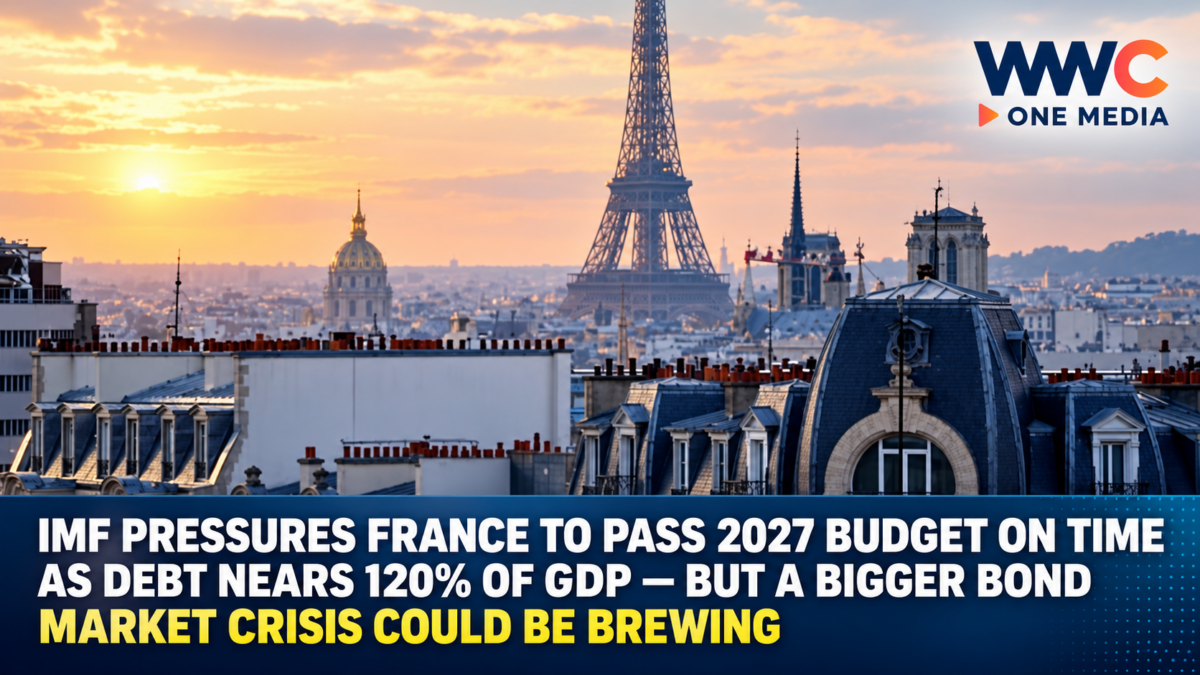
PARIS, FRANCE — October 14, 2026 — France is facing a critical financial and political test as the International Monetary Fund urges timely progress on the country’s 2027 budget, warning that mounting public debt and rising borrowing costs are narrowing the government’s room to maneuver.
The warning comes as Prime Minister Sébastien Lecornu attempts to secure parliamentary approval for a controversial fiscal plan containing €43 billion in new tax and spending measures.
France’s economy is struggling with weak growth, elevated energy costs and growing concerns among investors about the sustainability of government borrowing.
The country’s public debt is projected to reach approximately 119.3% of gross domestic product in 2026.
Meanwhile, government interest payments are expected to rise from €79.2 billion this year to €91.2 billion in 2027.
The figures illustrate the scale of the challenge facing Europe’s second-largest economy.
France is attempting to reduce its annual budget deficit while maintaining essential public services, supporting economic growth and accommodating greater defense spending.
But the government’s minority position in parliament makes agreement difficult.
The International Monetary Fund has stressed the importance of credible medium-term fiscal planning, while IMF Fiscal Affairs Director Rodrigo Valdés has warned more broadly that rising sovereign borrowing costs are increasing the urgency of fiscal consolidation worldwide.
France’s government needs to convince lawmakers that reducing its deficit is necessary. But the bigger question is whether political resistance could delay the budget long enough to deepen investors’ concerns about one of Europe’s largest government debt markets.
IMF Warning Comes at a Dangerous Time for France
France’s fiscal difficulties are attracting heightened international attention.
The IMF’s latest Fiscal Monitor warns that large government deficits, elevated borrowing costs and growing debt burdens are becoming major risks for economies worldwide.
Speaking on October 14, Rodrigo Valdés highlighted the consequences of rising sovereign bond yields and deteriorating fiscal positions.
The IMF argues that governments must develop credible policies to control deficits and manage debt.
Its warning is particularly relevant to France.
The country faces substantial financing needs while its political system remains deeply divided over spending priorities and tax policy.
Timely budget approval would help clarify the government’s fiscal plans and provide greater predictability for investors.
However, approval alone would not solve the country’s debt problems.
Actual implementation, economic performance and future financing costs will ultimately determine whether the debt burden stabilizes.
France’s 2027 Budget Contains €43 Billion in New Measures
The French government presented its proposed 2027 budget on October 1.
Its central objective is to reduce the public deficit from a projected 5.4% of GDP in 2026 to 5.0% in 2027.
To achieve that target, the government is proposing approximately €43 billion in new fiscal measures.
Combined with previously adopted measures taking effect, the total fiscal effort is estimated at €54 billion.
These figures describe the government’s projected budgetary adjustment.
They should not be confused with €54 billion in additional cash savings compared with 2026 or an equivalent reduction in outstanding public debt.
The proposed changes include restrictions on some spending programs, adjustments to pension-related benefits and tax measures affecting businesses and households.
The budget also assumes that economic growth will recover to approximately 1.0% in 2027.
That forecast depends partly on an improvement in international conditions and reduced pressure from energy prices.
France’s Financial Challenge in Numbers
| Fiscal indicator | Government projection |
|---|---|
| Public debt, 2026 | 119.3% of GDP |
| Public deficit, 2026 | 5.4% of GDP |
| Public deficit target, 2027 | 5.0% of GDP |
| New 2027 fiscal measures | €43 billion |
| Total stated fiscal effort | €54 billion |
| Debt-interest costs, 2026 | €79.2 billion |
| Debt-interest costs, 2027 | €91.2 billion |
| Economic growth forecast, 2027 | 1.0% |
| State financing requirement, 2027 | €339.7 billion |
The figures are drawn from the French government’s budget documents and Agence France Trésor.
They remain forecasts and proposed policy measures, not final 2027 results.
Debt-Interest Costs Are Becoming a Major Threat
France’s rising debt-interest bill is among the clearest signs of fiscal pressure.
The government projects that annual interest costs will increase by €12 billion between 2026 and 2027.
That represents an increase of approximately 15%.
Higher interest payments reduce the resources available for other priorities.
They also make it more difficult to reduce the deficit.
When governments refinance maturing bonds at higher interest rates, borrowing costs can continue rising even without a large increase in new spending.
France’s debt-management agency expects the state to face financing requirements of approximately €339.7 billion in 2027.
Its planned medium- and long-term bond issuance, net of buybacks, is approximately €340 billion.
These figures reflect both refinancing of existing obligations and other financing requirements.
They do not mean the government expects to run a €340-billion annual budget deficit.
That distinction is important when evaluating public debt statistics.
Bond Markets Are Sending France a Warning
Investors have become increasingly concerned about France’s fiscal trajectory.
French government bond yields have risen as lenders demand greater compensation for inflation, political uncertainty and public debt risks.
Higher yields mean the government generally faces more expensive financing when issuing new bonds.
They can also influence borrowing costs throughout the economy.
Banks, companies and households operate in financial markets affected by sovereign bond prices.
A sustained rise in government borrowing costs can therefore place pressure on investment and economic activity.
However, higher yields do not automatically mean a country is about to default.
France remains a major developed economy with deep financial markets and access to euro-area institutions.
The immediate concern is that prolonged political uncertainty could make financing more expensive and fiscal consolidation harder to achieve.
Parliament Begins the Budget Battle
France’s National Assembly began examining the revenue portion of the 2027 budget on October 13.
Lawmakers are debating how the proposed measures should be distributed among taxpayers, businesses, retirees and public institutions.
The government lacks a comfortable parliamentary majority.
That makes it difficult to pass controversial reforms without compromise.
Political parties disagree over whether the budget should rely more heavily on spending cuts or tax increases.
Some opposition lawmakers argue that the proposals place an excessive burden on households.
Others believe France needs a more ambitious effort to reduce deficits.
The parliamentary process could therefore substantially change the government’s original proposal.
No final 2027 budget had been approved as of October 14.
Pension Proposals Trigger Strong Resistance
Pensions have emerged as one of the most sensitive issues.
The government has proposed changes affecting certain pension increases and tax benefits for retirees.
Among the measures discussed is a modification of the tax allowance associated with pension income.
Lawmakers have already challenged that proposal during committee scrutiny.
Reuters reported on October 7 that the National Assembly’s finance committee rejected a government plan to reduce the ceiling on a pension-related tax deduction.
The government also proposed limiting pension increases for certain retirees, while offering different treatment to lower-income pensioners.
Such proposals are politically difficult because retirees form an important voting constituency.
Pension spending also represents a major component of France’s public finances.
The dispute illustrates why reducing deficits can prove more difficult in practice than setting fiscal targets.
Government Wants to Protect Essential Spending
The proposed budget is not an across-the-board reduction in every public service.
The government has identified some priority areas for additional funding or protection.
Defense is particularly important as European countries respond to heightened geopolitical tensions.
Other priorities include security, justice and selected strategic investments.
The challenge is that protecting certain programs can require larger adjustments elsewhere.
Some ministries may face spending restrictions while unavoidable costs such as debt interest continue to rise.
This creates political disagreements over which services should receive funding and which programs should be reduced.
The government argues that difficult choices are necessary to restore fiscal credibility.
Opponents warn that poorly designed cuts could weaken public services or economic growth.
IMF Wants a Stronger Multiyear Fiscal Strategy
The IMF’s concerns extend beyond the 2027 budget.
In its 2026 assessment of France, the Fund recommended a front-loaded structural fiscal adjustment averaging approximately 0.8% of GDP annually between 2027 and 2029.
That recommendation is more ambitious than merely stabilizing the deficit at around 5%.
The IMF has urged France to develop a clearly specified multiyear fiscal strategy.
Its recommendations include improving spending efficiency, reducing ineffective tax expenditures and pursuing reforms that strengthen long-term economic growth.
The Fund also emphasizes the need to protect vulnerable households when implementing fiscal adjustments.
That reflects a central difficulty.
Rapid spending cuts can weaken economic activity if poorly designed.
But postponing fiscal adjustments can increase borrowing costs and reduce future policy flexibility.
France must find a credible balance between those risks.
Can France Reach the EU’s 3% Deficit Limit?
The government remains committed to bringing the public deficit below 3% of GDP by 2029.
That threshold is part of the European Union’s fiscal framework.
However, moving from approximately 5.4% in 2026 to below 3% by 2029 would require sustained adjustments.
It would also require economic conditions that do not undermine revenue projections.
France faces pressures from defense spending, population aging, debt interest and other long-term commitments.
The IMF has warned that without additional reforms, progress may be insufficient to meet the government’s medium-term objectives.
The European Commission will also be watching whether France’s budget plans align with its fiscal commitments.
Failure to meet those objectives could create further political and market pressure.
Middle East War Complicates France’s Recovery
France’s fiscal outlook has deteriorated partly because of international economic shocks.
The Middle East conflict has raised energy prices and contributed to inflation concerns.
Higher fuel prices can affect transportation, manufacturing and household purchasing power.
They can also reduce business confidence and slow economic activity.
Lower growth can weaken tax revenues.
Higher inflation and borrowing costs can increase some public expenditures.
The French government has revised its 2026 growth expectation to approximately 0.5%.
Its 2027 forecast assumes an improvement to 1%.
However, that rebound is not guaranteed.
If energy prices remain elevated or global financial conditions deteriorate, France may struggle to meet its fiscal targets.
The 2027 Presidential Election Raises the Stakes
France is approaching its 2027 presidential election.
That creates another layer of uncertainty.
President Emmanuel Macron’s term is nearing its end, while opposition parties are advancing competing fiscal and economic programs.
The National Rally has proposed a different path for reducing public debt and the deficit.
Other political groups favor alternative approaches to taxation, pensions and public spending.
Investors are assessing not only the current government’s budget but also the likelihood that fiscal policy could change after the election.
This uncertainty can affect confidence in long-term government commitments.
However, it would be premature to claim that any particular party is certain to win or implement its proposed policies.
Election results and future parliamentary arrangements remain unknown.
Why France Matters to the Eurozone
France is one of the euro area’s largest economies and government bond issuers.
Its fiscal position therefore matters beyond its borders.
French government securities are widely held by banks, institutional investors and other financial-market participants.
Significant changes in French borrowing costs can affect investment portfolios and broader European financial conditions.
Persistent concerns about major member states’ debt could also complicate euro-area economic policy.
The European Central Bank is responsible for maintaining price stability across the currency union.
But it cannot replace the need for governments to manage their own fiscal commitments.
A deterioration in confidence would create difficult choices for European policymakers.
That is one reason the IMF places importance on credible and timely national budget decisions.
What Could Happen if the Budget Is Delayed?
A prolonged budget dispute could produce several consequences.
Investors might demand higher yields on French government bonds.
Government agencies and businesses could face greater uncertainty over future tax and spending rules.
Political tensions might intensify as parties seek concessions.
Fiscal reforms could also be delayed or weakened.
However, a delay would not automatically mean France becomes unable to make payments or that the government immediately shuts down.
France has legal and institutional arrangements for dealing with budget difficulties.
The practical consequences would depend on how long the dispute continued and which measures were adopted.
The main concern is the cumulative effect of uncertainty on confidence and borrowing costs.
What This Means for Global Investors
The French budget debate is becoming an important test of investor confidence in advanced-economy government debt.
Major economies are facing greater pressure from aging populations, defense spending, climate-related investments and debt servicing.
The IMF has warned that public debt globally is approaching historically elevated levels.
Investors are paying closer attention to whether governments can support their borrowing plans with credible fiscal policies.
For bondholders, the key issues include inflation, yields, fiscal discipline and political stability.
For equity investors, government borrowing costs may influence financing conditions and economic growth.
The outcome of France’s budget negotiations could therefore affect financial sentiment beyond the country’s borders.
Implications for Asian Markets and the Philippines
France’s fiscal difficulties are relevant to Asia primarily through financial and economic channels.
European borrowing costs can influence international bond markets.
Changes in the euro may affect companies involved in trade with Europe.
A weaker European economy could also affect demand for imports and investment.
For the Philippines, any effects would depend on broader economic developments rather than the French budget alone.
There is no verified evidence that the October 14 IMF warning has directly changed Philippine interest rates, inflation or government financing costs.
The wider lesson is that fiscal credibility matters when governments face rising debt-service expenses.
Clear budget planning and manageable borrowing requirements can help reduce uncertainty for investors.
What Happens Next?
The National Assembly has begun debating the budget, with further discussions and votes expected during the legislative process.
Lawmakers will examine tax measures, government spending and the social-security financing bill.
The government may need to negotiate amendments to obtain sufficient support.
Investors will watch whether the final budget retains credible deficit-reduction measures.
The IMF and European institutions will evaluate the consistency of France’s fiscal plans with medium-term sustainability.
Bond-market movements will provide another indication of financial confidence.
The immediate test is whether France can approve a workable budget in time for the 2027 fiscal year.
The longer-term test is whether it can follow through on deficit reduction without causing excessive damage to growth.
The Bigger Question: Can France Restore Fiscal Confidence Before Markets Force Harder Choices?
France is facing a difficult combination of political fragmentation, weak economic growth and rising debt costs.
The government wants to reduce the budget deficit, but many proposed measures are unpopular.
Opposition parties disagree over the right approach.
Meanwhile, international investors are becoming increasingly sensitive to the risks posed by large government borrowing requirements.
The IMF’s warnings underline the importance of acting before financing pressures become more severe.
A timely and credible budget could help reduce uncertainty.
But lasting confidence will require more than parliamentary approval.
France must demonstrate that its fiscal strategy is realistic and that its economic policies can support sustainable growth.
France’s 2027 budget has become a crucial test of whether the government can contain rising debt costs and reassure investors. But the biggest question is still ahead: Will lawmakers agree on a credible fiscal rescue plan—or could another political deadlock push French borrowing costs even higher and expose a deeper crisis in Europe’s bond markets?