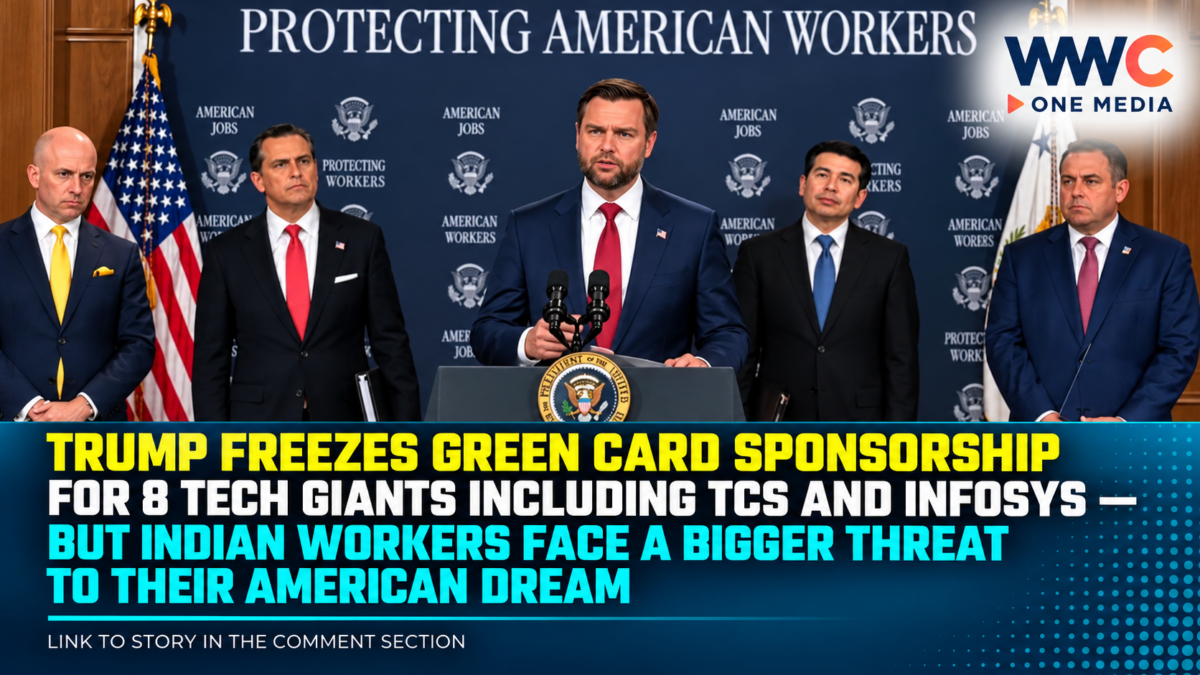
WASHINGTON / BENGALURU — US President Donald Trump’s administration has suspended eight major technology companies from a crucial employment-based green card programme, dealing another blow to foreign professionals seeking permanent residency in America. Indian technology giants Tata Consultancy Services, Infosys, Wipro and HCLTech are among the affected companies, alongside Microsoft, Adobe, Cognizant and Capgemini. But while analysts expect limited immediate disruption to business operations, the deeper threat may fall on thousands of skilled workers whose plans to settle permanently in the United States now face greater uncertainty.
The United States has introduced another major restriction affecting the global technology workforce.
On Thursday, October 8, the Trump administration announced that eight prominent technology companies would be suspended from participating in the Permanent Labor Certification programme, commonly known as PERM.
The programme is a key step in obtaining employment-based US permanent residency for many skilled foreign workers.
US Labor Secretary Keith Sonderling said the government would stop accepting new PERM applications from the affected companies and suspend the processing of pending applications.
The administration alleges that some technology employers have abused immigration and recruitment systems in ways that disadvantage American workers.
The allegations remain contested, and the suspension should not be treated as a judicial finding that every affected company committed fraud.
For India’s information technology industry, the immediate financial effect may be manageable.
However, the move creates new challenges involving employee retention, overseas deployment and the long-term attractiveness of US-based careers.
Eight Major Technology Companies Face PERM Restrictions
The companies identified in the October 8 suspension are:
- Tata Consultancy Services (TCS)
- Infosys
- Wipro
- HCL Technologies
- Microsoft
- Adobe
- Cognizant
- Capgemini
Four are among India’s leading information technology services companies.
The others include major multinational technology and consulting groups that employ substantial numbers of skilled foreign professionals.
The restrictions target the companies’ participation in the PERM process.
They do not mean that all eight businesses have been prohibited from operating in the United States.
They also do not establish that employees working for these firms must immediately leave the country.
The critical issue is the interruption of an important employer-sponsored pathway to permanent residency.
What Is the PERM Green Card Programme?
PERM is a labor certification process administered by the US Department of Labor.
For many employment-based green card cases, employers must obtain certification before proceeding with an immigration petition.
The process generally requires an employer to test the US labor market and demonstrate that qualified, available American workers cannot be recruited for the offered position under the applicable rules.
The certification is intended to protect US workers and ensure that foreign-worker sponsorship does not undermine legally required wage and recruitment standards.
After obtaining certification, an employer may proceed with an immigrant petition through US Citizenship and Immigration Services.
Even then, the employee may need to wait for an immigrant visa number to become available.
For Indian nationals, employment-based green card waiting times can be particularly difficult because demand substantially exceeds the available visas in some categories.
PERM is therefore an important part of a longer process rather than an automatic green card approval.
By suspending employer participation, the government has interrupted a major step for affected workers.
Existing H-1B Visa Holders Are Not Automatically Losing Their Jobs
One of the most important clarifications concerns the difference between PERM and the H-1B programme.
The H-1B visa allows qualifying foreign professionals to work temporarily in certain specialty occupations.
PERM, by contrast, is commonly used in the process of seeking employment-based permanent residency.
The October 8 action targets PERM applications associated with the eight companies.
It does not automatically cancel existing H-1B visas.
That distinction was emphasized by India’s technology industry association NASSCOM and the country’s Ministry of External Affairs.
Workers who already hold valid temporary status should not assume that their visas have been revoked solely because their employer appears on the suspension list.
However, the interruption could create complications for employees relying on employer sponsorship to complete their green card applications.
Their individual circumstances may differ depending on the stage of the immigration process, existing approvals and visa status.
The exact consequences require case-specific assessment.
Why the Trump Administration Is Taking Action
The administration says its enforcement campaign is designed to protect American workers.
Officials allege that some large technology employers have misused the foreign labor system while US employees faced layoffs and reduced opportunities.
The government maintains that employers should recruit qualified US workers before obtaining labor certification for foreign employees.
Supporters of stricter enforcement argue that the system must prevent unfair recruitment practices, wage suppression and the use of foreign labor to circumvent domestic hiring requirements.
Critics raise a different concern.
They argue that broad restrictions can affect compliant employers and highly skilled employees whose expertise contributes to American businesses.
They also warn that unpredictable immigration policies can discourage international talent from building careers in the United States.
Those competing arguments are central to the controversy.
The government has cited allegations of abuse, but employers must still be assessed according to the evidence and procedures applicable to their cases.
TCS Says the Immediate Business Impact Will Be Limited
Tata Consultancy Services has sought to reassure investors.
In a stock exchange filing on October 9, TCS said it had submitted fewer than 10 PERM applications during the preceding two years.
The company therefore does not expect the suspension to materially affect its workforce strategy or client relationships.
TCS also reiterated a plan to recruit 15,000 additional employees in the United States over five years.
The response reflects how Indian IT services companies have changed their staffing strategies.
Historically, Indian outsourcing firms relied extensively on sending personnel to US client locations.
In recent years, many have increased local hiring while expanding offshore delivery capabilities.
These changes have reduced dependence on certain immigration processes.
For TCS, the limited number of recent PERM applications supports its view that immediate operational disruption will be manageable.
However, that assessment relates to the company’s existing business structure.
It does not mean the policy has no consequences for individual workers seeking permanent residency.
Infosys Also Expects No Material Impact
Infosys, India’s second-largest IT services company, offered a similar assessment.
In an October 10 regulatory communication reported by Reuters, Infosys said it did not expect the PERM suspension to materially affect its operations.
The company indicated that it was prepared to cooperate with the US Department of Labor and relevant authorities.
It also said it would provide clarifications as required through the appropriate procedures.
The response suggests that Infosys sees the development as a regulatory matter it can manage without major immediate disruption.
However, the long-term effects will depend on whether the suspension continues and whether additional regulatory restrictions are introduced.
Investors will be watching the company’s US hiring plans, labor costs and ability to retain employees with specialized skills.
Indian IT Companies May Face Higher Hiring Costs
Even if immediate financial disruption is limited, the longer-term economics could become more challenging.
Analysts interviewed by CNA said that companies might increasingly rely on hiring American workers directly or using US-based subcontractors.
These alternatives can provide operational flexibility.
But they may also cost more than transferring personnel from India.
Pareek Jain, chief executive of research firm EIIR Trend, estimated that hiring in the United States could be approximately 25% to 50% more expensive than deploying Indian employees, depending on the position.
The figure is an industry estimate, not a guaranteed increase in costs for every affected company.
Actual costs depend on wages, benefits, employee seniority, location, contractual arrangements and the type of work involved.
Higher personnel expenses can affect profit margins, particularly for technology services firms operating under competitive client contracts.
Companies may respond by changing staffing structures, increasing automation or delivering more services remotely.
The Bigger Risk Could Be Losing Skilled Employees
For many Indian professionals, employment in the United States offers more than higher salaries.
It can provide international experience, long-term professional development and the possibility of building a permanent life with their families.
A predictable green card pathway is therefore an important part of career planning.
HFS Research executive Achyuta Ghosh told CNA that the restrictions are potentially a greater talent-retention concern than an immediate operational crisis.
Employees may become reluctant to remain with companies unable to sponsor their permanent residency applications through the affected process.
Some may seek opportunities with different employers or consider relocating to another country.
Others may choose to return to India.
But experts do not expect a sudden, large-scale return of Indian technology professionals over the next six to 12 months solely because of this policy.
Any workforce adjustment is more likely to develop gradually if uncertainty persists.
What Happens to Green Card Applicants Already in the System?
Workers at different stages of the immigration process may face different consequences.
The reported suspension includes new PERM applications and pending PERM processing associated with the affected companies.
An employee who has not yet received PERM certification may face a significant delay.
Someone who already has an approved labor certification or immigrant petition may be in a different position.
The October 8 announcement should not be interpreted as an automatic cancellation of every previously approved immigrant petition.
Nor does it prove that an individual’s existing visa status has become invalid.
Immigration procedures involve multiple agencies and stages.
Workers should distinguish between a labor certification, an immigrant petition, a pending adjustment-of-status application and a valid temporary work visa.
These are different legal statuses and processes.
Affected employees should review their individual cases with qualified immigration counsel or their employer’s authorized legal team before making major decisions.
India’s Government Criticizes the US Restrictions
New Delhi has expressed concern about the policy.
On October 9, India’s Ministry of External Affairs said the American measures did not support the shared ambitions of the two countries.
The ministry emphasized the value of international talent mobility.
India’s response reflects the importance of technology professionals to the broader US–India economic relationship.
Indian employees have long played a significant role in American technology companies, research institutions and business services.
The movement of skilled workers also supports commercial relationships between Indian outsourcing firms and US clients.
Restrictions on labor mobility can therefore become a diplomatic issue, even when they originate from domestic employment policy.
The Indian government’s criticism does not establish that the United States has agreed to reverse the suspension.
As of October 11, no confirmed blanket reversal had been announced.
Indian Professionals Are Central to America’s H-1B Workforce
Official US Citizenship and Immigration Services data show the scale of India’s role in the temporary skilled-worker system.
In fiscal year 2024, approximately 71% of approved H-1B petitions were for beneficiaries born in India.
China accounted for approximately 12%.
Those figures illustrate the importance of Indian professionals to US employers.
However, they describe H-1B petition approvals, not the percentage of green card applications affected by the October 8 PERM suspension.
The distinction is essential.
Not every H-1B worker is sponsored for permanent residency.
Not every employment-based green card application involves one of the eight suspended companies.
The suspension therefore affects a specific part of the immigration system, not the entire Indian professional workforce in the United States.
Trump’s Wider Immigration Crackdown Adds to Uncertainty
The PERM restrictions are part of a broader effort by the Trump administration to tighten immigration enforcement.
Earlier measures included tougher scrutiny of employment-based visa programmes and significant changes affecting H-1B petition costs.
The administration has also increased scrutiny of institutions accused of misusing immigration programmes.
Reuters reported that the October 8 announcements included investigations involving major US universities and exchange-visitor visa practices.
The government argues that such actions protect the integrity of immigration and labor systems.
Opponents warn that aggressive restrictions could affect America’s ability to attract leading international talent.
For technology companies, the cumulative uncertainty complicates long-term workforce planning.
Businesses making decisions about research facilities, client operations and engineering teams often need predictability over several years.
Rapidly changing immigration requirements can make those decisions more difficult.
Could Singapore, Malaysia and the UAE Benefit?
The restrictions may create opportunities for competing technology hubs.
Analysts interviewed by CNA identified Singapore and the United Arab Emirates as potential destinations for some experienced Indian professionals.
Singapore has established strengths in artificial intelligence, financial technology and technology management.
Malaysia may appeal to specialists in cloud computing, cybersecurity and engineering.
The UAE is also expanding its technology and digital infrastructure sectors.
Workers who previously planned to build long-term careers in the United States could consider these markets if American permanent residency becomes harder to obtain.
However, a shift is not guaranteed.
The markets differ in size, compensation levels, immigration rules and availability of specialist positions.
CNA’s sources noted that Singapore and the UAE have much smaller technology employment markets than India.
Therefore, neither country is likely to absorb large numbers of displaced workers automatically.
The most realistic possibility is a gradual reallocation of selected high-value professionals.
India’s Technology Industry Faces a Second Challenge From AI
The immigration restrictions arrive during a major transformation of India’s IT services sector.
Artificial intelligence is changing how companies develop software, deliver customer support and manage technology operations.
Routine programming and traditional outsourcing functions face increased pressure from automation.
At the same time, demand is growing for specialists in AI systems, cybersecurity, cloud infrastructure and complex engineering.
According to recruitment data cited by Instahyre’s Sarbojit Mallick, hiring for AI and machine-learning positions rose approximately 45% in India’s 2025–26 financial year.
Overall IT hiring remained relatively flat.
The figures suggest that demand is shifting rather than rising uniformly across all technology roles.
Professionals returning from the United States may find opportunities in global capability centres and advanced technology firms.
But equivalent salary levels and senior positions are not guaranteed.
Workers with generalist skills may face greater competition than those with specialized expertise.
Can India Turn a US Immigration Restriction Into an Opportunity?
India has developed a large domestic market for technology services, global capability centres and advanced engineering.
An increase in available experienced professionals could benefit certain employers.
Companies developing AI products, cybersecurity services and cloud infrastructure may have opportunities to recruit people with international experience.
However, the potential benefits should not be overstated.
Returning professionals may face lower salaries than they previously earned in America.
Some may encounter a mismatch between their experience and available jobs.
Employers may also be reluctant to expand hiring during periods of uncertain global technology spending.
The outcome will depend on the duration of the US restrictions, the pace of domestic job creation and the specific qualifications of affected workers.
It remains too early to conclude that the policy will produce a major reverse brain drain.
Why the Policy Matters to the Global Technology Industry
The US immigration system influences how multinational technology businesses allocate people and investment.
Companies need skilled workers to design software, manage cloud infrastructure, develop artificial intelligence and support global clients.
When employers face obstacles in sponsoring long-term residency, they may modify recruitment and location strategies.
Some work could shift toward offshore delivery centres.
Some businesses may prioritize local US recruitment.
Others may expand operations in alternative technology hubs.
Such adjustments could create both winners and losers.
American workers may benefit from additional local hiring opportunities if firms respond as intended by the administration.
But companies could also face higher costs or difficulties filling specialized positions.
The overall economic consequences cannot yet be established from the initial suspension alone.
What Investors Should Watch Next
The immediate market reaction suggests that investors are distinguishing between regulatory uncertainty and operational disruption.
Reuters reported that Indian IT shares gained after TCS issued reassuring comments on the limited effect of the suspension.
However, the industry continues to face multiple pressures, including changing client demand and AI-led business transformation.
The key developments to monitor are the duration of the PERM restrictions, the outcome of any regulatory reviews, changes to US local hiring costs and the treatment of existing immigration applications.
Analysts will also examine whether affected companies alter staffing models, shift more work offshore or experience difficulty retaining specialist employees.
Company earnings and official regulatory disclosures will provide more reliable evidence than speculation about mass departures or an immediate collapse in outsourcing activity.
The Bigger Picture: America’s Green Card Crackdown Tests Global Talent Mobility
The Trump administration’s decision to suspend eight major technology companies from the PERM programme marks a significant development in US employment-based immigration policy.
The measure does not automatically revoke H-1B visas or force all affected workers to leave the country.
Major Indian IT companies also say their immediate business operations should remain largely unaffected.
But the consequences could be more serious for individual professionals who have planned their careers around obtaining permanent residency.
For them, uncertainty over employer sponsorship can affect family plans, employment choices and decisions about where to build a future.
The policy also presents a difficult balancing act for the United States.
The administration wants to strengthen protection for domestic workers and prevent alleged abuses of immigration programmes.
Technology employers, meanwhile, argue that access to international expertise remains important for innovation and competitiveness.
Trump’s green card restrictions may not immediately disrupt India’s biggest technology outsourcing companies.
But the larger test is whether the United States can enforce its labor rules without driving valuable global talent toward competing technology hubs.
For Indian professionals, the biggest concern may no longer be whether they can obtain a job in America — but whether that job can still lead to a permanent future there.