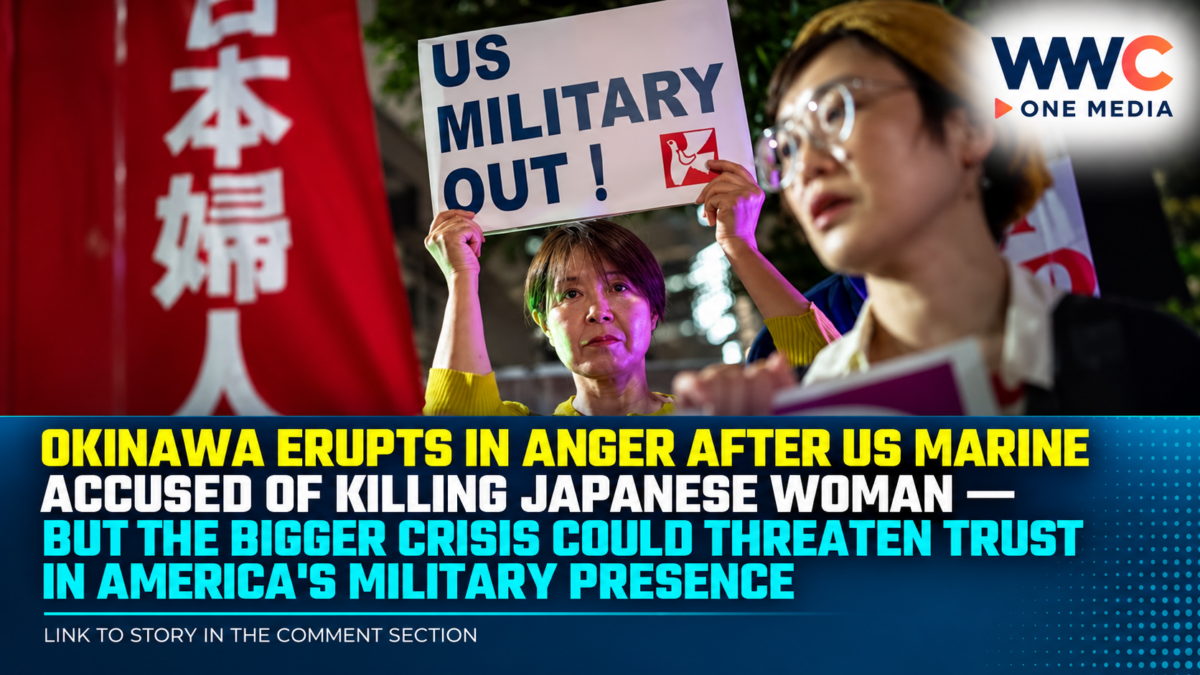
NAHA, OKINAWA — The alleged killing of a 39-year-old Japanese woman by a US Marine has reignited anger across Okinawa, triggering protests, emergency restrictions on American troops and a diplomatic confrontation between Tokyo and Washington. Japanese authorities arrested 20-year-old Lance Corporal Devin Jacob Ballard on suspicion of robbing and killing Anna Yagi at a hotel in Naha. But as local residents demand stronger accountability and even the withdrawal of American forces, the bigger question is whether the United States can restore public trust on an island central to its military strategy in East Asia.
The killing of Anna Yagi has reopened one of the most sensitive issues in Japan’s relationship with the United States: the conduct of American military personnel stationed in Okinawa.
A week after Ballard’s arrest, residents interviewed by Agence France-Presse described a mixture of grief, fear and frustration.
For many Okinawans, the latest case has revived memories of earlier crimes involving US service members and longstanding complaints about the concentration of American military facilities on the island.
Japan’s government has formally protested to Washington, while US military commanders have introduced a curfew and additional disciplinary measures.
US Secretary of State Marco Rubio has also pledged cooperation with Japanese investigators.
Yet despite these responses, residents remain divided over the future of the American military presence.
Some believe US forces are essential to regional security. Others argue that the repeated controversies have placed an unacceptable burden on Okinawa’s communities.
Japanese Woman Found Dead in Naha Hotel
The case began on October 3, when 39-year-old Anna Yagi was discovered unconscious in a hotel room in Naha, Okinawa’s capital.
Emergency responders pronounced her dead.
According to Japanese police reports cited by international news organizations, investigators suspect that Yagi was strangled.
Authorities allege that her belongings were taken after the killing.
Police reviewed hotel surveillance footage that reportedly showed a man believed to be the suspect entering the hotel with Yagi and subsequently leaving alone.
Investigators examined his movements and the circumstances surrounding the encounter.
The following day, October 4, Japanese authorities arrested Ballard on suspicion of murder and robbery.
The Marine was assigned to the III Marine Expeditionary Force and stationed at Marine Corps Air Station Futenma.
The US military confirmed his identity and said it was cooperating with the Japanese investigation.
Ballard denies the allegations. He has not been convicted, and the accusations remain subject to legal proceedings.
Alleged Killing Triggers Anger Across Okinawa
For many Okinawa residents, the incident has intensified existing fears.
In interviews carried by CNA and AFP, some residents called for American troops to leave the island.
Takako Kakazu, a 55-year-old mother, expressed frustration about recurring incidents involving US military personnel.
She questioned how much more suffering local women would have to endure.
Her reaction reflects a longstanding concern in parts of Okinawa that the island’s residents shoulder disproportionate risks associated with hosting major US military installations.
Another resident, 23-year-old café worker Airi Hiane, said she was troubled by the recurrence of allegations involving American personnel.
Hiane emphasized the need for service members to obey local rules and respect the communities where they live.
However, she also acknowledged that demanding the complete removal of American forces would be difficult.
These reactions illustrate that the controversy is not simply divided into supporters and opponents of the US military.
Many residents recognize the alliance’s importance while demanding stronger safeguards and accountability.
Japan’s Prime Minister Files Strong Protest With Washington
Japanese Prime Minister Sanae Takaichi responded forcefully after news of the case emerged.
On October 4, she condemned the suspected killing and announced that Japan had lodged a strong protest with the United States.
The Japanese government demanded cooperation with investigators and stronger measures to prevent similar incidents.
Foreign Minister Toshimitsu Motegi also raised the matter with US Ambassador George Glass.
Defence Minister Shinjiro Koizumi communicated Japan’s concerns to senior US military officials.
Tokyo’s response reflects the sensitivity of criminal allegations involving foreign military personnel.
The US–Japan security alliance is an important element of regional defence planning, particularly amid tensions involving China and Taiwan.
But the Japanese government also faces pressure to demonstrate that local residents’ safety and legal rights are being protected.
The challenge is maintaining military cooperation while ensuring that allegations of serious crimes receive independent and credible investigation.
US Military Imposes Curfew and Alcohol Restrictions
American military commanders responded with restrictions on personnel stationed in Okinawa.
Lieutenant General Benjamin Watson announced a month-long curfew and restrictions on alcohol consumption.
Military operations on the island were also paused for 48 hours so service members could undergo training focused on discipline, conduct and professional standards.
The measures were intended to reinforce expectations for personnel living and serving in Japanese communities.
US commanders acknowledged that misconduct allegations can damage relations with Okinawan residents.
However, the restrictions do not establish that all American personnel have engaged in wrongdoing.
They are command-level measures intended to respond to a serious incident and reinforce standards.
For Okinawa residents demanding more lasting changes, the key question is whether temporary restrictions will produce meaningful improvements.
Marco Rubio Promises Full Cooperation
On October 10, US Secretary of State Marco Rubio discussed the case with Japanese Foreign Minister Toshimitsu Motegi.
According to Reuters, citing a US State Department statement, Rubio expressed condolences over Yagi’s death and emphasized Washington’s commitment to cooperating with Japanese authorities.
The diplomatic call demonstrated that the controversy had reached senior levels of both governments.
Rubio’s response was intended to reassure Tokyo that the investigation would receive appropriate cooperation.
The US Marine Corps has separately said it takes the accusations seriously.
These commitments matter because the case involves both criminal justice and the wider relationship between American troops and their host communities.
However, promises of cooperation should not be interpreted as a completed prosecution or a final determination of criminal responsibility.
Japanese authorities must continue their investigation through the applicable legal process.
Okinawa Governor Demands More Effective Discipline
Okinawa Governor Genta Koja has criticized the effectiveness of existing US military disciplinary measures.
He argues that repeated incidents have undermined residents’ confidence.
Following the arrest, Koja called for stronger preventive action and raised the matter with senior US military representatives.
The governor’s position highlights a recurring point of tension between Okinawa and Japan’s central government.
Tokyo views the American military presence as essential to national security.
Local officials, meanwhile, face the immediate consequences of crimes, accidents, environmental concerns and noise complaints associated with military installations.
The governor’s demands therefore go beyond the prosecution of one suspect.
They also concern whether existing agreements and oversight arrangements adequately protect Okinawan communities.
Okinawa Lawmakers Renew Calls to Review US Military Agreement
The controversy has renewed debate over the legal framework governing American forces in Japan.
Okinawa lawmakers have called for a review of arrangements related to the US military presence, including the Status of Forces Agreement.
The agreement establishes rules concerning the legal status of US personnel stationed in Japan.
Critics have long argued that the arrangements require changes to improve transparency and accountability.
Supporters of the existing security framework emphasize the need for predictable legal procedures that allow American forces to operate effectively while respecting Japanese sovereignty.
The latest case has brought those competing concerns back into the national discussion.
But the calls for a review are not the same as a confirmed government decision to terminate the agreement or remove US military bases.
No such sweeping policy change had been announced as of October 11.
The 1995 Crime That Changed Okinawa’s Relationship With US Forces
The latest allegations have revived memories of a major incident in 1995.
That year, three US military personnel raped a 12-year-old Okinawan girl.
The crime triggered widespread protests and intensified demands to reduce the US military footprint on the island.
It became a defining episode in Okinawa’s postwar political history.
Since then, further incidents involving US personnel have periodically renewed public anger.
Concerns have extended beyond criminal cases to aircraft accidents, environmental issues and noise from military installations.
For residents who have lived through decades of controversy, the latest investigation reinforces longstanding questions about whether the benefits of hosting US forces are fairly balanced against the burdens borne by local communities.
At the same time, individual misconduct must not be used to presume the guilt of other service members.
Accountability requires distinguishing specific criminal allegations from the conduct of the wider military community.
Why Okinawa Hosts So Many American Troops
Okinawa occupies a strategically important position in East Asia.
The island chain lies between Japan’s main islands and Taiwan, close to areas that feature prominently in regional security planning.
Japan hosts approximately 50,000 US military personnel, with a substantial share stationed on Okinawa.
Most of the approximately 18,000 US Marines based in Japan are assigned to the island.
American installations support training, logistics, aircraft operations and other defence activities.
Washington and Tokyo view these capabilities as important to deterrence and the readiness of the US–Japan alliance.
Okinawa’s geography makes the island significant in any discussion of potential crises involving Taiwan or the East China Sea.
However, this strategic importance does not eliminate concerns about safety and community impact.
It helps explain why the debate over the bases is so difficult.
Residents Divided Over Economic Benefits of US Bases
The American presence also influences Okinawa’s economy.
Military installations create employment and generate commercial activity.
Some local businesses depend partly on spending by American personnel and their families.
According to AFP’s reporting carried by CNA, military base-related income accounts for approximately 5% of the region’s annual total income.
This dependence helps explain why some residents hesitate to support complete removal of US forces.
One Naha bar owner, Stephen Butler, said the incident could affect relations between foreign residents and local communities.
His establishment was also affected by the military’s alcohol restrictions.
Butler emphasized that many Americans living in Okinawa maintain positive relationships with Japanese residents.
His perspective highlights another side of the controversy.
Although the alleged killing has generated understandable anger, economic and personal relationships between Okinawans and Americans remain important parts of everyday life.
Futenma Relocation Faces Renewed Political Pressure
Marine Corps Air Station Futenma has long been one of Okinawa’s most controversial military facilities.
The base is located near densely populated communities in Ginowan.
Plans to relocate its operations to Henoko, elsewhere on Okinawa, have faced years of opposition and delays.
Some residents argue that moving facilities within the prefecture does not sufficiently reduce Okinawa’s overall burden.
The latest case may strengthen demands for a more substantial reduction in the American military footprint.
However, the criminal investigation has not resulted in an announced cancellation of the Henoko relocation project.
The broader dispute remains unresolved.
For the Japanese government, any major change would require balancing local concerns with national security planning and commitments to Washington.
Why the Case Matters to the US–Japan Alliance
The controversy comes at a time when the United States and Japan are strengthening military cooperation.
Both governments regard the alliance as an important element of regional stability.
Security concerns involving China, North Korea and Taiwan have increased the strategic importance of American forces in Japan.
But effective alliances require more than military equipment and formal agreements.
They also depend on public confidence in the institutions and personnel involved.
Repeated allegations of serious misconduct can weaken that confidence, particularly in communities that host large military installations.
The alleged killing of Anna Yagi therefore presents two parallel challenges.
Japanese investigators must establish what happened and pursue justice under the law.
American and Japanese authorities must also address the concerns of residents who believe existing preventive measures have been insufficient.
The Bigger Picture: A Criminal Case Becomes a Test of Public Trust
Okinawa’s latest controversy began with the death of a 39-year-old woman in a Naha hotel.
It has since developed into a major diplomatic and political issue.
A US Marine has been arrested on suspicion of murder and robbery.
Japanese authorities are investigating, while the accused denies the allegations.
Japan’s prime minister has lodged a formal protest.
US commanders have imposed disciplinary restrictions, and Secretary of State Marco Rubio has pledged cooperation.
Residents, meanwhile, are demanding accountability and renewed discussion about the American military presence.
The outcome of the investigation will be critical.
But the broader issue will remain even after the criminal proceedings reach a conclusion.
Okinawa’s residents want assurances that their safety is being treated as seriously as the island’s strategic importance.
The United States and Japan now face a difficult test: demonstrating that their military alliance can protect regional security while also protecting the trust and well-being of the communities that host its forces.
For Okinawa, the question is no longer only what happened in a Naha hotel. It is whether lasting changes will follow one more tragedy that has shaken public confidence.